
On this page
“About 49 things to say out loud in every lesson” is the number we lead with, and a number like that is easy to skim past. So here is one lesson from start to finish: what it asks you to say, in what order, and why the count matters more than it sounds.
First, where the number comes from. In October 2026 we counted every prompt in our course content that expects a spoken answer. A lesson averages about 49 (German lessons about 60), and a full course comes to roughly 10,000 spoken answers (German about 12,000). The lesson below, from the Spanish course for English speakers, has 50.
The lesson: what I want
It’s an A1 lesson called “What I Want,” and it teaches three forms of querer (to want): quiero (I want), quieres (you want) and quiere (he or she wants). Before you speak, you read a short text that explains the three forms and shows them in examples, and you can have it read aloud to you with each word highlighted.
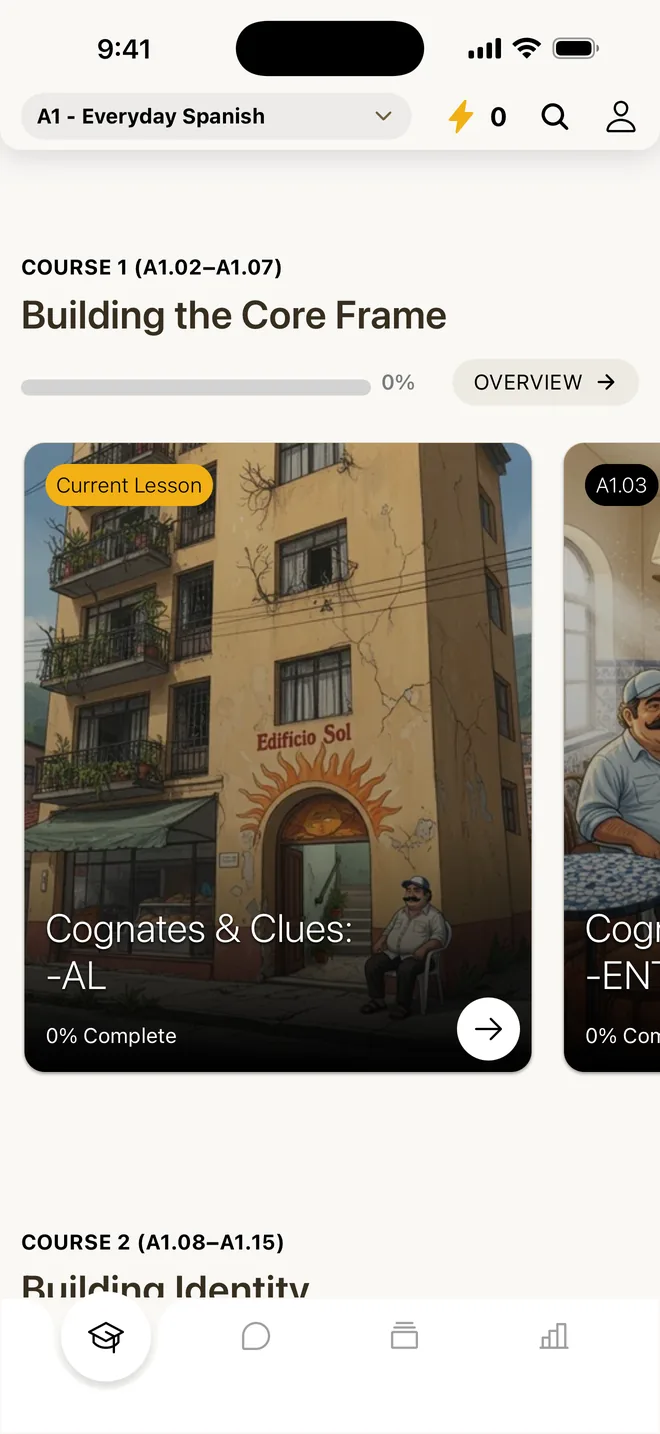
Then the story starts. The Spanish course is set in and around Edificio Sol, an apartment building in Medellín, and this lesson opens early in the morning at Doña Carmen’s bakery. Carmen is behind the counter and already pointing at things. ¿Quieres café? (Do you want coffee?)
The first six answers
Your first prompt is the one you’d guess:
She pours before you finish. Then she lifts a loaf:
Then a glass of water you never asked for shows up, and the lesson slips in negation:
Carmen takes the glass back, in the lesson’s words “a little offended on its behalf.” She holds up an empanada, and you learn the polite way out, No, gracias. Then her favorite question, ¿Tienes hambre? (Are you hungry?), which teaches that quiero works with actions too:
By answer six, the lesson turns it around and you’re the one asking:
Six answers in, you’ve said quiero with a thing, with por favor, with no and with a verb, and you’ve asked a question with quieres. None of it was a drill. Each sentence was something you needed to say right then.
Then Mateo shows up
The bakery door opens and Mateo, one of your neighbors, shuffles in half asleep. He doesn’t order. He points at your coffee and makes a sound, and Carmen looks at you to translate. That’s how the lesson gets you to quiere:
The third form shows up because the story needs it: someone has to order for Mateo.
From things to plans
Next the prompts move from coffee to verbs: estudiar (to study), hablar (to talk), descansar (to rest), viajar (to travel). Then Carmen asks the bigger question: ¿Y en Medellín? ¿Qué quieres? (And in Medellín? What do you want?) You add cocinar (to cook) and salir (to go out), and one prompt asks you to put three answers together:
That’s the longest answer in the lesson, and it’s the kind of thing you’d say to a new neighbor.
The fast round
The second half speeds up. The prompts get shorter, the story keeps moving (Mateo tries for three cookies and Carmen says no, and Don Miguel at the door turns down bread that Carmen sends out anyway), and you mix every form you’ve used: ¿Quieres agua?, No quiere estudiar, Quiero esa empanada, Quiere descansar.
The last prompt brings back the first. Carmen turns to you with the pot in her hand, same as that morning, and asks ¿Quieres café? This time you answer Sí, quiero un café, por favor (Yes, I want a coffee, please): a longer, more polite version of where you started.
What 50 answers add up to
Counting through the lesson:
- 47 of the 50 answers use querer, for 51 uses in all: quiero 27 times, quiere 16, quieres 8.
- 9 answers are questions and 10 use no.
- Together the answers come to about 150 Spanish words, all said out loud.
Each answer changes something from the one before: who wants, what they want, whether it’s a question or a refusal. That variety is why 51 uses of one verb read like a conversation. It’s also the pattern memory research rewards. Every prompt makes you pull the form out of memory rather than recognize it on a screen, and researchers have found that retrieving something repeatedly is what makes it stick (we wrote about that research in why speaking early works).
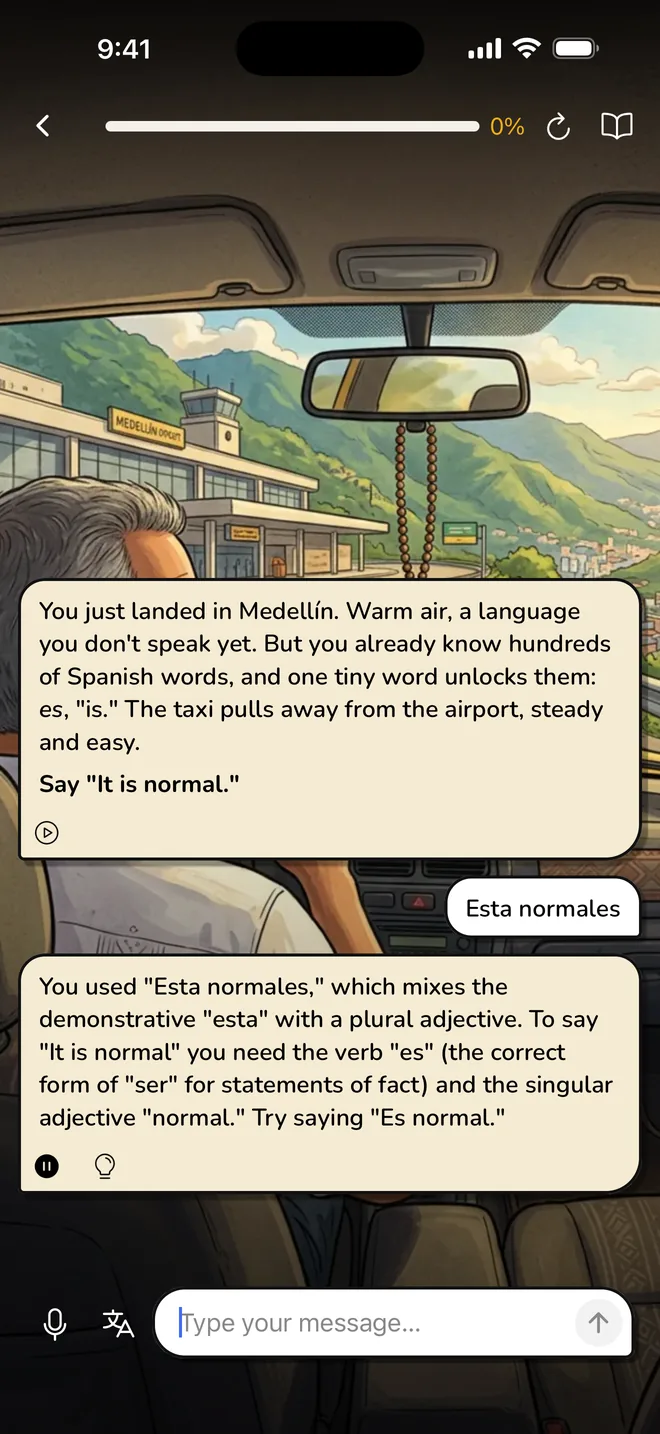
Every answer also gets graded. You see a score, a natural corrected version of what you said and a short reason why. If you’re stuck, you can ask for a hint or a translation, and if you can’t talk where you are, you can type.
Over a course of 200+ lessons, the answers add up to roughly 10,000. That’s the number we care about most, because the skill of answering out loud only grows by doing it.
What it isn’t
This is a guided conversation. Carmen has an answer in mind for each prompt, so the lesson gives you the structure and the story and you supply the Spanish. It prepares you for talking to people; it doesn’t replace them. Avita also doesn’t score your pronunciation; feedback is on what you said, not your accent. The role-play scenarios and open chat in Avita Pro are where you get less scripted practice.
The first five lessons of every level are free, so you can check whether 49 answers feels like a lot or a little.
Our take: Fifty answers about coffee and bread won’t make anyone conversational on their own. What we’re counting on is the next lesson, with a new verb and a new scene, and the one after that, each asking you to put your own sentences together out loud.
Questions people ask
How many sentences do you say in an Avita lesson?
About 49 on average, counted from the course content in October 2026. German lessons run longer, at about 60. Every answer is a full sentence you say out loud, or type if you can't talk where you are. Over a full course that adds up to roughly 10,000 spoken answers, or about 12,000 in German.
What happens after I answer?
Each answer gets a score, a natural corrected version of what you said and a short reason why. If you're stuck before answering, you can ask for a hint or a translation. Avita doesn't score pronunciation, so the feedback is about the words and grammar you used, and the next prompt picks up the story from there.
Do I need to know any Spanish to start?
No. The Spanish course starts at A1 (beginner), and each lesson teaches its grammar and words in a short reading before you speak. The lesson in this article comes from early in A1. You can start without an account, and the first five lessons of every level are free.
Is an Avita lesson a free conversation?
Not quite. Lessons are guided: a character from the story prompts you, and each prompt has an answer in mind, which is what lets every answer be graded and corrected. For less scripted practice, Avita Pro adds role-play scenarios, like ordering at a café or sorting out a problem with your hotel room, plus open chat about anything.