On this page
You already know more Spanish than you think, and you can say a real sentence with it today. After months of apps that taught us words, what finally got us talking was embarrassingly simple: a few sentence frames, the Spanish we already knew from English, and saying whole sentences out loud every day, starting on the first one. This guide is that first week, written down so you can skip the words-only phase.
Why full sentences beat single words
Saying café to a waiter works. You’ll get a coffee. But you’ve practiced one noun, and the next time you need to ask for the bill, a taxi or the bathroom, you’re starting from zero again.
Say Quisiera un café, por favor (I’d like a coffee, please) and you’ve practiced a verb, an article, a noun and a politeness marker in the order Spanish puts them. Swap one word and you have a new sentence: Quisiera la cuenta, por favor (I’d like the check, please). The frame is the thing you’re learning. The nouns are interchangeable.
There’s a second reason. Speaking means pulling a sentence out of your head under a little time pressure, and that’s a different skill from recognizing a sentence when you see it. Memory researchers call that pulling-out step retrieval practice, and their experiments keep finding that it makes things stick better than reading them again (Jeffrey Karpicke and Henry Roediger’s 2008 paper in Science is the one most people cite). If you only ever read Spanish, you’re skipping the step that does the most work.
The six frames that carry week one
You don’t need to conjugate many verbs to start talking. These six frames take a second verb in its dictionary form (the infinitive, the one ending in -ar, -er or -ir), so every new verb you learn plugs straight in.
- Quiero… (I want…): Quiero un café. (I want a coffee.) Quiero aprender español. (I want to learn Spanish.)
- Necesito… (I need…): Necesito un taxi. (I need a taxi.) Necesito practicar más. (I need to practice more.)
- ¿Puedo…? (Can I…?): ¿Puedo pagar con tarjeta? (Can I pay by card?)
- Tengo que… (I have to…): Tengo que trabajar mañana. (I have to work tomorrow.)
- Voy a… (I’m going to…): Voy a cocinar esta noche. (I’m going to cook tonight.)
- Me gusta… (I like…): Me gusta caminar. (I like walking.) No me gusta madrugar. (I don’t like getting up early.)
Voy a deserves a special mention. It’s the everyday way to talk about plans in Latin American Spanish, and it means you can skip the future tense for a long time. Voy a llamar a mi mamá (I’m going to call my mom) is completely natural.
Learn twenty common verbs in the infinitive (hablar, comer, ir, ver, trabajar, comprar, llamar, salir, dormir, leer and so on) and these frames give you a few hundred sentences before you’ve touched a verb chart. When you’re ready for the charts, our Spanish conjugator has them.
The Spanish you already know
English took a large share of its vocabulary from Latin and French, and Spanish grew out of Latin, so the two overlap a lot. Colorín Colorado, a bilingual education resource, puts it at 30–40% of English words having a related word in Spanish. You don’t have to memorize most of these. You have to learn the patterns that convert them.
- -tion becomes -ción: información, conversación, situación, educación, nación
- -al stays -al: normal, natural, hospital, animal, ideal, final, local, personal
- -ty becomes -dad: universidad, realidad, posibilidad, comunidad
- -ble stays -ble: posible, terrible, horrible, probable, flexible
- -ous becomes -oso: famoso, delicioso, nervioso, curioso
- -ly becomes -mente: normalmente, exactamente, totalmente
- -ist becomes -ista: turista, dentista, artista
The catch is pronunciation. These words are spelled almost like English and sound nothing like it. Spanish vowels are short and always the same (a as in “father”, e as in “bet”, i as in “machine”, o as in “note” without the glide, u as in “rule”), the h is silent, and the stress usually lands somewhere different: con-ver-sa-CIÓN, hos-pi-TAL, u-ni-ver-si-DAD. Say them slowly a few times before you use them.
Now drop them into your frames:
- Es una situación normal. (It’s a normal situation.)
- Estoy un poco nervioso. (I’m a little nervous. A woman says nerviosa.)
- Normalmente trabajo en casa. (I usually work from home.)
- ¿Es posible pagar en efectivo? (Is it possible to pay in cash?)
A few false friends will catch you, so learn these early. Embarazada means pregnant, not embarrassed. Éxito means success; the exit is la salida. Librería is a bookstore, and a library is biblioteca. Actualmente means currently, not actually.
What to say in week one
Here’s the short list we’d want if we were starting over. We’ve used usted (the polite “you”) in the questions, because it’s safe with strangers everywhere in Latin America.
Introducing yourself:
- Hola, me llamo Ethan. (Hi, my name is Ethan.)
- Soy de Boston, pero vivo en Medellín. (I’m from Boston, but I live in Medellín.)
- Estoy aprendiendo español. (I’m learning Spanish.)
Keeping a conversation going when you’re lost:
- ¿Cómo se dice “receipt” en español? (How do you say “receipt” in Spanish?)
- ¿Puede repetir, por favor? (Can you repeat that, please?)
- Más despacio, por favor. (Slower, please.)
- No entiendo. ¿Qué significa “tinto”? (I don’t understand. What does “tinto” mean?)
Ordering and paying:
- Quisiera un café con leche. (I’d like a coffee with milk.)
- ¿Cuánto cuesta? (How much is it?)
- La cuenta, por favor. (The check, please.)
If you’re in Colombia, listen for ¿Me regala un tinto? (literally “will you gift me a black coffee?”). Nobody expects it for free; it’s the everyday polite way to order, and using it will get you a smile.
Getting around:
- ¿Dónde está el baño? (Where’s the bathroom?)
- ¿Dónde queda la estación? (Where’s the station? Quedar is common across Latin America for where places are.)
A 7-day plan
Fifteen to twenty minutes a day, out loud, somewhere you won’t feel silly. Every day, say each sentence at least three times, then cover it and say it again from the English.
- Day 1, introduce yourself. Write five true sentences about you: name, where you’re from, where you live, what you do, why you’re learning. Trabajo en una oficina (I work in an office). Record yourself saying all five. Keep the recording.
- Day 2, wants and needs. Make ten sentences with quiero and necesito, half with a noun and half with a verb. Quiero un vaso de agua. Necesito descansar. (I want a glass of water. I need to rest.)
- Day 3, cognates. Pick fifteen words from the patterns above and put each into one of your frames. Quiero visitar el hospital. No me gusta la situación. Focus on the stress.
- Day 4, survival questions. Drill the “I’m lost” phrases until they come out without thinking. Then practice asking ¿Cómo se dice…? about ten things in the room.
- Day 5, plans. Say what you’re going to do tomorrow, hour by hour, with voy a. Voy a desayunar a las ocho. Voy a trabajar hasta las cinco. (I’m going to have breakfast at eight. I’m going to work until five.)
- Day 6, likes and reasons. Ten sentences with me gusta or no me gusta, each followed by porque (because). Me gusta Medellín porque tiene buen clima. (I like Medellín because the weather’s nice.)
- Day 7, put it together. Talk for two minutes without stopping: who you are, what you like, what you’re doing tomorrow. Record it and play it next to Day 1.
Listen to both recordings back to back. You’ll hear mistakes, and you’ll also hear that you said a few dozen real sentences in a language you couldn’t speak a week ago.
How to practice out loud so it sticks
Say it out loud. In lab studies, people remember words they said aloud better than words they read silently, an effect psychologists call the production effect (we cover it in our guide to practicing alone). Mumbling counts. Running sentences in your head mostly doesn’t.
Answer in full sentences even when a single word would do. If you’re practicing with a list of questions and the answer is yes, say Sí, quiero un café, not sí. The extra words are the practice.
Produce before you check. Look at the English, say the Spanish, then look. That small struggle to find the sentence is the retrieval practice from earlier, and it’s what builds the ability to speak on the spot.
Mix old sentences with new ones. Day 5 should still include a few Day 1 sentences. Coming back to things after a gap is what keeps them from fading.
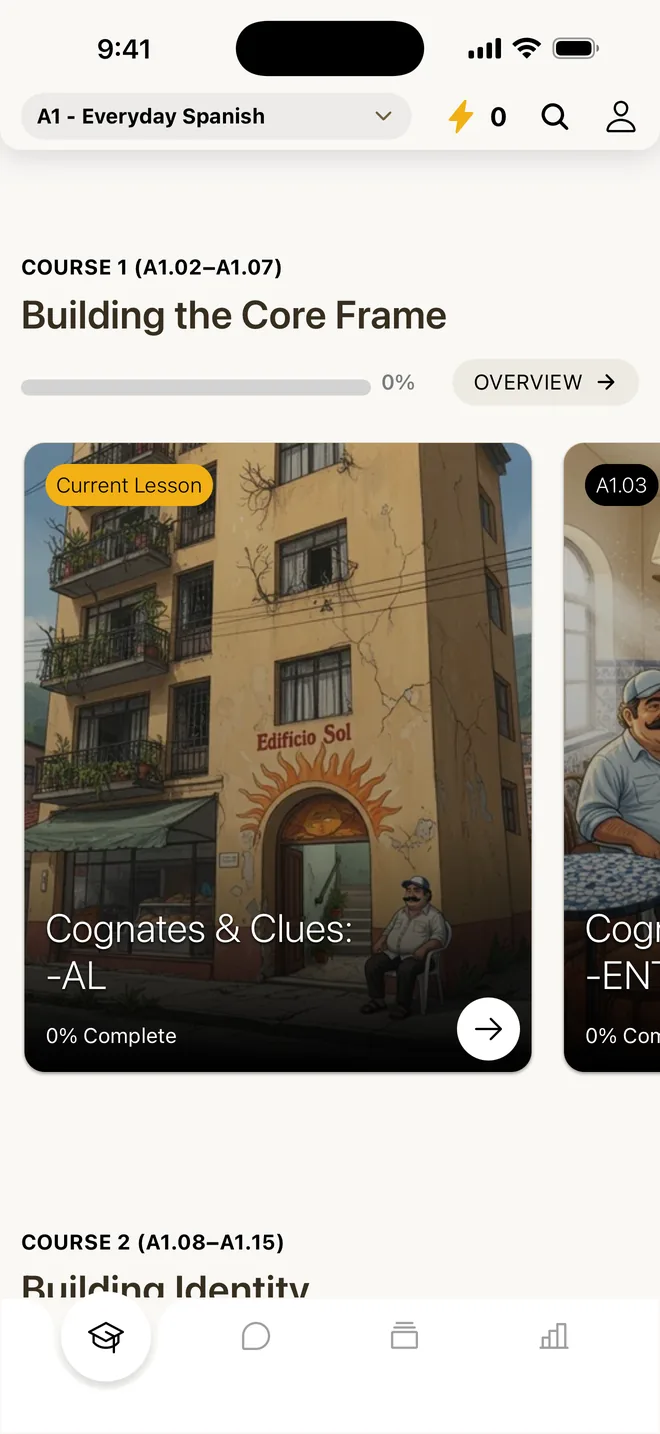
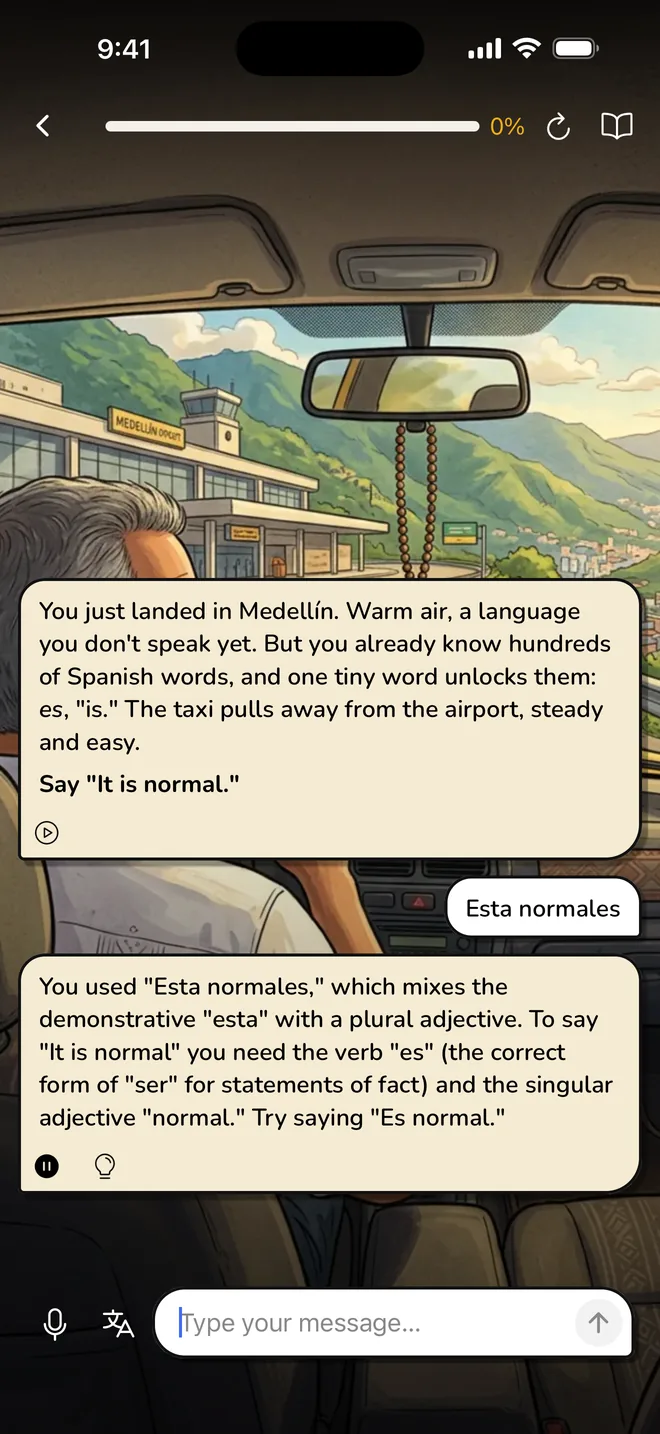
Get some feedback. Practicing alone gets you most of the way in week one, but you’ll lock in a mistake or two without someone telling you. We built Avita for this. Its Spanish course is a story set in Edificio Sol, an apartment building in Medellín, where neighbors like Doña Carmen at the bakery talk to you and you answer out loud. A lesson asks you to say about 49 things, and every answer gets a score, a natural corrected version and a short reason why. The first five lessons of every level are free, and you can start without an account. If you’d rather practice with a person, a patient friend or a tutor does the same job.
What not to worry about yet
Your first week will be full of mistakes, and that’s fine. A few things you can safely ignore for now:
- Getting el and la right every time. La problema is wrong (it’s el problema), and everyone will still understand you.
- The subjunctive, the past tenses beyond what you need, and most of the grammar chart. Frames and the present tense carry you a long way.
- A perfect accent. Clear vowels and the right stress matter far more than sounding native.
- Tú versus usted versus vos. You’ll hear all three in Latin America (Medellín uses a lot of vos and usted), and usted is a safe choice with strangers.
If freezing up is your bigger problem than grammar, read our guide on speaking anxiety.
Our take: The first week is the cheapest time to build the habit of answering in full sentences, because nobody expects anything of you yet. Keep the Day 1 recording. A month from now it’ll be the most encouraging thing on your phone.
Questions people ask
Can you really speak Spanish on the first day?
Yes, in a limited way. With a handful of frames like quiero (I want), necesito (I need) and voy a (I'm going to) plus a dictionary-form verb, you can say real, useful sentences on day one. They won't be fancy, and you'll make mistakes, but people will understand you. The point of day one is to start producing sentences, not to be correct.
What should I learn first in Spanish?
Learn a few sentence frames and the survival questions first: how to introduce yourself, ask for things, say you don't understand and ask someone to repeat or slow down. Then add common verbs in the infinitive and the cognates you already know from English. Leave the full conjugation charts, the subjunctive and most tenses for later.
How many words do I need to start speaking Spanish?
Fewer than you think. There's no magic number, but six frames, twenty common verbs and the cognates you already know from English give you a few hundred possible sentences. What matters more than vocabulary size in the first weeks is how often you pull those words out of memory and say them in full sentences.
Should I learn Latin American Spanish or Spain Spanish?
Pick the one you'll actually use. If you're traveling, moving or talking to people from Latin America, learn Latin American Spanish. The differences are mostly some vocabulary, the vosotros form used in Spain and pronunciation. Speakers from both understand each other without trouble, so switching later is easy. This guide and Avita's Spanish course both use Latin American Spanish.
Is it OK to make mistakes when I start speaking?
It's necessary. Saying la problema instead of el problema won't stop anyone from understanding you, and every mistake that gets corrected teaches you something reading never would. Try to get feedback from a person, a recording you compare with native audio, or an app that corrects your answers, so mistakes get fixed instead of turning into habits.
How long should I practice speaking Spanish each day?
Fifteen to twenty minutes of out-loud practice every day beats a long session once a week. Short daily sessions let you come back to yesterday's sentences before they fade. In that time, aim to say at least a few dozen full sentences, mixing new ones with old ones.