Ethan
Ethan co-founded Avita with Reed after the two of them moved from Boston to Buenos Aires to learn Spanish. He builds the app and writes about what actually gets people speaking. Like Reed, he's still learning too.
Written by Ethan
- October 27, 2026
Why speaking early works: the research on output
Speaking from the start helps for two reasons: producing a sentence forces you to process grammar that understanding lets you skip (Merrill Swain's output hypothesis), and pulling language out of memory strengthens it more than reading it again (the testing effect).
- Compare
Avita vs Busuu: which is better for speaking? (2026)
Busuu is a complete course in 14 languages with real native speakers correcting your writing and recordings, plus certificates; Avita is built for people who need to speak, with about 49 spoken answers in every lesson, each a full sentence that's graded and corrected right away.
- Compare
Avita vs Duolingo: which gets you speaking? (2026)
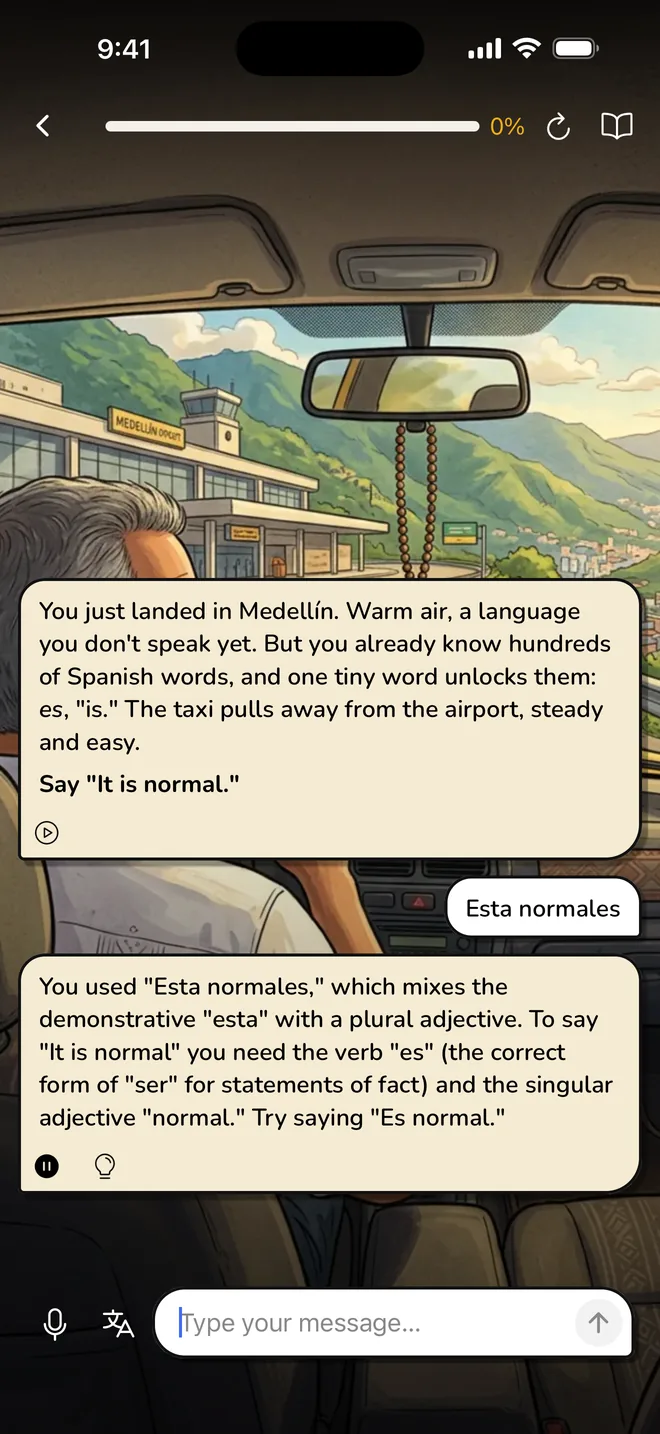
If your goal is to hold a conversation, Avita is built for it: every lesson has you say about 49 things out loud, each a full sentence that gets a score, a corrected version and a reason.
- Compare
Avita vs Rosetta Stone: which gets you speaking? (2026)
Rosetta Stone teaches 25 languages through pictures and audio with no translation, and its speaking practice is mostly saying words and phrases from the screen while TruAccent scores your pronunciation; its newer Chat Missions conversations are typed, in a web browser.
- Compare
Avita vs Speak: which speaking app fits you? (2026)
Speak and Avita both have you speak out loud from the first lesson, so the right pick depends on your language and what you want corrected.
- Compare
Best apps to practice speaking Spanish (2026): a fair roundup
To practice speaking Spanish, pick an app where you build your own sentences out loud and get feedback on each one.
- Guide
How to speak Spanish from day one: a 7‑day plan
You can speak Spanish on day one by learning a few sentence frames (quiero, necesito, voy a + a verb) and saying full sentences out loud instead of single words.
- Guide
How to practice speaking a language alone (no partner needed)
You can do most of your speaking practice alone: shadow short native clips, narrate what you're doing, describe your day at night, answer prompts in full sentences and record yourself, then bring old sentences back on a schedule.
- Guide
Spanish for heritage speakers: how to stop freezing
Many heritage speakers freeze because they grew up hearing far more Spanish than they spoke, so their listening raced ahead while their speaking got far less practice, especially verb endings and adult vocabulary.
- Guide
Foreign language speaking anxiety: why you freeze, what helps
Freezing when you try to speak a new language is common and well documented: in Horwitz, Horwitz and Cope's 1986 study, 49% of beginning Spanish students said they panic when they have to speak without preparation.