
On this page
Busuu and Avita both say they’ll get you speaking, and both mean it, in very different ways. Busuu is a structured course with a big community of native speakers who correct your work. Avita, the app Reed and I built after moving to Buenos Aires, is a story you talk your way through, one spoken answer at a time. Here’s what you do in each, how much you say out loud, and when Busuu is the better pick.
What Busuu is
Busuu is a full language course in an app, covering 14 languages: English, Spanish, French, German, Italian, Portuguese, Dutch, Polish, Russian, Turkish, Arabic, Japanese, Korean and Chinese. You can use it on iPhone, Android or the web.
Busuu describes its method as communicative, modeled on how languages are taught in classrooms. Each lesson has a goal, like introducing yourself, describing your hometown or ordering food. You learn the vocabulary with audio, translations and example dialogues, then practice in two ways. Controlled practice means gap fills, multiple choice, dictation and putting sentences in order. Free practice means writing (or recording) your own answer to a prompt. There are also voice recognition exercises for pronunciation, video flashcards with real people, a review mode for words and grammar you’ve saved, a study plan, and official certificates on the top plan.
Two features stand out for speaking:
- Community corrections: when you write or record an answer, it goes to other Busuu learners who speak that language well, and they correct it. You return the favor in your own language. Busuu says Premium members are prioritized and often hear back within minutes; free members can send a limited number of exercises.
- Conversations: from the Speak tab or a lesson on your timeline, you pick a scenario with a stated goal and have an improvised conversation at your level (Busuu says A1 to C1). At the end you get feedback: what you got right, plus corrections with short explanations about grammar and word choice. Conversations started in English and Spanish and are in more courses now, so check whether yours has them.
Busuu is free to download with a limited free version, and you need a paid plan for the full course.
Avita vs Busuu at a glance
| Avita | Busuu | |
|---|---|---|
| How you answer | Out loud, in your own full sentences | Mostly tapping, typing and writing; some recording and speaking |
| Speaking per lesson | About 49 things to say out loud (German about 60) | Varies by lesson; no published count |
| Feedback | Score, natural corrected version and a short reason on every answer, right away | Instant right/wrong on exercises; human corrections on writing and recordings; feedback after a Conversation |
| Structure | One story with recurring characters, A1 to B2 | Goal-based lessons on a CEFR timeline |
| Grammar teaching | Short text at the start of each lesson, read aloud | Dedicated vocabulary and grammar lessons |
| Human input | None | Community of native speakers |
| Languages | Spanish, French, Italian, German for English speakers; English for Spanish and Italian speakers | 14 languages |
| Platforms | iPhone and Android | iPhone, Android and web |
| Free option | First 5 lessons of every level; 3 days of full access with a free account | Limited free version |
| Best for | Getting through real conversations soon | A complete, structured course with human feedback on writing |
How a lesson feels in each
A Busuu Spanish lesson on ordering food might open with new words and audio: la cuenta (the check), para llevar (to go). You hear them in a short dialogue, then practice: fill the gap in ¿Me trae ___ cuenta?, pick the right translation, put a jumbled sentence back in order, type what you hear. At the end there’s often a writing task, something like “Write a short message ordering lunch for two,” which you can send to the community. Before long, a native speaker in Bogotá or Madrid may have rewritten your sentence and left a comment, which is a nice thing to find in your notifications.
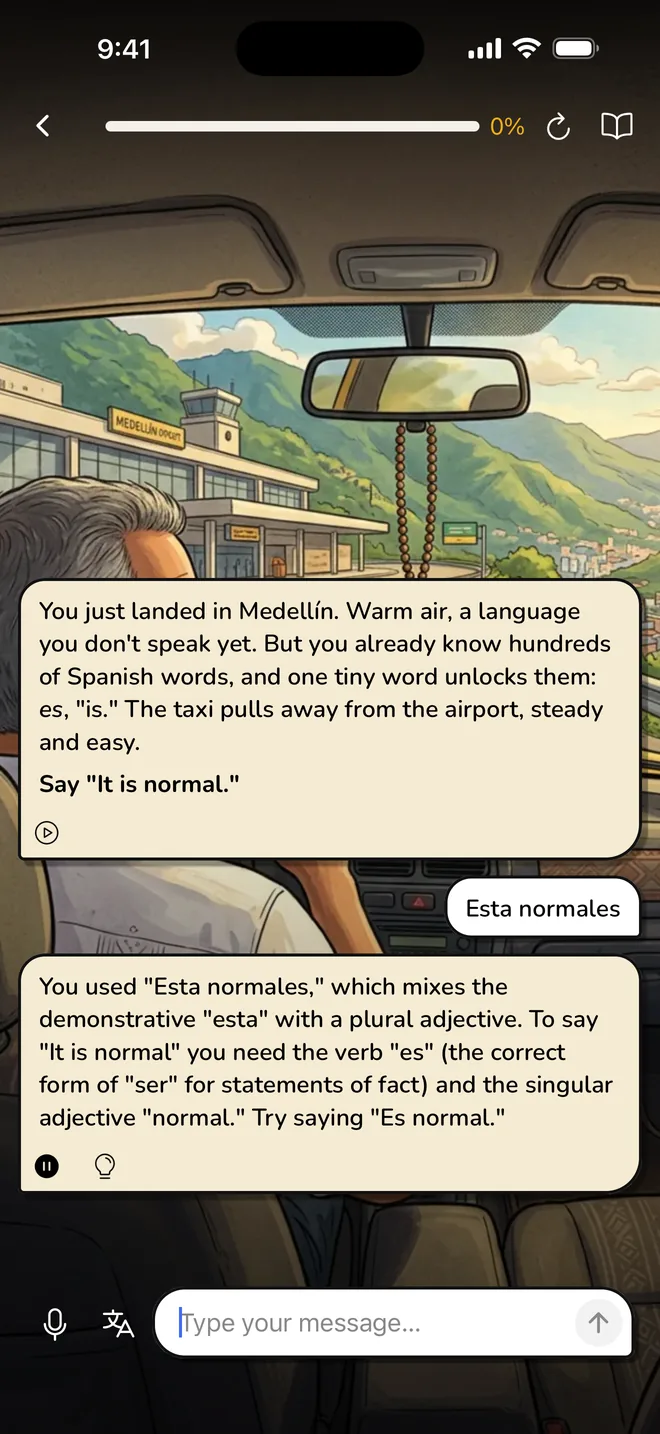
An Avita Spanish lesson starts with a short text that teaches the grammar and words you’re about to use, and Listen reads it aloud with each word highlighted. There’s an optional flashcard warm-up. Then the conversation begins, and it doesn’t stop until the lesson ends.
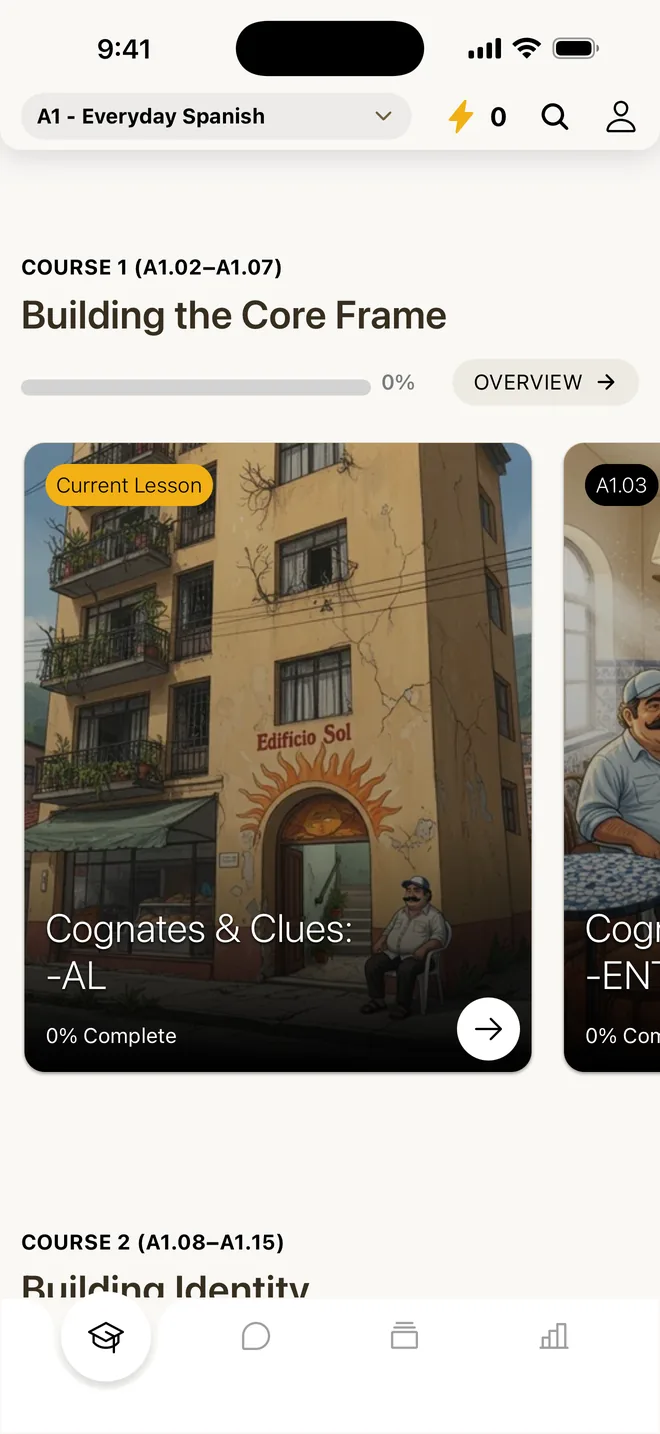
Our Spanish course is set in Edificio Sol, an apartment building in Medellín, Colombia. Say you’re in the lesson where you meet your neighbor Mateo:
- Mateo: ¿Y tú de dónde eres? (So where are you from?)
- You say: Soy de Boston, pero vivo aquí por dos semanas. (I’m from Boston, but I live here for two weeks.)
- Avita scores it and shows Soy de Boston, pero vivo aquí desde hace dos semanas (I’m from Boston, but I’ve lived here for two weeks), with a short reason: to say how long something has been going on, Spanish uses desde hace, not por.
Then Mateo asks what you do for work, whether you like the neighborhood, if you’ve tried the bakery downstairs. You answer each question out loud, in a sentence you put together yourself. If you blank, you can ask for a hint or a translation, or type when you can’t talk.
How much do you speak?
We measured ours from the course content: an Avita lesson asks you to say about 49 things out loud (German about 60), and a full course is roughly 10,000 spoken answers (German about 12,000).
Busuu doesn’t publish a comparable number, and lessons vary, so we won’t make one up. From Busuu’s own description of its method, most of a lesson is vocabulary, controlled practice (gap fills, multiple choice, dictation, word order) and writing, with voice recording and pronunciation exercises mixed in. Conversations are the part that looks most like Avita: you speak, improvise and get corrected afterward. They’re a feature you open from the Speak tab or reach on your timeline, while in Avita the conversation is the lesson itself.
That’s the main difference. If you want speaking to be one of four skills you train, Busuu covers it. If speaking is the skill you need, Avita has you do it about 49 times every lesson.
Feedback compared
Busuu’s community feedback is something Avita doesn’t have: a person who grew up speaking the language reads your sentence and tells you how they’d say it. It’s slower than instant feedback, and quality depends on who picks up your exercise, but at its best it’s exactly what you’d get from a friend who’s a native speaker. Conversations add faster feedback on spoken practice, delivered when the conversation ends.
Avita has no humans in the loop. What it gives you instead is speed and volume: every spoken answer gets a score, a corrected version that sounds natural and a one-line reason, right after you say it. You see the fix while the sentence is still in your head, then you use it in your next answer. Avita doesn’t score your pronunciation; it grades what you said.
Who should pick Busuu
Busuu is the better choice if:
- You’re learning a language Avita doesn’t teach, like Japanese, Korean, Portuguese, Arabic or Dutch.
- You want an official certificate at the end of a level. Avita doesn’t offer one.
- You want feedback from real native speakers, and writing matters to you as much as speaking (emails to a landlord, messages to colleagues).
- You like a traditional course structure with separate vocabulary and grammar lessons and progress tests.
- You want to study on a laptop or offline. Busuu has a web version and an offline mode on paid plans; Avita is phone-only and needs a connection.
Who should pick Avita
Avita fits better if:
- You need to talk to people soon: a move, a new job, your partner’s family, a trip you’re nervous about.
- You can read and write a bit but go blank when someone asks you a question out loud.
- You want to learn Spanish, French, Italian or German (or English, if you speak Spanish or Italian), and you’d rather follow one story with the same neighbors than jump between topics.
- You want Latin American Spanish, with characters in Medellín.
Using both together
These two fit together well because they’re strong in different places. Use Busuu for a language’s written side: work through its grammar lessons and send writing exercises to the community, so a native speaker catches the errors you’d never spot yourself. Use Avita every day for speaking, so the grammar you read about turns into sentences you can say without thinking. If Busuu teaches you desde hace on Monday, you’ll want to say it out loud on Tuesday, when a neighbor asks how long you’ve lived in Medellín.
Our take: Busuu is a thorough, well-built course with something rare: real native speakers correcting your work. If you want a certificate, a language we don’t teach, or strong writing, choose Busuu. If your goal is to hold a conversation, Avita has you speak about 49 times a lesson, every answer a full sentence, graded and corrected on the spot. The first lessons are free without an account, so you can hear the difference for yourself.
Questions people ask
Is Busuu good for speaking?
Busuu has several speaking features: voice recognition exercises for pronunciation, recorded answers that native speakers in the community can correct, and Conversations, where you improvise in a scenario and get corrections at the end. Speaking is one of several skills a lesson trains, alongside vocabulary, grammar exercises and writing. If speaking is your main goal, an app where every lesson is a conversation gives you more of it.
How do Busuu's community corrections work?
When you write or record an answer to a prompt, Busuu can send it to other learners who speak that language well, and they correct it. You help others in the languages you know. Busuu says Premium members are prioritized and often get feedback within minutes, while free members can send a limited number of exercises.
Does Avita have native speakers or teachers?
No. Avita has no human teachers or live classes. Instead, every answer you say out loud gets an immediate score, a natural corrected version and a short reason, about 49 times per lesson. If you want a person to hear you, Avita pairs well with Busuu's community corrections or a weekly lesson with a teacher.
Which languages do Avita and Busuu teach?
Busuu teaches 14 languages, including Japanese, Korean, Chinese, Arabic, Dutch, Polish, Russian and Turkish. Avita teaches Spanish, French, Italian and German to English speakers, and English to Spanish and Italian speakers, each with 200+ lessons from A1 to B2. Spanish in Avita is Latin American, set in Medellín.
Does Busuu give certificates? Does Avita?
Busuu offers official certificates on its top plan. Avita doesn't offer certificates. If you need proof of a level for a job or school, Busuu is the better choice. If you need to get through real conversations, Avita puts all of its lesson time into speaking.