
On this page
Babbel is a well-made app, and we say that as two people who built a competitor. Its lessons are written by linguists, its grammar notes are clear, and it teaches far more languages than we do. This page answers a narrower question: if what you need is to hold a conversation, which app gets more of the language out of your mouth? We went through Babbel’s help center and product pages in October 2026 to answer it, and we’ll tell you where Babbel is the better pick.
What is Babbel?
Babbel is a subscription app and website that teaches 13 languages to English speakers: Spanish (one course for Mexican Spanish, one for Spain), French, German, Italian, Portuguese, Swedish, Dutch, Danish, Norwegian, Indonesian, Polish, Turkish and Russian. How far each course goes varies a lot. European Spanish reaches C1. French, German and Italian reach B2. Mexican Spanish and Brazilian Portuguese stop at B1, and several of the smaller courses stop at A2.
Courses are split into themed units (ordering food, talking about your hobbies), and each lesson mixes listening, speaking, writing and grammar exercises. Babbel’s help center puts a lesson at 10 to 15 minutes; its marketing page says the average is 6. Around the lessons you get spaced-repetition review with flashcard, listening, speaking and writing modes, podcasts, Guided Conversations, and a newer speaking feature called Babbel Speak. Babbel runs in the app and in a web browser, lets you download lessons for offline use, and gives you a CEFR-aligned certificate when you finish a level. Signing up is free and so is the first lesson of every course. Everything else needs a subscription.
Avita vs Babbel at a glance
| Avita | Babbel | |
|---|---|---|
| How you answer | Out loud, in full sentences | A mix of listening, matching, typing and speaking exercises |
| Speaking per lesson | About 49 spoken answers (German about 60) | Speaking exercises in lessons that include them; no published count |
| What you say | You build the sentence yourself from an English prompt | You repeat a word or phrase after hearing it |
| Feedback on each answer | A score, a natural corrected version and a short reason why | Pronunciation feedback on each repeat |
| Open conversation | Role-play scenarios and open chat (Avita Pro) | Babbel Speak (beta, mobile only, Spanish, French, German, Italian) |
| Structure | One continuing story per course | Themed units of standalone lessons |
| Grammar teaching | A short text to read and listen to before each conversation | Learning Tips and grammar exercises inside lessons |
| Languages | Spanish, French, Italian, German for English speakers; English for Spanish and Italian speakers | 13 languages for English speakers, plus English courses |
| Where it runs | iPhone and Android | iPhone, Android, web, offline downloads |
| Free option | First 5 lessons of every level; a free account gets 3 days of full access, no card | First lesson of every course |
| Best for | People who need to speak soon | All-round study, and languages Avita doesn’t teach |
What a lesson feels like in each
A Babbel lesson
A Babbel lesson takes one situation, say ordering food, and walks you through a handful of new words and phrases voiced by native speakers. You match what you hear to the right words, type words into sentences, and read short Learning Tips that pop up to explain a grammar point or a bit of culture. New words show up on their own and the next exercise loads as soon as you finish the last one, so it moves quickly.
When the lesson reaches a speaking exercise, you hear the word or phrase first, tap the orange microphone, and say it back. Babbel’s speech recognition compares your version with the target and tells you how close you got. Babbel’s own troubleshooting advice is to repeat the phrase exactly as shown, because “even small changes can affect the result.” That tells you what the exercise is for: saying a known phrase well.
An Avita lesson
Take our Spanish lesson on me gusta. It opens with Read: a short text explains that Spanish doesn’t say “I like,” it says “it pleases me,” and that the verb changes when the thing you like is plural. Listen reads that text aloud with each word highlighted. Then there’s an optional flashcard warm-up with the lesson’s key words.
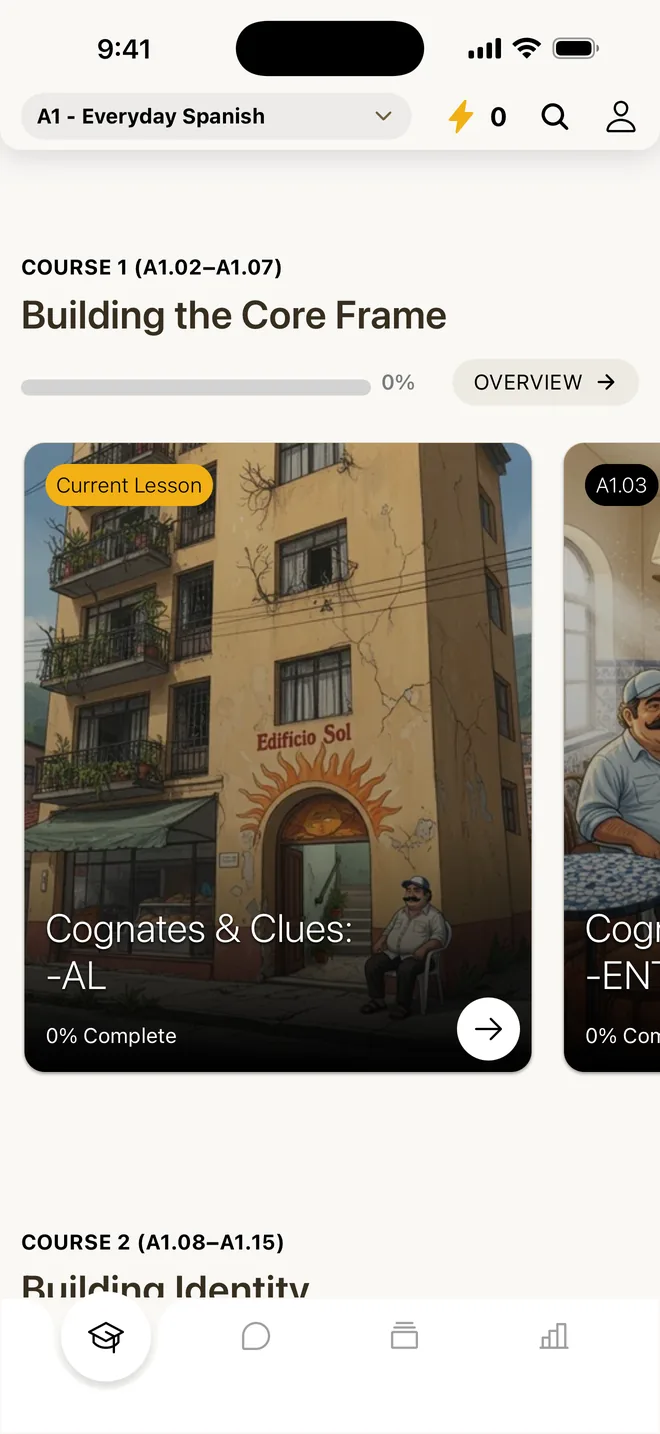
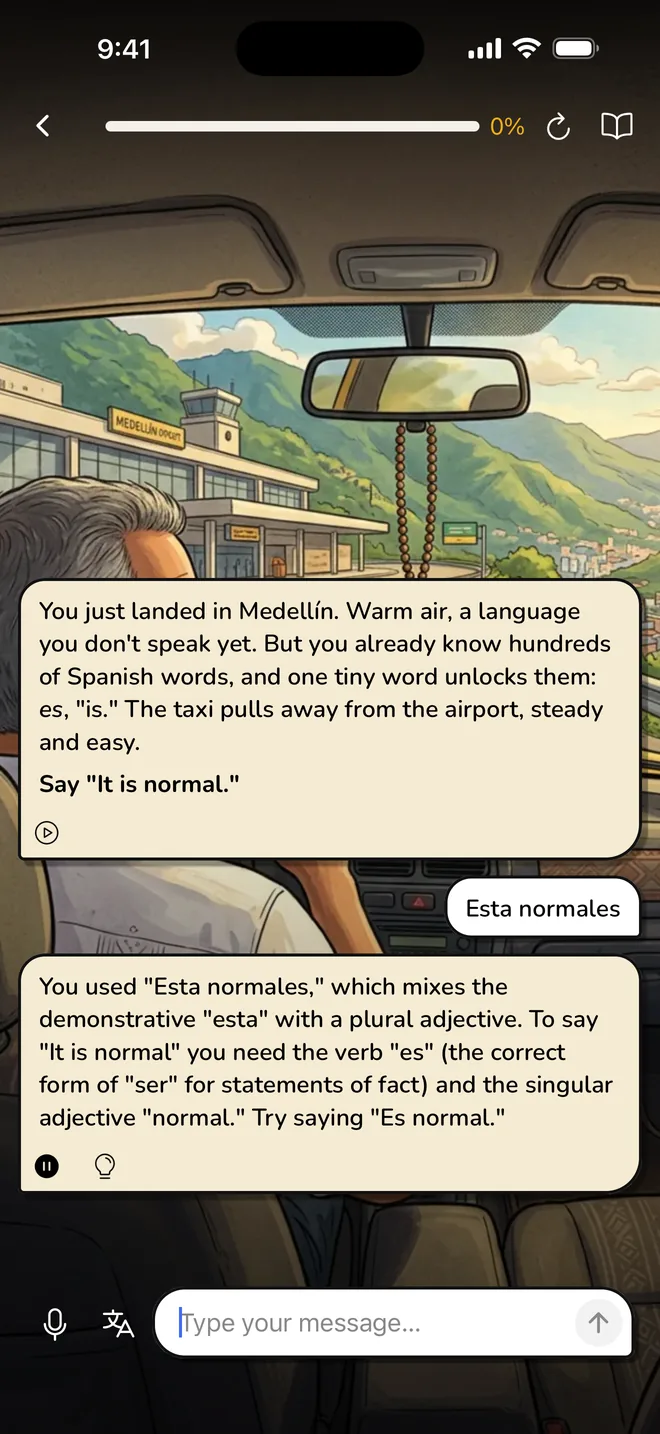
Then you Speak. You’re at the bakery in Edificio Sol, the apartment building in Medellín where our Spanish course is set. A new bakery has opened down the street and Doña Carmen is doing market research with a napkin and a pen. She asks what you like about her place. The screen says: Say “I like the bread more than the coffee.” Nobody plays you the Spanish first. You say Me gusta más el pan que el café (I like the bread more than the coffee), and she writes it down. A few lines later you tell her you don’t like her coffee, and she slides a darker cup across the counter. If you get stuck, you can ask for a hint or a translation, and if you can’t talk right then, you can type.
That one lesson asks you to say 49 things out loud.
Speaking practice compared
The two apps ask your mouth to do different jobs. Repeating a phrase you just heard trains pronunciation and gets you used to the sound of your voice in another language. Building a sentence from its meaning trains the part that breaks down in real conversations, when you have to find the words yourself while someone waits. Merrill Swain’s output hypothesis (1985) is the classic case for that second kind of practice: when you try to say something and can’t, you notice the gap, and noticing it pushes you to learn what goes there.
Babbel has more speaking tools outside the main lessons:
- Guided Conversations: scripted dialogues. You listen to a short conversation, then speak the lines for one of the parts. They’re available on mobile at A1 and A2 in French, German, Italian, and Mexican and European Spanish.
- Babbel Speak: an open conversation feature that launched in open beta in September 2025. You pick an everyday scenario, see the tasks you need to complete, and take turns talking with a virtual partner. You can slow down its replies, see translations and ask for hints. It’s mobile only. With American English as your display language it covers French, German, Italian and Mexican Spanish; with British English, Spanish only.
So Babbel does have open-ended speaking now. The difference is volume and where it lives. In Avita, speaking is the lesson. Every lesson has you say about 49 things out loud (about 60 in German), and a full course comes to roughly 10,000 spoken answers (about 12,000 in German). Each one is a full sentence you put together yourself.
Babbel doesn’t publish how many times you speak in a lesson, so we won’t guess. If you want to compare, do one Babbel lesson and one Avita lesson on the same day and count how many times you said something you had to come up with yourself.
Feedback compared
Babbel’s feedback on in-lesson speaking is about pronunciation: how closely what you said matches the phrase you were given. That’s useful, and it’s something Avita doesn’t do. We don’t score pronunciation.
Babbel Speak works differently on purpose. Babbel says it won’t stop or correct you in the middle of a response. The point is to practice being understood without worrying about perfect grammar, and after the conversation you get feedback on the tasks you completed and your vocabulary.
Avita grades every answer. Each one gets a score, a natural corrected version, and a short reason why. Say you tell Carmen Me gusta los buñuelos. You’ll see the natural version, Me gustan los buñuelos (I like the buñuelos), with a note that buñuelos is plural, so the verb is gustan. Then the conversation keeps going, and two lines later she asks you something that needs gustan again.
Who should pick Babbel
Babbel is the better choice if:
- You want a language we don’t teach: Portuguese, Swedish, Dutch, Danish, Norwegian, Polish, Turkish, Indonesian or Russian.
- You want to study on a laptop, or offline on a flight. Avita is phone-only and needs a connection.
- You want reading and writing practice as much as speaking, with typed exercises and grammar notes in every lesson.
- You want feedback on how you pronounce individual words and phrases.
- You’re learning Spain’s Spanish and want to go past B2. Babbel’s European Spanish course goes to C1; ours stops at B2.
- You like short, standalone lessons you can do in any order, plus podcasts and a certificate at the end of each level.
Who should pick Avita
Avita is the better choice if:
- You need to talk soon: a move abroad, a partner’s family, a new job.
- You understand more than you can say and freeze when it’s your turn. We wrote a whole guide on understanding but not speaking.
- You want Latin American Spanish past B1. Avita’s Spanish is Latin American and runs from A1 to B2; Babbel’s Mexican Spanish course goes up to B1.
- You want a story that pulls you back. Spanish follows your neighbors in Medellín, Italian a new life in Bologna, French a new life in France, German an allotment garden colony in Berlin.
- You’d rather hear what you got wrong after every sentence than at the end of a session.
Using both together
The two apps overlap less than you’d think, so using both is reasonable. Use Babbel on a laptop for reading, writing and grammar review, and use Avita when you can talk out loud. One routine: a Babbel lesson on the commute, where you can’t speak anyway, then an Avita lesson at home where you have to say it. Babbel’s podcasts fill a walk.
If you only want to pay for one, decide what you need to be able to do in six months. If the answer is “talk to people,” that settles it.
Our take: If your goal is conversation, start with Avita. You’ll say about 49 sentences out loud in every lesson and get each one corrected, and that speaking is the whole lesson. If you need a language we don’t teach, want to learn on a computer, or want a course that gives reading and writing equal weight, Babbel is the better buy, and a good one.
Questions people ask
Is Babbel good for speaking practice?
Babbel puts speaking exercises inside its lessons, but most of them have you repeat a word or phrase after hearing it, and speech recognition scores how closely you matched it. That helps pronunciation. For producing your own sentences, Babbel has Guided Conversations (scripted, A1 to A2) and Babbel Speak, a beta conversation feature on mobile. If speaking is your main goal, you'll want more practice building sentences yourself than the core lessons give you.
What is Babbel Speak?
Babbel Speak is a conversation feature in Babbel's mobile app, launched in open beta in September 2025. You pick an everyday scenario, see the tasks to complete, and take turns talking with a virtual partner, with hints and translations available. Babbel says it won't correct you mid-response; you get feedback on tasks and vocabulary afterward. With American English as your display language it covers French, German, Italian and Mexican Spanish.
Is Avita or Babbel better for Latin American Spanish?
Avita's Spanish course is Latin American Spanish, set in an apartment building in Medellín, Colombia, and runs from A1 to B2 with about 49 spoken answers per lesson. Babbel's Mexican Spanish course goes up to B1, and its courses include speakers from several Spanish-speaking countries. If you want to keep going past B1 in Latin American Spanish, Avita goes further; if you want Spain's Spanish to C1, Babbel does.
Can I use Babbel or Avita for free?
Babbel lets you register for free and try the first lesson of every course; full access needs a subscription. Avita lets you start without an account, the first 5 lessons of every level are free, and a free account gets 3 days of full access with no card. Avita Pro includes every lesson in every course, plus role-play scenarios and open chat.
Does Avita score pronunciation like Babbel?
No. Babbel's speech recognition compares how you said a word or phrase with the target and gives pronunciation feedback. Avita doesn't score pronunciation. It grades what you said: every spoken answer gets a score, a natural corrected version and a short reason why, so the feedback is about words and grammar. If accent work is your priority, Babbel's repeat exercises are a good complement.
Can I use Avita on a computer or offline like Babbel?
Not right now. Avita is an app for iPhone and Android and needs a connection. Babbel runs in the app and in a web browser, and its app lets you download lessons and podcasts for offline use. If you mostly study on a laptop or on flights, that's a real point in Babbel's favor.