On this page
Try this: play a minute of a podcast in the language you’ve been learning. You can probably follow most of it. Now pause and retell that minute out loud. For a lot of people, the gap between those two tasks is enormous, and it’s the reason they say “I understand, I just can’t speak.” You’re in good company: heritage speakers who grew up hearing the language, people with years of app streaks, people who’ve lived abroad for a while and mostly listened. It’s also a very fixable place to be stuck, because the slow part, all that input, is already done.
Why you can understand more than you can say
Understanding and speaking use the same language but different skills. Linguists call them receptive (listening, reading) and productive (speaking, writing).
When you listen, the sentence arrives already built. You get the words, the grammar, the context and the speaker’s face, and your job is to match what you hear to what you know. Partial knowledge is often enough. You might not remember whether it’s por or para, but you’ll still understand Lo hice para ti (I did it for you).
When you speak, you build the sentence from nothing. You have to pick the words, conjugate the verb, put everything in order and pronounce it, all in real time while someone waits. Partial knowledge isn’t enough anymore. If you can’t pull para out of memory in that second, the sentence stalls.
Research on vocabulary shows the same gap. In a 2008 study, Stuart Webb tested Japanese university students learning English and found they could recognize more words than they could produce, with a wider gap for less common words. Recognizing a word and being able to say it are two different levels of knowing it.
The immersion students who understood everything
The best-known evidence for this gap comes from Canada. In the 1980s, the linguist Merrill Swain studied students in French immersion programs, kids who had spent years learning school subjects in French. Their listening and reading were close to native. Their speaking and writing were not: even after years in the program, they kept using grammar no native speaker would.
When Swain looked at what happened in class, she found the students heard plenty of French but said relatively little of it, and their errors often went uncorrected. Her conclusion became the output hypothesis (Swain, 1985): understanding input isn’t enough to reach accurate speech. You also need to produce the language, and to be pushed to say things precisely.
She later described three things output does that listening can’t:
- You notice gaps. You try to say “I’ve been living here for two years” and realize you have no idea how. (In Spanish: Hace dos años que vivo aquí.) Listening never forces that moment, because you never have to build the sentence yourself.
- You test your guesses. Every sentence you say is a hypothesis about how the language works. Say Soy aburrido when you mean you’re bored and someone will laugh, because you just said “I’m boring.” The correct version is Estoy aburrido. You probably won’t make that mistake again.
- You think about the language. Having to produce something makes you pay attention to its form in a way passive listening doesn’t.
To be fair to the other side, researchers still argue about how much output adds beyond input, and lots of people reach high levels mostly through listening and reading. Input is how you got to where you are. But if you can understand and can’t speak, more input alone is a slow way out.
Why apps built on recognition leave you here
Think about the exercises in a typical language app: pick the right answer from four options, tap words from a bank into the right order, match pairs, choose the missing word. All of them put the answer, or its pieces, on the screen. You’re recognizing, not producing.
Those exercises aren’t useless. They build familiarity and comprehension, and they’re a gentle way to start. The problem is that they mostly train the skill you already have. You can finish hundreds of them and never once pull a full sentence out of your own head.
Memory research explains why this matters. In Henry Roediger and Jeffrey Karpicke’s 2006 study, students who reread a passage did better on a test five minutes later than students who were tested on it. Two days and a week later, that flipped: the tested group remembered more. In a follow-up published in Science in 2008, students learning Swahili vocabulary were asked to predict how much they’d remember a week later. Their predictions had no relationship to how much they actually remembered: restudying felt just as effective as testing themselves, even though it wasn’t. Recognition gives you the same false comfort: it feels like knowing, right up until someone asks you a question.
How to close the gap
Closing the gap is mostly practice at getting out what’s already in there. These steps work for any language; the examples are Spanish.
- Flip the direction of your practice. Stop going from Spanish to English (reading, listening, translating into your language) as your main drill. Start from English, or from a situation, and produce the Spanish. If you use flashcards, put the English side first and say the full Spanish sentence before you flip.
- Answer in full sentences, out loud. Someone asks ¿Qué hiciste el fin de semana? (What did you do this weekend?). Don’t stop at Nada (nothing). Say No hice mucho, me quedé en casa y vi una película (I didn’t do much, I stayed home and watched a movie). The full sentence is the practice.
- Push a little past comfortable. Swain’s word was “pushed” output. Describe your job, tell what happened yesterday, explain why you like a certain movie. When you hit a gap, write it down. That list of things you couldn’t say is the most valuable study material you have.
- Close each gap the next day. Look up how to say it, then say it out loud several times in a sentence of your own. Come back to it two or three days later, then again a week later. Research on spacing backs this up: a 2006 review of 317 experiments by Nicholas Cepeda and colleagues found that practice spread over days is retained better than the same practice crammed into one session.
- Get feedback on what you actually say. This is the hypothesis-testing part, and it needs a listener: a tutor, a language partner, a patient relative, or an app that grades spoken answers. Without it you’ll repeat a few mistakes until they’re habits.
- Lower the stakes before you raise them. Freezing is partly nerves. Talk to yourself first, then to a recording, then to shopkeepers and waiters, then to the people whose opinion you care about. Our guide to speaking anxiety covers this in more detail.
- Count output, not exposure. Hours of podcasts don’t tell you much about speaking. The number of sentences you said out loud today does. Fifty a day is a reasonable target to start with.
If you’re a heritage speaker
Heritage speakers often have the widest version of this gap. You might have native-like comprehension and a good accent, and still answer your grandmother in English because the Spanish won’t come out fast enough. The fix is the same: produce, in full sentences, with feedback. Start with the conversations you’ll actually have, about family, food and what you did this week, so the practice pays off at the next visit. We wrote a separate guide on Spanish for heritage speakers.
How long does it take?
It depends on how wide your gap is and how much you speak each day, so anyone giving you a fixed number is guessing. One thing works in your favor: you’re not learning these sentences from scratch. Phrases you’ve heard a hundred times can come out easily after only a few rounds of saying them yourself. For a fuller answer, see how long it takes to become conversational.
Where Avita fits
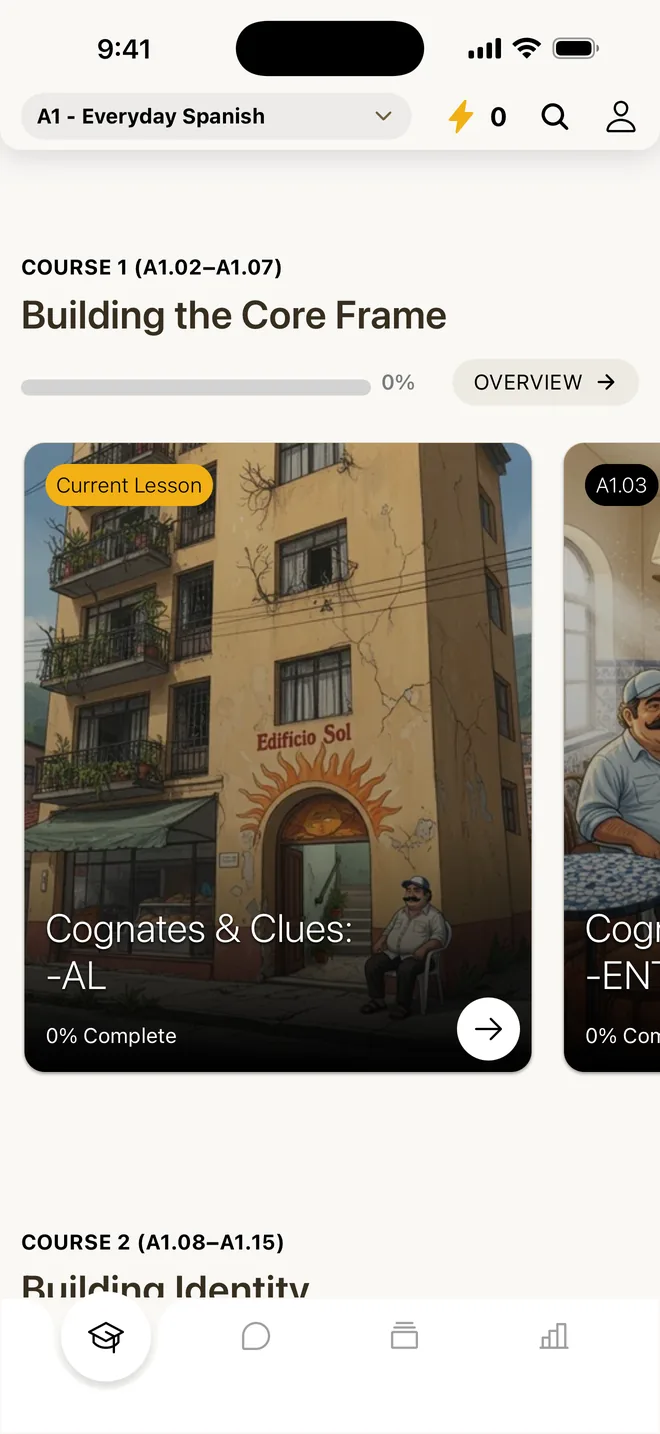
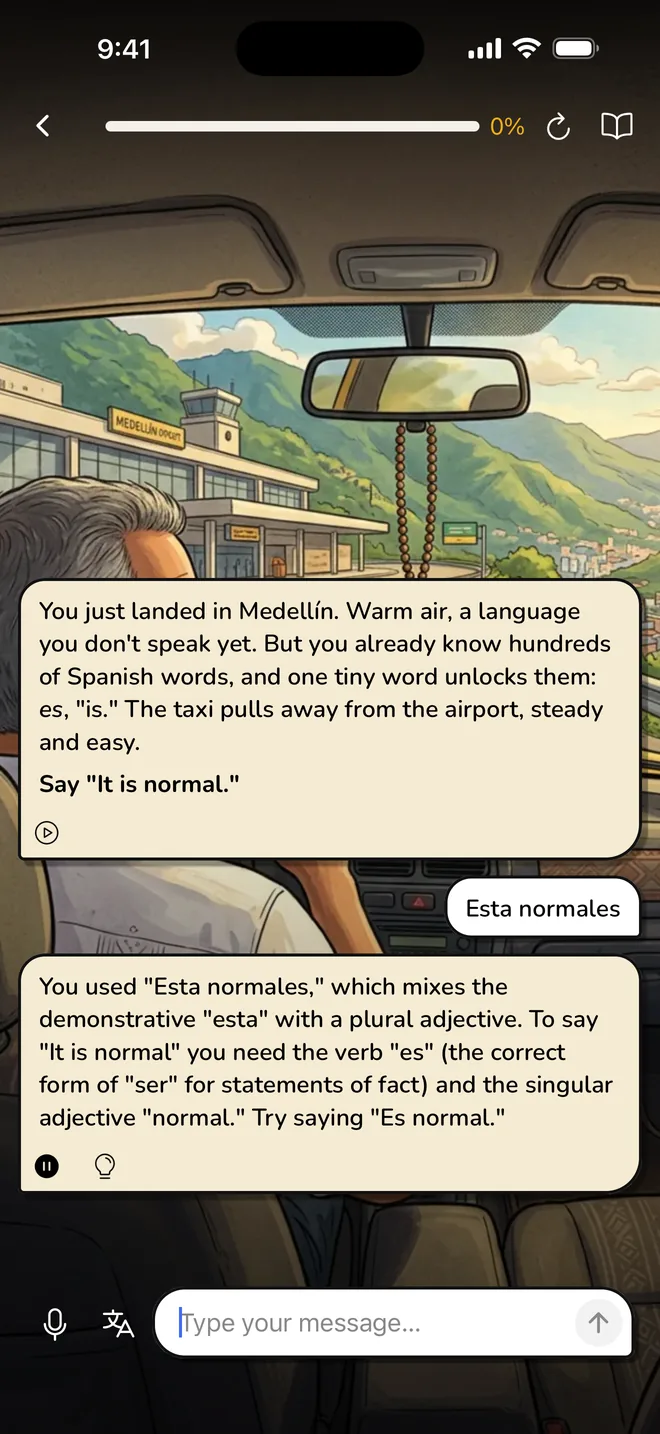
We built Avita after the apps we tried left us in exactly this gap: lots of vocabulary, no conversation. Every lesson is a spoken conversation inside a story, and you answer out loud in full sentences. There’s no multiple choice, no word bank and no tiles to tap, so every answer is something you had to produce. A lesson asks you to say about 49 things out loud (about 60 in German), and every answer gets a score, a natural corrected version and a short reason why. If you’re stuck, you can ask for a hint or a translation instead of guessing from a list.
Avita teaches Spanish, French, Italian and German for English speakers, and English for Spanish and Italian speakers. The first five lessons of every level are free.
It’s not the right tool for every gap. If your problem is the reverse, that you can say plenty but can’t follow native speakers at full speed, you need more listening: podcasts, shows and conversations where you mostly listen. And a human tutor gives you something an app can’t, a real person to talk to. The two work well together.
Our take: Keep the podcasts for your commute, but stop counting them as speaking practice. Count the sentences you said out loud instead. It’s the one number that tracks the skill you’re missing, and you already have the input to build those sentences from.
Questions people ask
Why can I understand a language but not speak it?
Because understanding and speaking are different skills. Listening lets you match what you hear to what you know, so partial knowledge is often enough. Speaking means building a sentence from nothing in real time, which needs words and grammar you can pull from memory instantly. If you've mostly listened, read or done recognition exercises, that retrieval skill hasn't had much practice.
Is it normal to understand more than you can speak?
Completely. Receptive skills almost always run ahead of productive ones, in a first language and in a second. Research on vocabulary consistently finds that learners recognize more words than they can produce, and Merrill Swain's studies of Canadian French immersion students found near-native comprehension alongside clearly non-native speech. The gap is normal. Staying in it for years usually means you need more speaking practice.
Will listening more eventually make me able to speak?
It helps, and some people do get there mostly through input, but it's a slow route if speaking is your goal. Listening builds comprehension, which you already have. To speak, you need to practice producing sentences: saying them out loud from memory, getting corrected and coming back to them. Keep listening, but shift most of your practice time to output.
How do I stop freezing when someone talks to me?
Practice the retrieval before the real conversation. Answer questions out loud in full sentences on your own every day, so the sentences you need have already come out of your mouth many times. Start with low-stakes situations like ordering food before conversations that matter to you. Learning a few rescue phrases, like asking someone to repeat or slow down, also helps.
Do language apps help with speaking?
It depends on what the app makes you do. Exercises where the answer is on screen, like multiple choice, word banks and tapping tiles, mostly train recognition. Apps where you answer out loud in your own words train speaking. Avita is built around spoken answers: about 49 per lesson, each graded and corrected, with no multiple choice. A tutor or conversation partner trains it too.