On this page
Most “fluent in three months” promises skip the questions that decide the answer: conversational at what level, in which language, and with how many of your practice hours spent speaking instead of reading. Below are the benchmarks we trust, where they come from, and what they add up to if you have 20 minutes a day or two hours.
What does “conversational” mean?
The most useful yardstick is the Common European Framework of Reference for Languages (CEFR), the Council of Europe’s scale from A1 to C2. Here is what the first four levels mean for talking to people, paraphrased from the CEFR global scale:
| Level | What you can do in a conversation |
|---|---|
| A1 (beginner) | Introduce yourself and ask and answer simple personal questions, as long as the other person talks slowly and helps |
| A2 (elementary) | Handle simple, routine exchanges: shopping, directions, your job, your family |
| B1 (intermediate) | Deal with most situations while traveling, describe experiences and plans, give short reasons for your opinions |
| B2 (upper intermediate) | Talk with native speakers “without strain for either party” |
When people say “conversational,” they usually mean B1. At A2 you can get through a transaction. At B1 you can have the conversation that happens after it: where you’re from, why you moved, what you thought of last night’s game. B2 is when dinner with your partner’s family stops being exhausting.
So the useful version of the question is: how long does it take to reach B1 in speaking?
What the Foreign Service Institute numbers say
The US Foreign Service Institute (FSI) trains American diplomats, and the State Department publishes how long its students usually need. The current figures:
| Language | FSI category | Typical training | Class hours |
|---|---|---|---|
| Spanish | I | 30 weeks | about 690 |
| French | I | 30 weeks | about 690 |
| Italian | I | 24 weeks | about 552 |
| Portuguese | I | 24 weeks | about 552 |
| German | II | about 36 weeks | about 828 |
Before you plan around these numbers, know what they measure.
The target is high. FSI times how long students take to reach a 3 in speaking and listening on the Interagency Language Roundtable scale, which the ILR calls general professional proficiency: enough accuracy and vocabulary for most formal and informal conversations on practical, social and professional topics. That is well past conversational.
The hours are bigger than they look. FSI counts a typical week as 23 hours in class plus 17 hours of self-study, so 30 weeks of Spanish is roughly 1,200 hours of total effort, full time, with teachers.
The figures have changed. Many websites still quote older, higher numbers for Category I languages; the State Department’s page now says 552 to 690. FSI also notes that the time varies with natural ability, prior language-learning experience and time in class.
German takes about 20% longer than Spanish or French on these numbers (828 class hours against 690). Italian and Portuguese come in faster, at 24 weeks.
How many hours to reach B1?
FSI doesn’t publish a figure for B1. The most widely cited per-level numbers come from Cambridge English, which estimates guided learning hours for people learning English: roughly 180 to 200 hours to reach A2, 350 to 400 for B1 and 500 to 600 for B2, counted from zero. Those are estimates for English, with a teacher, and Cambridge says your background changes them, so use them as an order of magnitude. Spanish, French and Italian are among the closest languages to English on FSI’s list, so the estimates are a reasonable starting point; for German, add something like FSI’s extra 20%.
Using 190 hours for A2 and 375 for B1, here is roughly how long each takes on different daily schedules:
| Daily practice | Hours per year | Rough time to A2 | Rough time to B1 |
|---|---|---|---|
| 15 minutes | about 90 | 2 years | 4 years |
| 30 minutes | about 180 | 1 year | 2 years |
| 1 hour | about 365 | 6 months | 1 year |
| 2 hours | about 730 | 3 months | 6 months |
| FSI pace (40 hours a week) | about 2,000 | 5 weeks | 10 weeks |
If your daily habit is a 15-minute streak, that is a four-year plan to B1 at this rate. Fifteen minutes still counts for something, but the math explains how someone can keep a long streak and still struggle to hold a conversation.
What changes the timeline
The hours are only half of it. What you do inside them matters as much.
How much of your practice is speaking
Understanding and speaking are different skills. Recognizing Ya me tengo que ir (I have to get going) when you hear it takes a fraction of the work of producing it on demand, with the pronoun in the right place, while someone waits for you. Plenty of people log hundreds of hours of tapping and listening and end up understanding a lot while saying very little. We wrote a guide about exactly that: I understand but I can’t speak.
If your goal is conversation, count spoken sentences, not minutes. Fifty full sentences said out loud train the skill you need; an hour of rereading the same material mostly trains recognition. (The research on why is in why speaking early works.)
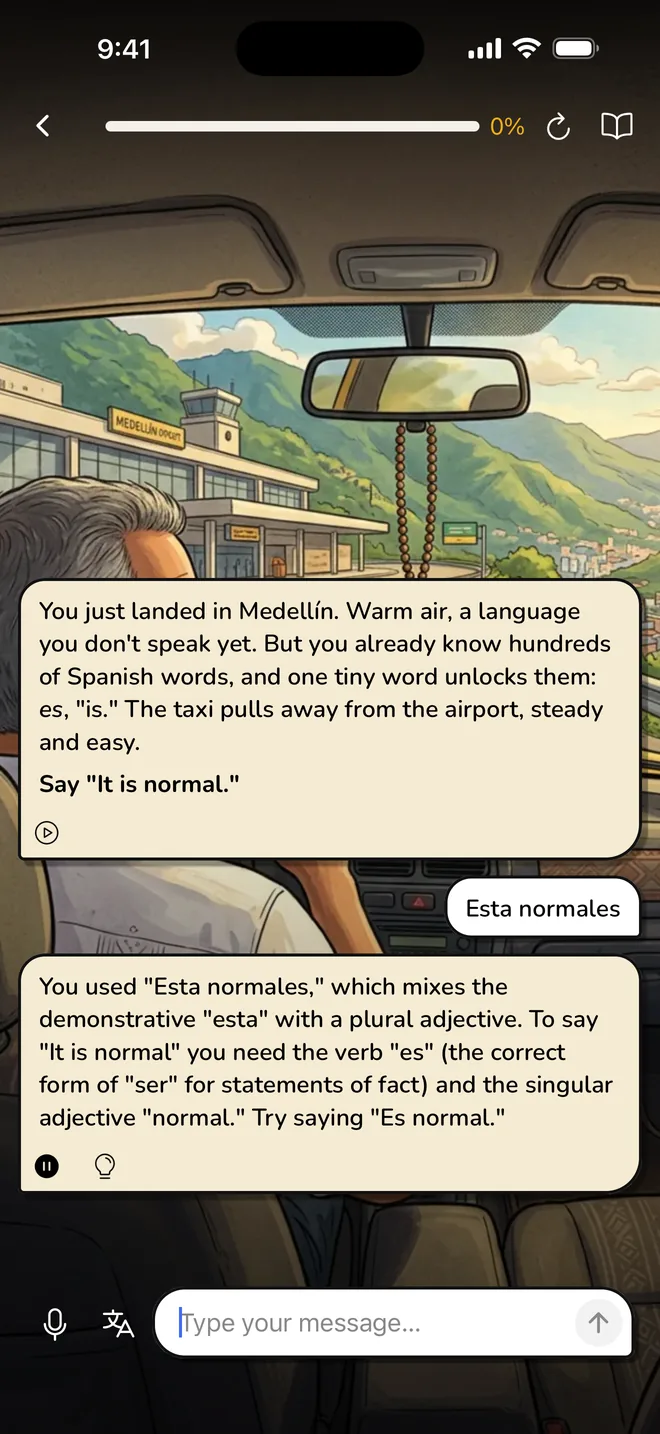
That count is what we built Avita around. A lesson asks you to say about 49 things out loud (German lessons about 60), and a full course is roughly 10,000 spoken answers (German about 12,000). Every answer is a full sentence, graded and corrected.
How your minutes are spread out
Thirty minutes every day will serve you better than three and a half hours on Sunday. Memory researchers have tested this for over a century: practice spread across days is remembered better than the same amount crammed into one sitting. Cepeda and colleagues pooled 317 of these experiments in a 2006 review in Psychological Bulletin, and the pattern held.
What you already know
FSI’s own caveat applies to everyone. If you’ve learned a second language before, you already know how to study one. If you grew up hearing Spanish at home, you may understand far more than you can say, which changes where you start (see our guide for heritage speakers).
Talking to people
Sooner or later the practice has to include people: a teacher, an exchange partner, a neighbor, your partner’s family. Practicing on your own gets the sentences ready. Live conversations teach you to recover when things go off script, and that recovery is most of what “conversational” feels like.
A realistic 12-week start
Assume 30 to 45 minutes a day, with at least half of each session spent speaking out loud.
- Weeks 1 to 4: learn the phrases and verbs you’ll use in every conversation, and say each one out loud as you learn it. In Spanish: Me llamo Jordan (My name is Jordan), Soy de Chicago (I’m from Chicago), ¿Me trae la cuenta, por favor? (Could you bring me the check, please?), Disculpe, ¿puede hablar un poco más lento? (Excuse me, could you speak a little slower?).
- Weeks 5 to 8: talk about yourself in more detail. Write down the five questions people always ask you, like ¿Qué haces los fines de semana? (What do you do on weekends?), and practice answering each one out loud until you can do it without looking.
- Weeks 9 and 10: add a past tense so you can tell stories. Ayer fui al mercado (Yesterday I went to the market). Practice telling one short story about your week.
- Weeks 11 and 12: have your first conversations with people. Keep them short and do two or three rather than one long one.
Twelve weeks at that pace is 40 to 60 hours. That won’t get you to B1. It will get you to what the CEFR describes at A1: a simple conversation with someone who talks slowly and is willing to help.
An Avita lesson a day can carry the speaking part of this plan (about 49 answers each), with flashcards for vocabulary and a person once you’re ready. A teacher, a language exchange or a book of dialogues you read aloud can do the same job if you’d rather.
How to tell you’re conversational
Run this on yourself:
- You can talk about yourself for two minutes without preparing.
- You ask follow-up questions instead of only answering them.
- When you don’t know a word, you get around it (¿Cómo se llama eso?, what’s that called?) instead of stopping.
- You can follow someone talking at a normal pace about something familiar, even when you miss words.
If you can do all four with a stranger, you’re conversational in any sense that matters.
Our take: If you need to hold a conversation within a year, plan on about an hour a day and spend at least half of it speaking out loud. At that pace, Spanish, French and Italian get you to B1 in roughly a year; German takes longer. Anyone promising fluency in a few weeks is counting something other than conversation.
Questions people ask
How many hours does it take to become conversational in Spanish?
Plan on a few hundred. Cambridge English estimates about 350 to 400 guided learning hours to reach B1, the level most people mean by conversational, and Spanish is one of the closest languages to English on the Foreign Service Institute's list. For comparison, FSI's full-time Spanish course runs 30 weeks, about 690 class hours plus self-study, but it aims well past conversational, at professional proficiency.
Can you become conversational in 3 months?
At a basic level, yes, if you put in serious time. At two hours a day, three months is roughly 180 hours, about what Cambridge English estimates for A2: simple, routine exchanges about familiar things. At 20 minutes a day, three months is about 30 hours, enough for introductions and simple questions with a patient listener. Reaching B1 in three months takes something close to full-time study.
Is German harder than Spanish for English speakers?
A little, by the Foreign Service Institute's measure. FSI lists Spanish and French as Category I languages, at 30 weeks of full-time training, and German as Category II, at about 36 weeks (roughly 828 class hours against 690). Italian and Portuguese are faster, at 24 weeks. At the same daily pace, expect German to take about 20% longer than Spanish.
What CEFR level counts as conversational?
Most people mean B1. The CEFR describes B1 as dealing with most situations while traveling, describing experiences and plans, and briefly giving reasons for opinions. A2 covers simple routine exchanges like shopping and directions. B2 is when you can talk with native speakers without strain on either side, which is closer to what most people picture when they say fluent.
How many minutes a day should I practice a language?
Thirty minutes to an hour a day is a realistic range. At an hour a day, B1 is about a year away; at 30 minutes, about two years. Spreading practice across every day also beats cramming the same minutes into one session, a pattern memory research has found again and again. Whatever your time, spend at least half of it speaking out loud.
Can a language app alone make you conversational?
It depends on how much the app makes you speak. If most of your time goes to tapping and matching, you mostly train recognition, and you can finish lessons and still freeze in conversation. Speaking-first apps like Avita have you answer out loud in full sentences, about 49 times a lesson. Either way, you'll need conversations with people eventually; an app is how you get ready for them.