On this page
Most of the speaking practice that gets you comfortable in a language doesn’t need another person in the room. A conversation partner is great, but think about how an hour-long language exchange goes: half of it happens in your partner’s language, and during your half you spend a lot of time listening. Alone, every minute of speaking is yours. What’s missing when you’re alone is feedback, so this guide covers both: the methods, and how to find out whether what you’re saying is right.
Why practicing alone works
Two findings from memory research explain most of it.
The first is the production effect. In a series of experiments published in 2010, Colin MacLeod and colleagues found that people remembered words they had read aloud better than words they had read silently. Even mouthing the words helped. Their explanation is that saying a word makes the memory of it more distinctive.
The second is retrieval practice. When Jeffrey Karpicke and Henry Roediger had students learn 40 Swahili–English word pairs, the students who kept testing themselves on every word remembered about 80% a week later. The ones who stopped testing themselves on a word once they’d got it, even if they kept studying it, remembered only about a third. Every time you build a sentence from memory instead of reading it, you’re doing the first kind of practice.
Alone, you can do a lot of both, without anyone waiting on you and without the nerves that come with an audience. The methods below run roughly from most guided to most free.
Shadowing
Shadowing means playing a short clip of a native speaker and speaking along with it, a split second behind, copying the rhythm and intonation as closely as you can.
Yo Hamada, who has studied shadowing in Japanese classrooms for years, published a review of the research in 2019. Most of the evidence is about listening: shadowing helps learners hear where words begin and end in fast speech, and it tends to help lower-level learners most. The evidence for speaking is thinner, which is one more reason to treat it as a warm-up.
How to do it:
- Pick a 30 to 60 second clip with a transcript, at your level or just above. Podcast episodes for learners work well.
- Listen two or three times without speaking.
- Read the transcript and make sure you understand every line.
- Shadow it with the transcript in front of you, mumbling at first if you need to.
- Shadow it without the transcript.
- Record one take and play it right after the original.
Shadowing has a limit. You’re repeating someone else’s sentences, so it trains your ear and your mouth but not your ability to build a sentence on the spot. Treat it as the warm-up and pair it with the methods below.
Narrate what you’re doing
We think self-talk is underrated. It costs nothing and fits into time you already have. While you cook, clean or get ready, describe what you’re doing in the language, out loud.
- Estoy haciendo café. (I’m making coffee.)
- Ahora voy a lavar los platos. (Now I’m going to wash the dishes.)
- ¿Dónde están mis llaves? No están en la mesa. (Where are my keys? They’re not on the table.)
It works in any language. In French: Je prépare le dîner (I’m making dinner). In Italian: Sto cercando le chiavi (I’m looking for my keys). In German: Ich suche meine Schlüssel (I’m looking for my keys).
When you don’t know a word, talk around it instead of stopping. If you can’t remember “can opener”, say la cosa para abrir latas (the thing for opening cans). Describing around a missing word is a skill you’ll use in every real conversation, and self-talk is a free place to practice it.
Describe your day at night
Narration keeps you in the present tense. Describing your day pushes you into the past, which is where a lot of real conversation lives. Before bed, spend three to five minutes telling the story of your day:
Hoy me levanté a las siete. Fui al trabajo en bus. Almorcé con una amiga y hablamos de su viaje. (Today I got up at seven. I went to work by bus. I had lunch with a friend and we talked about her trip.)
Each time you get stuck, write down what you were trying to say. Look it up afterward. That list of gaps is your study plan for tomorrow.
Answer prompts in full sentences
Prompts give you something to talk about when your own day isn’t very interesting. Write a list, put it on your phone, and answer one or two a day out loud. Some to start with:
- ¿Qué hiciste ayer? (What did you do yesterday?)
- ¿Cómo es tu casa? (What’s your home like?)
- ¿Qué vas a hacer este fin de semana? (What are you going to do this weekend?)
- ¿Qué te gusta comer? (What do you like to eat?)
- ¿Por qué estás aprendiendo español? (Why are you learning Spanish?)
- Describe a tu mejor amigo. (Describe your best friend.)
- Si tuvieras un día libre, ¿qué harías? (If you had a day off, what would you do?)
Two rules make prompts work. Answer in at least two full sentences, never a single word. And give a reason with porque (because), which forces you to connect ideas the way you do in conversation: Me gusta la comida mexicana porque es picante y barata (I like Mexican food because it’s spicy and cheap).
Record yourself
Your phone’s voice memo app is the cheapest speaking coach you’ll find. Record your prompt answers or your end-of-day story and listen back the next day, when you’ve forgotten what you meant to say and can hear what you said.
Keep one recording a month of the same prompt. Listening to month one next to month three tells you more about your progress than any streak counter.
Nobody likes hearing their own voice. Listen anyway, and listen for specific things: a word you hesitated on, a vowel that sounds English, a verb ending you swallowed.
Bring sentences back on a schedule
Solo practice has a trap: you build a great sentence on Monday and never say it again. Keep a running note of sentences you’ve built or had corrected. The next day, read the English, say the target language from memory, then check. Do it again three days later and again a week after that.
Spacing works. A 2006 review by Nicholas Cepeda and colleagues pulled together 317 experiments and found that spreading practice over time beats cramming it into one session. A spaced-repetition flashcard app can handle the schedule for you. Avita has spaced-repetition flashcards built in, with curated decks or a custom deck on any topic you describe, and any spaced-repetition app will do the same job. Whatever you use, put a full sentence on the card and say it out loud.
How to get feedback when you’re alone
This is the hard part. Without feedback, you’ll practice a few mistakes until they become habits. Some ways around it:
- Compare against a native model. Shadowing clips and recordings of yourself make your pronunciation problems obvious when you play them back to back.
- Use your phone’s dictation as a rough check. Switch your keyboard to the language you’re learning and speak a sentence. If it types what you meant, a person would probably understand you too. If it keeps mangling the same word, that word needs work. Dictation guesses from context, so treat it as a smoke test, not a grade.
- Check your grammar after the fact. Write down a few sentences you said and check the verbs against a reference like our Spanish conjugator.
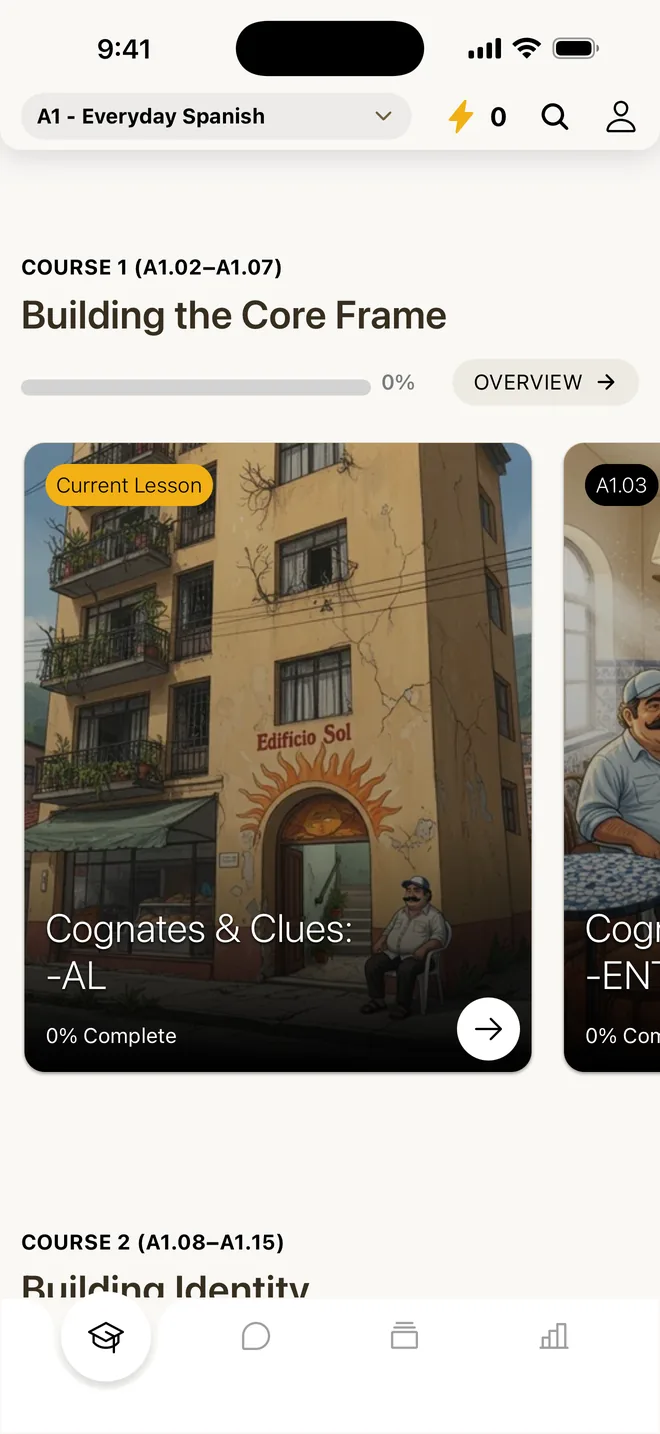
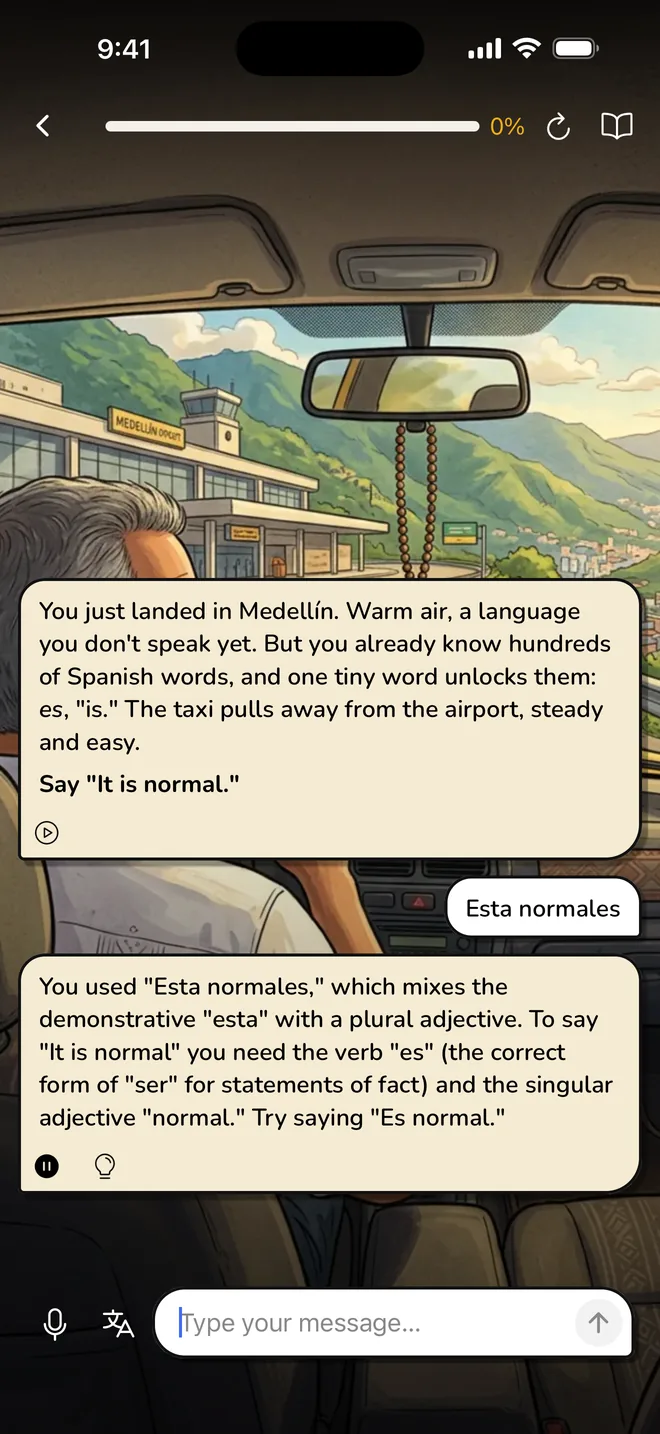
- Use something that grades what you say. In Avita, a character from the story talks to you, you answer out loud, and every answer gets a score, a natural corrected version and a short reason why. A lesson asks you to say about 49 things. It doesn’t score your pronunciation, so keep shadowing and recording for that.
- See a person now and then. A weekly language exchange or tutor session shows you where you are and gives you a deadline to practice toward. Solo practice makes that hour much more useful.
A 20-minute daily routine
If you want a plan, this one covers all of the above:
- 3 minutes: say yesterday’s sentences from memory.
- 5 minutes: shadow one short clip.
- 7 minutes: answer a prompt, or do one speaking lesson.
- 3 minutes: describe your day or narrate what you’re doing.
- 2 minutes: write down the gaps you hit.
Self-talk can also happen outside the 20 minutes, while you’re doing the dishes.
Mistakes that waste solo practice
- Practicing in your head. Silent rehearsal feels productive, but the gains come from saying it.
- Only reading aloud or shadowing. Both help, but you never build your own sentences.
- Stopping at single words. Say Sí, quiero ir (Yes, I want to go), not just sí.
- Recording and never listening.
- Waiting until you’re “ready” to talk to people. Solo practice is preparation. At some point, say something to a real person, even if it’s ordering a coffee. If that part scares you, read our guide on speaking anxiety.
Our take: Talking to your kitchen feels ridiculous at first, but it’s practice nobody has to schedule and nobody can cancel. Put most of your planning into the feedback side, because that’s where solo practice usually falls short.
Questions people ask
Can you learn to speak a language without a partner?
You can do most of the work alone. Speaking fluency comes from many repetitions of building sentences and saying them out loud, and you can do those repetitions anywhere. What you can't fully get alone is correction, so add feedback from recordings, an app that grades spoken answers or an occasional session with a person, and eventually use the language with real people.
Does talking to yourself help you learn a language?
Yes, as long as it's out loud and in full sentences. Narrating what you're doing makes you pull words and grammar from memory, and research on the production effect found that words said aloud are remembered better than words read silently. It's also where you practice talking around words you don't know, a skill every real conversation needs.
What is shadowing and does it work?
Shadowing is speaking along with a native recording a split second behind, copying its rhythm and intonation. Research, much of it by Yo Hamada in Japanese classrooms, mainly shows benefits for listening, especially for lower-level learners. It's a good warm-up for pronunciation and rhythm, but since you're repeating someone else's sentences, pair it with practice where you build your own.
How can I get feedback on my speaking without a tutor?
Record yourself and play it right after a native recording of similar sentences. Use phone dictation in the target language as a rough intelligibility check. Write down sentences you said and check the grammar against a reference. An app that grades spoken answers, like Avita, scores each sentence, shows a natural corrected version and explains why. Pronunciation still needs recordings or a person.
Is reading aloud the same as speaking practice?
Not quite. Reading aloud trains pronunciation and rhythm and helps memory, but the sentence is already built for you. Speaking means choosing the words and grammar yourself in real time. Use reading aloud and shadowing as warm-ups, then spend most of your time answering prompts, narrating and describing your day in your own words.
How long should I practice speaking alone each day?
Around twenty minutes a day is enough to make steady progress: a few minutes recalling yesterday's sentences, a short shadowing clip, a prompt or a speaking lesson, and a quick description of your day. Daily practice matters more than long sessions, because coming back to sentences after a gap is what keeps them.