
On this page
“Speaking practice” covers very different activities. Repeating Je voudrais un café after a recording is speaking practice. So is answering a question you didn’t see coming, and so is a 45-minute video call with someone in Rome. They train different things, and most apps are good at one or two of them. If you pick an app without knowing which kind you need, you can do a year of “speaking” and still freeze at the first real question.
So instead of ranking apps, this guide sorts them by the kind of speaking they make you do. It covers learners of Spanish, French, Italian and German, and English learners who speak Spanish or Italian. We make Avita, which sits in one of these groups, and we’ve said where the others do a better job. Competitor details were checked on each company’s own site, help center or app listing in October 2026.
The four kinds of speaking practice
| Kind | What you do | What it trains | Apps that do it |
|---|---|---|---|
| Repeat after me | Say a word or sentence you just heard | Pronunciation, mouth memory, early confidence | Pimsleur, Speak, Duolingo, Babbel |
| Guided conversation | Answer a character or prompt in your own sentence | Building sentences under light pressure | Avita, Speak, Babbel Speak, Busuu Conversations, Duolingo Video Call, Pimsleur Conversation Coach |
| Free conversation with a person | Talk to a real speaker about anything | Listening at real speed, handling the unexpected | italki, Preply, Tandem, HelloTalk, Busuu community |
| Output from day one | Produce sentences from the first lesson instead of waiting | The habit of speaking before you feel ready | Avita, Language Transfer, Pimsleur |
Most people need some of each, in roughly that order, with listening alongside. The useful question is which one you’re short on.
Repeat after me: for your mouth and your accent
This is the most familiar kind of speaking practice, and it’s still useful. You hear a native speaker, you say it back, and you get your mouth used to sounds English doesn’t have, like the French u in tu or the German ch in ich.
- Pimsleur is built around it. Its 30-minute audio lessons follow what it calls the principle of anticipation: the recording asks you for something, pauses for your answer, then plays the right one. Its Voice Coach gives pronunciation feedback. Pimsleur has courses in 50+ languages, including all four here.
- Speak has you repeat the phrase patterns locals use until they feel automatic, with real-time feedback on pronunciation. It teaches Spanish, French and Italian (plus Japanese, Korean and Mandarin) to English speakers. German isn’t on its list.
- Duolingo has speaking exercises from the first lesson where you repeat words and translate sentences aloud.
- Babbel uses speech recognition in its lessons for pronunciation.
Where it falls short: you’re saying someone else’s sentence. Getting Ich hätte gern ein Bier (I’d like a beer) perfect after a recording doesn’t mean you can produce it when a waiter in Berlin is looking at you. Use repetition for sounds, then move on.
Guided conversation: building your own sentences
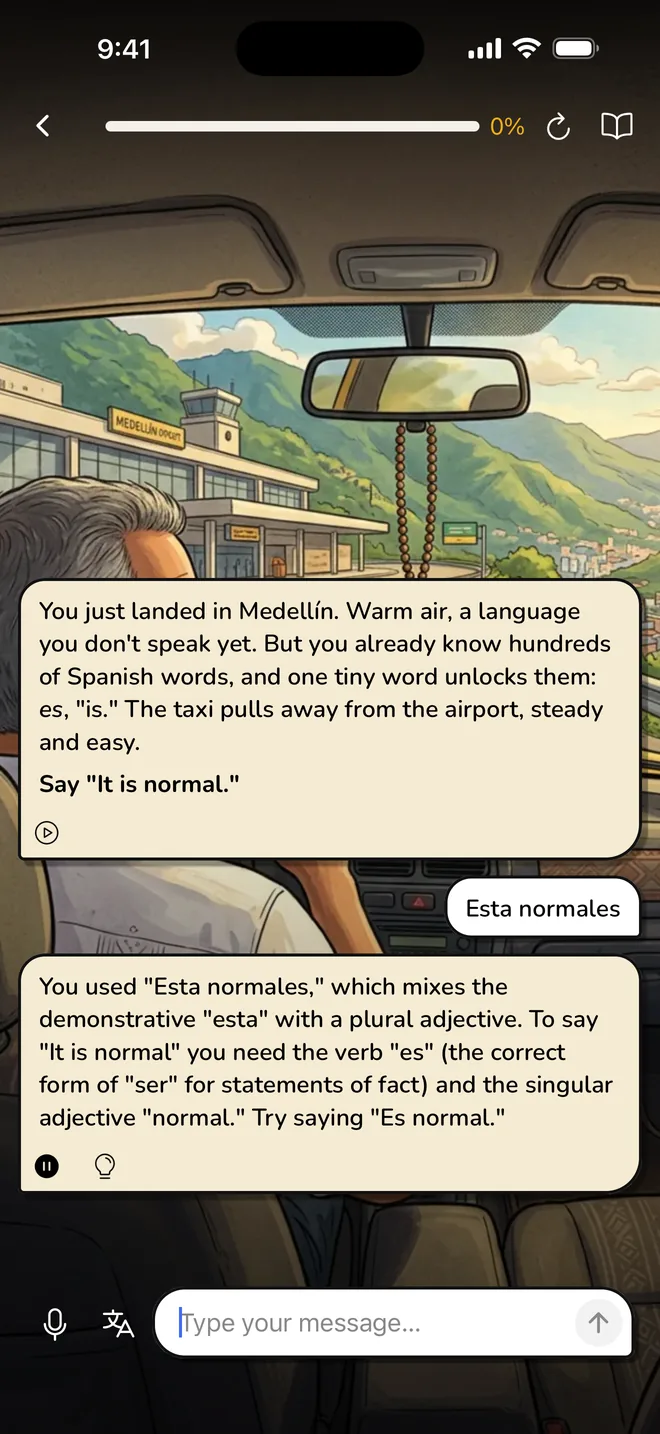
Here an app sets up a situation, someone says something to you, and you answer in your own sentence. The situation is controlled, so you’re never completely lost, but you have to do the work of building the sentence yourself. If you can repeat phrases but freeze when someone asks you something, this is probably what you’re missing, and it’s where we built Avita.
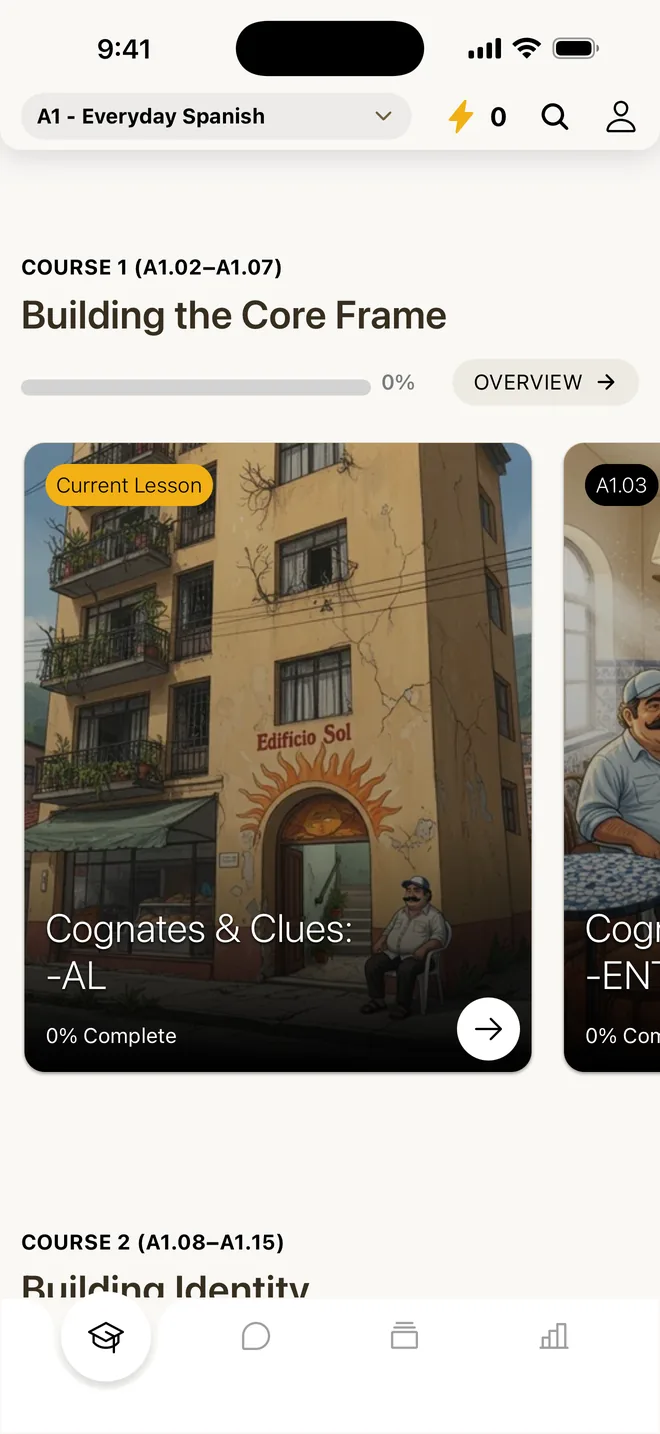
- Avita makes every lesson a guided conversation inside a story: an allotment garden colony in Berlin for German, a new life in Bologna for Italian, a new life in France for French, an apartment building in Medellín for Spanish, and Brooklyn for Spanish speakers learning English. You answer characters out loud in full sentences, about 49 times a lesson (about 60 in German). There’s no multiple choice or word bank. Every answer gets a score, a natural corrected version and a short reason. A short reading before each conversation teaches the grammar you’re about to use. Avita Pro adds role-play scenarios, like ordering at a café or getting a haircut, and open chat.
- Speak moves from drills into role-play conversations where you use the patterns you practiced. Its whole product runs on AI speech technology, across six languages.
- Babbel Speak is a newer tab in Babbel with guided scenarios that walk you step by step toward speaking in full sentences, in Spanish, French, German and Italian. Babbel calls it a beta and says it’s free for registered users for a limited time.
- Busuu Conversations is speak-only (there’s no written reply option), leveled A1 to C1, with feedback at the end. Busuu’s 2024 launch post lists its English, Spanish, German, Italian and French courses, though its current feature page names only English and Spanish, so check the app for your language. Free learners can try a few lessons; full access needs a paid plan.
- Duolingo Video Call is a short call with the character Lily, about a minute early in a course and up to three minutes later, according to Duolingo. It’s part of Duolingo Max, and Duolingo has listed it for learners of English, Spanish, French, German, Italian and Portuguese.
- Pimsleur Conversation Coach is in beta for All Access subscribers learning Latin American Spanish, French and Japanese, per its latest app release notes.
The thing to compare here is volume. Many apps now have a conversation feature somewhere; fewer make it the whole lesson. Ask how many sentences you’ll build in a typical session and whether each one gets corrected.
Where it falls short: a guided conversation is still a conversation with an app. It won’t teach you to follow a fast speaker who changes the subject. Avita also doesn’t score pronunciation, so pair it with something that does if your accent worries you.
Free conversation with a person: the real thing
Nothing in an app replaces talking to a person who doesn’t know what you’re going to say. There are two ways to get it.
Pay a tutor. italki and Preply are marketplaces of independent tutors in every language on this page. italki lists 20,000+ teachers in 150+ languages and works pay-as-you-go. Preply works by subscription to one tutor, billed every 28 days. As of October 2026, italki’s Spanish page puts tutors at $4 to $60 an hour. We compared the two approaches in detail in Avita vs a tutor.
Trade with another learner. Tandem and HelloTalk match you with native speakers who want to learn your language. On Tandem you can text, send voice notes, or call by audio or video; it reviews each new member’s application. HelloTalk offers text, voice and video chats plus live Voice Rooms. Both are free to start. Your partner isn’t a teacher, though, and half the time is theirs.
Get recordings corrected. Busuu lets you record a spoken answer (up to 30 seconds) and have native or fluent speakers in its community correct it. It’s slower than a live call, but less nerve-racking.
Where it falls short: people cost money or time and they’re not always available, and if you freeze in front of others, early sessions can go mostly to the freeze. Our speaking anxiety guide has ways around that.
Output from day one: the habit
This one is about timing. Some methods ask you to listen for hundreds of hours before you speak. Dreaming Spanish (and Dreaming French), a large library of comprehensible-input video, recommends starting to speak at level 6 of its roadmap. It’s excellent for listening.
Other methods have you speaking from the first minute. The linguist Merrill Swain argued in 1985 that understanding input isn’t enough on its own: trying to say something is how you notice what you can’t yet say. That’s the case for speaking early, and it’s the approach we take. We go deeper on it in why speaking early works.
- Avita starts with full spoken sentences in lesson one, after a short reading.
- Language Transfer is a free, donation-funded audio course. A teacher works through the language with a recorded student, and you pause, think and answer out loud before the student does. It has a complete Spanish course, an unfinished complete German course, and introductions to French and Italian.
- Pimsleur asks you to answer aloud from the first lesson.
Where it falls short: speaking early without enough listening can leave you able to talk but not to follow the reply. Add listening, whichever method you choose.
By language
| Spanish | French | Italian | German | English (for Spanish or Italian speakers) | |
|---|---|---|---|---|---|
| Avita | Yes | Yes | Yes | Yes | Yes |
| Speak | Yes | Yes | Yes | Not listed | Check the app |
| Pimsleur | Yes | Yes | Yes | Yes | Check the app |
| Babbel and Babbel Speak | Yes | Yes | Yes | Yes | Check the app |
| Busuu Conversations | Yes | Check the app | Check the app | Check the app | Yes (Spanish speakers) |
| Duolingo Video Call (Max) | Yes | Yes | Yes | Yes | Check the app |
| Language Transfer | Complete | Intro | Intro | Complete (unfinished) | Launching (Spanish speakers) |
| italki, Preply, Tandem, HelloTalk | Yes | Yes | Yes | Yes | Yes |
“Check the app” means the company’s own pages didn’t confirm it, or contradicted each other.
How to put it together
If you’re starting from zero and need to speak within a few months, here’s how we’d split the week:
- Every day: one guided-conversation lesson where you build your own sentences. On Avita that’s about 49 spoken answers, corrected.
- A few times a week: 10 minutes of repeat-after-me on sounds that give you trouble, or Pimsleur on your commute.
- Once a week, from the first month if you can stand it: a tutor or an exchange partner.
- Whenever you can: listening you can mostly follow.
Our take: Repeating phrases trains your mouth, and talking to people trains you for the unexpected. The step in between, building your own sentences many times a day and getting each one corrected, is the easiest one to skip, and it’s the one we built Avita for: every lesson is a conversation, about 49 spoken answers each, in Spanish, French, Italian, German or English. Use Pimsleur or Speak for your accent, and get to a real person as soon as you can.
The first five lessons of every level are free, and you can start without an account. If you’re not sure where you are, our guide to practicing speaking alone is a good next read.
Questions people ask
Which language app makes you speak the most?
Count how many sentences you build and say out loud in a normal session. An Avita lesson asks for about 49 (about 60 in German), each in full sentences with a correction. We haven't found comparable published counts for other apps, so try a lesson or two of any app you're considering and count. Live tutors get you speaking most freely, but only for the sessions you book.
Is there an app to practice speaking French, Italian or German?
Yes. Avita has full courses in all three for English speakers, A1 to B2. Babbel Speak and Pimsleur cover all three, and Speak teaches French and Italian but not German. Busuu's pages disagree on which courses have Conversations, so check the app. For live conversation, italki, Preply, Tandem and HelloTalk all have speakers of each.
Are language exchange apps like Tandem and HelloTalk good for speaking practice?
They're a free way to talk with native speakers by text, voice notes, or audio and video calls. The trade-off is that your partner isn't a teacher, half the time goes to their language, and conversations depend on finding someone reliable. They work best once you can already build basic sentences, so you aren't spending every exchange searching for words.
Should I start speaking right away or listen first?
There are two camps. Input-first programs like Dreaming Spanish recommend lots of listening before you speak; its FAQ suggests starting at level 6 of its roadmap. Output-first courses like Avita and Language Transfer have you speaking from the first lesson, in line with Merrill Swain's 1985 argument that producing language helps you notice gaps. Either way, you need both listening and speaking.
Do I need a tutor if I use a speaking app?
You don't need one to make progress, but you should talk to real people eventually, and a tutor is the easiest way to arrange that. A speaking app gives you daily volume; a tutor gives you unscripted conversation and accent feedback. A tutor or exchange partner once a week, on top of daily app practice, covers both.