
On this page
If you need to speak a language soon, the obvious move is to pay someone to talk to you. That’s what a tutor on italki or Preply is: a real speaker on a video call who answers back, follows your interests and hears the mistakes you didn’t know you were making. We think everyone learning to speak should talk to real people as early as they can stand it. This page answers a narrower question: if you have a limited number of hours and dollars, where should your speaking practice go?
We built Avita, so read this knowing that. We’ve also tried to be specific about where a tutor wins, because in several places one does.
What italki and Preply are
Both are marketplaces of independent tutors: you pick one, book a time and meet on video.
italki says it has 20,000+ teachers across 150+ languages, and its Spanish page lists more than 2,300 Spanish tutors. Teachers set their own prices and you pay as you go, with no subscription. Tutors come in two kinds: professional teachers, who have teaching credentials, and community tutors, who are native or fluent speakers without formal training. You can book a trial lesson with up to three tutors (one each) before committing. italki suggests 30- or 45-minute lessons and lets you book up to 90. As of October 2026, its Spanish page says Spanish tutors cost between $4 and $60 per hour.
Preply says it has 100,000+ tutors across 120+ subjects, and its Spanish page lists over 15,000 Spanish tutors. You start with a 25- or 50-minute trial. If you stay, you subscribe to that one tutor and get charged every 28 days for a set number of lessons, with a minimum of four per cycle. Preply’s help center says lessons you haven’t scheduled by the renewal date expire. You can cancel a lesson for free up to 12 hours before it starts, and if a trial doesn’t work out, Preply lets you switch tutors or ask for a refund. As of October 2026, the price filter on its Spanish tutor page runs from $3 to over $50 a lesson.
A local class works the same way with more people in the room and a fixed timetable.
At a glance
| A tutor (italki, Preply) | Avita | |
|---|---|---|
| How you answer | Out loud, in live conversation | Out loud, in full sentences, to characters in a story |
| How much you speak | Depends on the tutor, your level and how many sessions you book | About 49 things to say out loud per lesson (German about 60) |
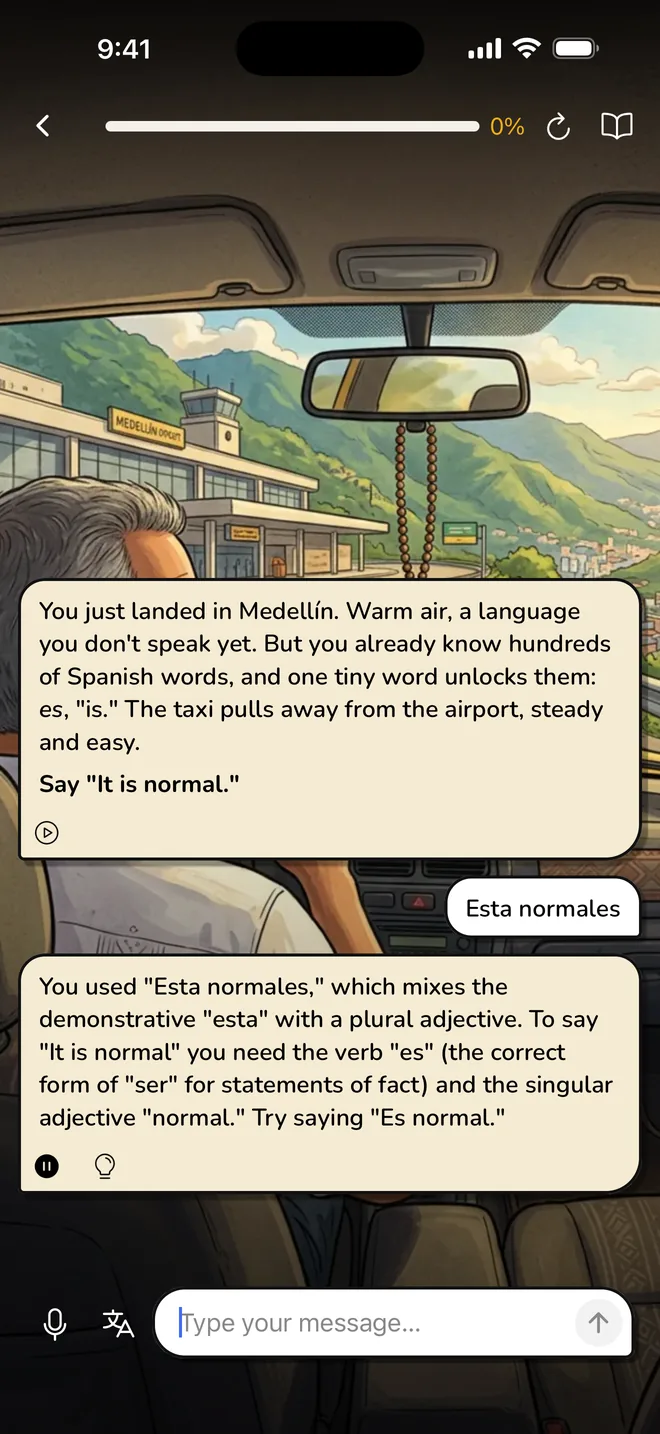
| Feedback on each answer | Whatever the tutor catches and chooses to correct | Every answer scored, with a corrected version and a short reason |
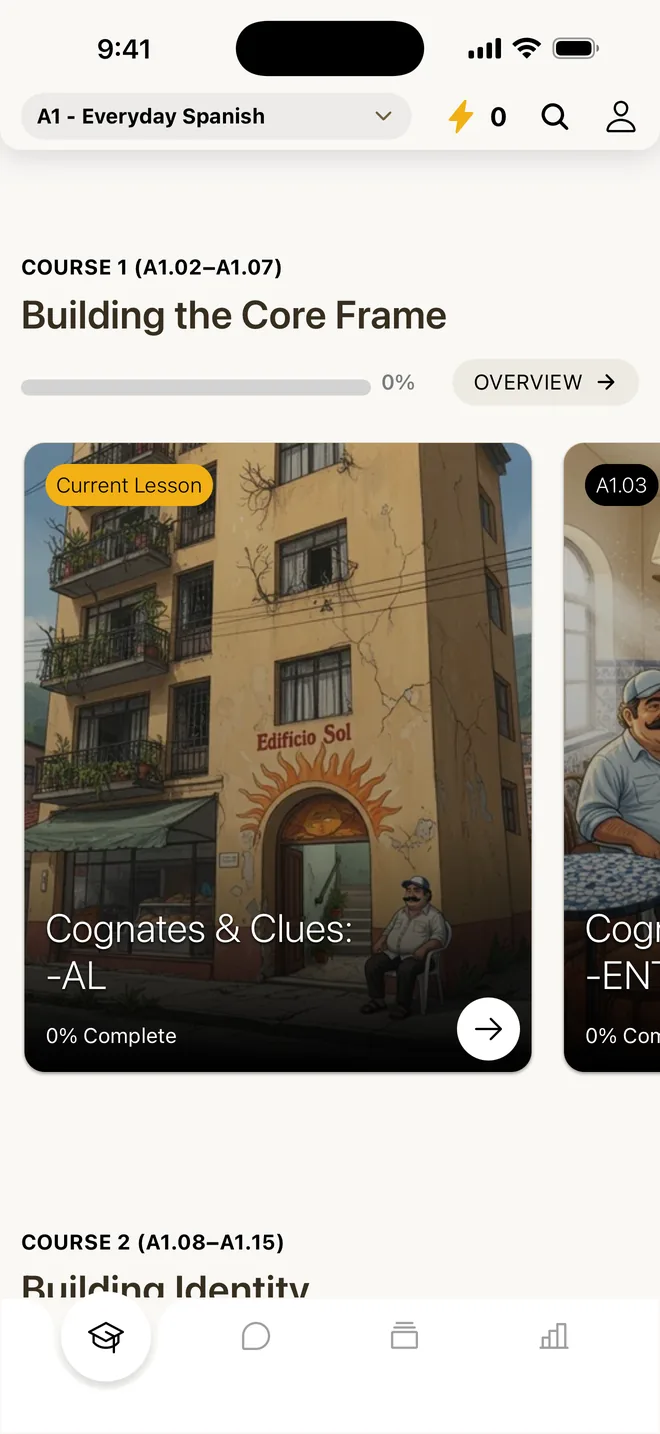
| Structure | The tutor’s plan, or yours | 200+ lessons per course, A1 to B2, one continuing story |
| Grammar teaching | Varies by tutor | A short reading before each conversation |
| Languages | Over 150 on italki | Spanish, French, Italian, German; English for Spanish and Italian speakers |
| When | Booked time slots | Any time, no booking |
| Cost model | Per lesson, set by each tutor | Flat subscription (monthly, yearly or lifetime) |
| Free option | Trial lessons (paid, often discounted) | First 5 lessons of every level free; 3 days of full access with a free account |
| Best for | Real, unscripted conversation | Daily speaking reps |
How a session feels in each
A good tutor session feels like coffee with a patient friend who happens to know grammar. They ask about your week. You stumble through it. They wait, rephrase, laugh at the right moment, and when you ask ¿Sabes a mi hermana? (meaning “Do you know my sister?”), they stop and explain that you saber facts but conocer people: ¿Conoces a mi hermana? Nothing in an app reproduces that. You’re listening to a real voice at real speed and deciding what to say with nothing on the screen to lean on.
The other side is that tutors vary a lot. Some talk for half the lesson. Some correct everything and some correct nothing. At the very beginning, a fair amount of paid time can go to the tutor explaining things a short reading could have covered. Finding the right person can take a few tries, which is what the trial lessons are for.
An Avita lesson is smaller and more predictable. In one early Spanish lesson, your neighbor Lina has left her notebook at your place. A short reading first shows you that Spanish uses estar for where someone is, and Listen reads it aloud with each word highlighted. Then the conversation starts. Lina texts Estoy en la universidad (I’m at the university) and you tell her Estoy en casa (I’m at home). Mateo asks ¿Estás en casa? (Are you home?) and you answer Sí, estoy en casa. Later he holds out an empanada and asks ¿Tienes hambre? (Are you hungry?), and you tell him No tengo tiempo (I don’t have time).
You say every one of those lines out loud. Each gets a score, a natural corrected version and a one-line reason. If you’re stuck you can ask for a hint or a translation, and if you’re on a quiet train you can type. Nobody is on the other end waiting for you.
Speaking practice compared
The tutor’s speaking is harder, in a good way. You choose your own words, you have to understand someone who isn’t reading from a script, and conversations go places neither of you planned. That kind of practice is what you’re ultimately training for.
The difference is volume and frequency. An Avita lesson asks you to say about 49 things out loud, and a full course adds up to roughly 10,000 spoken answers (German about 12,000). A tutor session has no fixed count; it depends on how much the tutor talks, how much explaining you need, and how many sessions you can afford. Every extra session is another lesson fee and another slot in your calendar, so your budget and schedule set the limit.
The linguist Merrill Swain argued in 1985 that learners need to produce language, not only understand it, partly because trying to say something is how you notice the gap between what you want to say and what you can say. Both options give you that. Avita gives you a smaller version of it every day for a flat price; a tutor gives you a richer version as often as you can book and pay for.
Nerves matter too. Plenty of people understand far more than they can say, and freeze the moment a real person is waiting. If that’s you, an hour on camera can go to the freeze instead of the practice. Avita has no audience, so the only pause is your own thinking time. We wrote more about this in our guide to speaking anxiety.
Feedback compared
A tutor can explain anything. They hear your accent, they can tell what you meant even when you said it wrong, and they can give you the cultural context a correction misses. Live conversation also forces a trade-off, though: if a tutor stops you for every slip, you never get a full sentence out, so many let small errors pass to keep you talking. Unless they type corrections into the chat, a lot of it is gone by the next morning.
Avita corrects every answer, every time, with the natural version and a short reason. You can see exactly where el should have been la. What it doesn’t do is score your pronunciation. If your accent is the thing holding you back, a tutor’s ear is better for that.
Who should pick a tutor
- You want unscripted conversation with a real person, especially for a job interview, an exam or a hard conversation you can see coming.
- You want detailed pronunciation and accent coaching. Avita doesn’t score pronunciation.
- You’re learning a language Avita doesn’t teach. italki lists over 150.
- You’re past B2 and want to go further. Avita’s courses run from A1 to B2.
- You need specialized vocabulary, like medical or legal Spanish, that a tutor can build lessons around.
- A booked slot with a person who expects you is what keeps you showing up.
Who should pick Avita
- You need a lot of speaking reps and can’t afford a tutor every day.
- Your schedule is unpredictable and your practice time comes in 10- or 15-minute pieces.
- You freeze when someone is watching and want to get the first few hundred sentences out in private.
- You’re a beginner and don’t want to pay by the hour to learn how estar works.
- You understand the language but can’t get words out, which is common for heritage speakers. Our guide on understanding but not speaking goes into this.
Avita Pro also adds role-play scenarios (ordering at a café, a problem with your hotel room, getting a haircut) and open chat about anything. That’s closer to tutor-style conversation, but it’s still you and the app, not a person.
Using both together
This is what we’d recommend to anyone who can afford a tutor. The two cover each other’s gaps.
- Do an Avita lesson every day. That’s about 49 spoken answers, each one corrected.
- See a tutor once or twice a week. Use the time for what only a person can do: open conversation, questions you’ve been saving, and pronunciation.
- Bring the week’s material to the session. If your lessons were about getting around a new neighborhood, ask your tutor to have that conversation with you without a script. You’ll find out quickly which phrases you own and which only work when the app sets them up.
- Turn the tutor’s corrections into reps. Describe the topic of your last session in Avita’s flashcards to get a custom deck, so the words you missed come back a few days later.
The tutor tests what the app taught you, and the app makes the tutor’s hour go further, because you aren’t spending it on basics.
Our take: If you can only pick one and your goal is to talk to people, a good tutor is the most human option and the one we’d want for real conversation and accent work. But most people can’t afford a tutor every day, and we think speaking improves fastest with daily volume. Avita gives you about 49 spoken, corrected answers per lesson, any time, for a flat price. What we’d recommend is both: Avita daily, a tutor weekly.
If you want to see what a lesson asks you to say before deciding, the first five lessons of every level are free, and you don’t need an account to start. You can also read the lessons in our free lesson library.
Questions people ask
Is a language app as good as a tutor for speaking practice?
They train different things. A tutor gives you unscripted conversation with a real person, and nothing else matches that. An app like Avita gives you many more sentences per week: about 49 spoken, corrected answers per lesson, whenever you have a few minutes. If your goal is conversation, we'd do daily app practice and see a tutor regularly, rather than choosing one.
How much does an online language tutor cost?
Tutors set their own rates on both big marketplaces. As of October 2026, italki's Spanish page says Spanish tutors cost between $4 and $60 per hour, and the price filter on Preply's Spanish tutor page runs from $3 to over $50 per lesson. Trial lessons are often cheaper. italki is pay as you go; Preply bills a subscription with one tutor every 28 days.
italki or Preply: which is better for speaking practice?
Both give you live video lessons with independent tutors, so your speaking practice depends mostly on the tutor you choose. The bigger difference is how you pay. italki is pay as you go with no subscription. Preply is a subscription with one tutor, charged every 28 days with at least four lessons per cycle, and its help center says unscheduled lessons expire at renewal. With an irregular schedule, pay as you go is easier.
How often should I see a tutor if I also use an app?
We'd aim for once or twice a week, with an app lesson on the other days. Use tutor time for what only a person can do: open conversation, the questions you've been saving up, and pronunciation. Bring the topics from your app lessons into the session and try them without a script. You'll quickly find out which phrases you can use on your own.
Can Avita replace a tutor?
Not completely. Avita has no human teachers and doesn't score pronunciation. What it can take over is the part of tutor time that goes to basic reps: building simple sentences, getting them corrected and building them again. Avita Pro adds role-play scenarios and open chat for freer practice, but talking with real people is still where all of this is headed.
Does Avita have live classes or human teachers?
No. Avita is an app for iPhone and Android where you speak with characters in a story, and the app grades and corrects every answer. There are no live classes, no human teachers and no desktop version. If you want a person to talk to as well, a tutor on italki or Preply pairs well with it.