On this page
You know the words. You practiced them on the walk over. Then the person behind the counter looks at you, and the sentence you had ready is gone. If that happens to you, you have a lot of company, and researchers have been studying it for decades.
What is foreign language anxiety?
In 1986, Elaine Horwitz, Michael Horwitz and Joann Cope published “Foreign Language Classroom Anxiety” in The Modern Language Journal. Counselors at the University of Texas had been seeing students who were capable in their other classes and fell apart in language class. The students described freezing when called on, going blank before tests, and standing outside the classroom door trying to work up the courage to walk in. When the university offered a support group to 225 beginning language students, 78 of them asked to join.
The authors compared this anxiety to three familiar ones:
- Communication apprehension: the fear of talking to people at all, made worse when you’re doing it in a language you only half control.
- Test anxiety: language classes evaluate you constantly, and every answer can feel like an exam.
- Fear of negative evaluation: worrying about what the teacher, the other students or the person in front of you thinks.
They argued it was more than those three added together. As adults, we’re used to being reasonably smart and socially capable. In a new language we can only present a smaller, simpler version of ourselves, and that gap between who we are and who we can sound like is uncomfortable in a way that math anxiety isn’t.
The paper also noted the reverse: some people who are shy in their own language find a new one freeing, as if someone else were doing the talking. If that’s you, use it.
How common is it?
The paper introduced the Foreign Language Classroom Anxiety Scale (FLCAS), a 33-item questionnaire that researchers still use widely. In the first group the authors reported, 75 students in introductory Spanish classes:
- 49% agreed that they start to panic when they have to speak without preparation.
- 65% disagreed with “I don’t worry about making mistakes in language class.”
- 33% said they get nervous and confused when speaking in class.
Across the whole questionnaire, 19 of the 33 anxious statements were endorsed by at least a third of the students, and seven by more than half. These were ordinary beginners in an ordinary Spanish class.
Many studies since have used the scale or others like it. A 2019 meta-analysis by Yasser Teimouri, Julia Goetze and Luke Plonsky pooled 105 samples covering 19,933 learners in 23 countries and found an average correlation of r = −.36 between language anxiety and achievement. That’s a moderate link: more anxious learners tended to do worse. It’s a correlation, so it runs both ways. Anxiety can hurt your performance, and struggling can make you more anxious.
Why speaking is the scary part
The most useful detail in the 1986 paper is easy to miss. Students told counselors they felt fairly comfortable answering drills or giving a speech they had prepared. They froze in role-plays. They also said they “knew” a grammar point and then “forgot” it during an oral exercise, when many things had to be remembered at once.
So the freeze isn’t random. It shows up when you have to build a sentence from scratch, in real time, while someone is judging it. Two things make that easier:
- The sentence has been built before. If you’ve said ¿Me puede dar un café, por favor? (Can I have a coffee, please?) out loud fifty times, saying it at the counter is a retrieval, not a construction project.
- The stakes are low while you build it. Making mistakes alone, with nobody watching, costs nothing.
The authors also flagged a belief that makes everything worse: that you shouldn’t say anything until you can say it correctly. Every speaker makes mistakes and forgets words, including good ones. Waiting for correct means waiting forever.
Why low-stakes repetition helps
Each piece of the research points the same way.
Prepared speech felt manageable to the anxious students in the 1986 paper. Repetition turns more of the language into prepared speech, until the role-play is mostly made of sentences you’ve said before.
Pulling something out of memory makes it easier to pull out next time. Memory researchers call this retrieval practice; in Karpicke and Roediger’s 2008 study in Science, students who kept recalling Swahili vocabulary remembered about 80% a week later, against about a third for students who stopped testing themselves once they’d got a word right. Speaking an answer is a retrieval. Rereading it isn’t.
Horwitz and her co-authors suggested that severe language anxiety could be treated like other specific anxieties, with systematic desensitization: gradual, repeated exposure to the thing you fear, starting with the easiest version.
Using the language goes with feeling calmer in it. In a 2008 study of 464 multilingual adults in Language Learning, Jean-Marc Dewaele, K. V. Petrides and Adrian Furnham found that people who used a language more often, felt more proficient in it and had more people to speak it with reported less anxiety in it. Learners taught only in a classroom reported more anxiety than those who also used the language outside class. That’s correlational too, but it fits everything above.
Practical steps you can start today
- Drop the “only when it’s correct” rule. Decide in advance that you’ll make mistakes and that each one counts as practice.
- Practice out loud, alone, every day. Full sentences, at normal volume. Thinking a sentence and saying it are different skills, and only one of them gets you through the bakery.
- Script the conversations you have over and over. Introducing yourself, ordering, asking for directions, explaining that you’re learning. Say each script until it’s boring.
- Learn your rescue lines first. Disculpe, ¿puede hablar más despacio? (Excuse me, can you speak more slowly?). No sé cómo se dice… (I don’t know how to say…). Recién empiezo con el español (I’m just starting out with Spanish). Most people slow down when they hear them, and knowing you have a way out lowers the stakes of every conversation.
- Climb a ladder. Alone, out loud. Then with one patient person: a teacher, an exchange partner, a friend who speaks the language. Then a short transaction with a stranger, like buying bread. Then a longer conversation. Move up a step when the current one feels dull.
- Count attempts, not errors. “I spoke Spanish to three people this week” is the number worth tracking.
- Slow down. Horwitz and her colleagues recommended relaxation techniques for anxious students. A slow breath before you speak and a slower pace while you speak cost nothing and give your memory a moment to catch up.
Practicing privately before you speak to people
Step 2 is the hard one to do consistently. Talking to yourself in an empty room feels odd, and nobody tells you whether what you said was right.
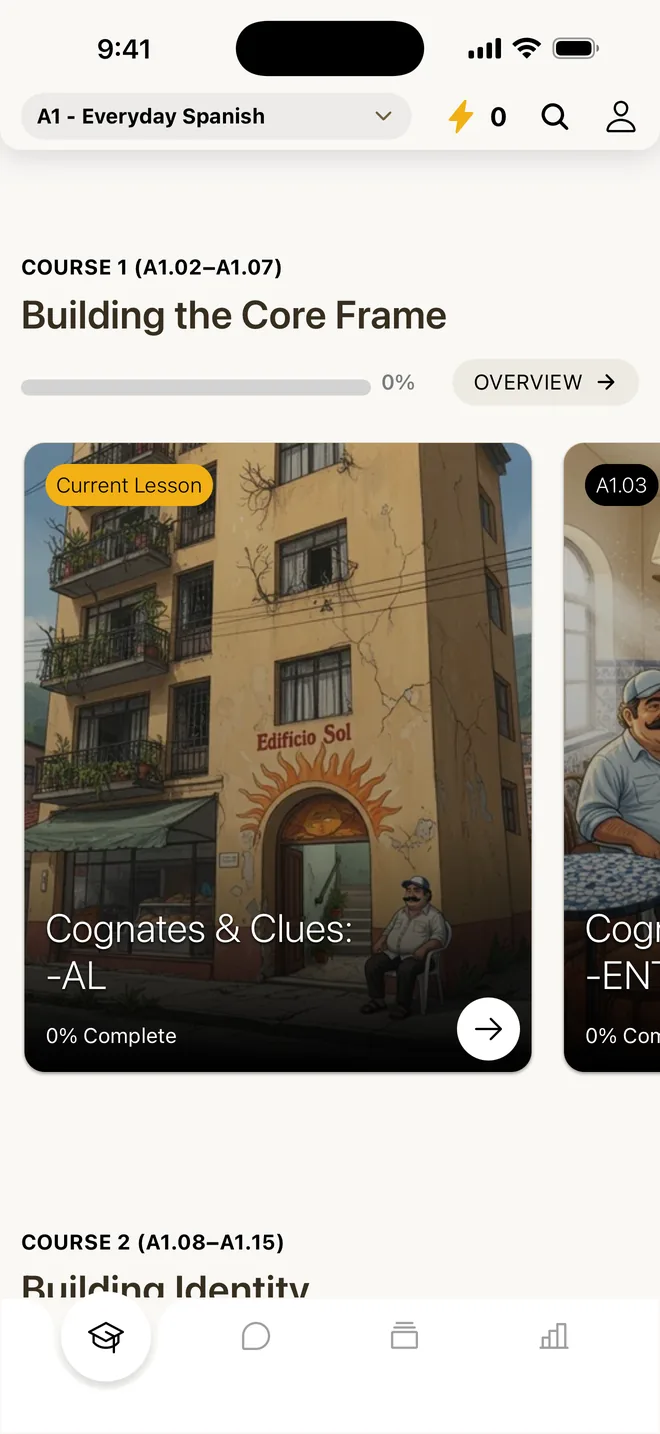
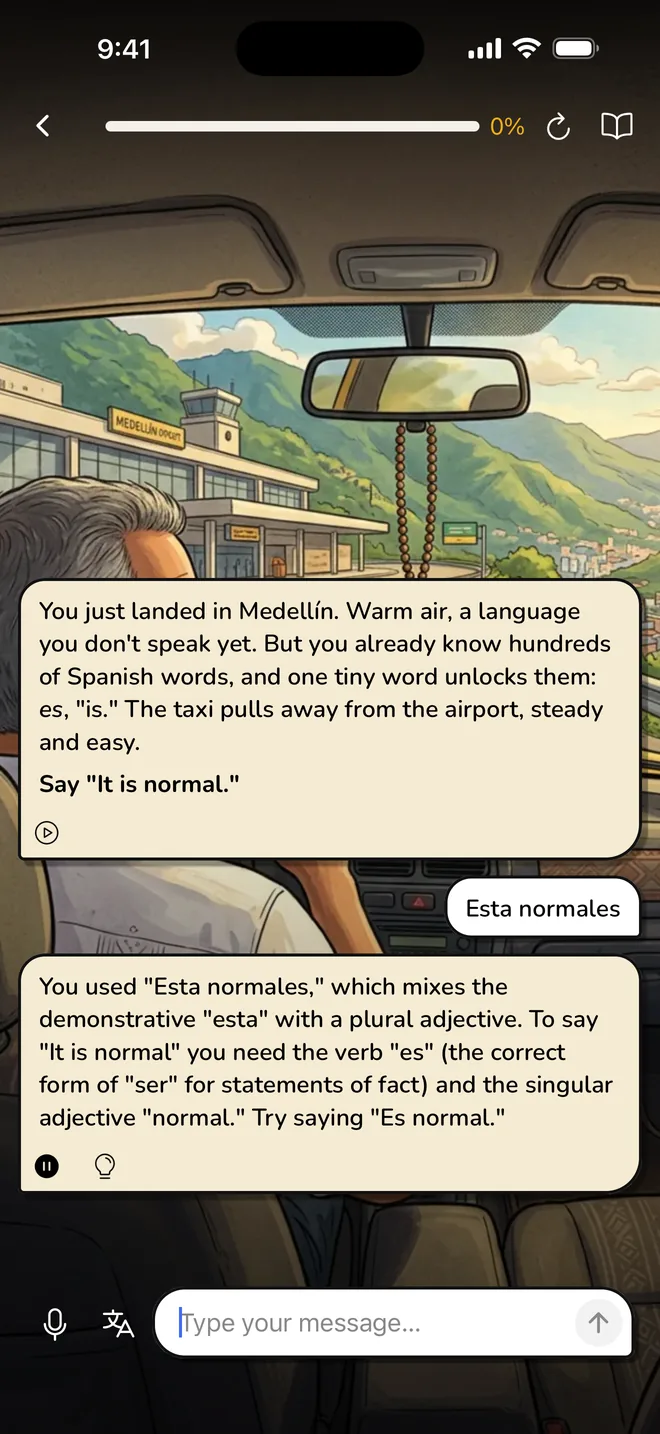
That’s the gap we built Avita for. In an Avita lesson, a character from the story talks to you and you answer out loud: about 49 times a lesson (about 60 in German), every answer a full sentence. Each one gets a score, a natural corrected version and a short reason why, and nobody else hears it. If you’re stuck you can ask for a hint or a translation, and if you can’t talk where you are, you can type.
Think of it as a rehearsal room. The goal is still a conversation with a person. Other ways to rehearse work too: reading dialogues aloud, describing what you’re doing as you cook, or a patient teacher (we compared the options in Avita vs tutors and in our guide to practicing speaking alone).
When it’s more than nerves
The 1986 paper was careful on this point: language teachers don’t have the time or training for severe anxiety, and students with strong reactions should probably be referred to counselors. If the fear stops you from going to class, from making calls or from leaving the house in a new country, bring it to a counselor or therapist. The authors noted that therapists had already treated other learning-related anxieties successfully with behavioral techniques.
Our take: Speaking anxiety eases when the sentences you need have been said many times before, somewhere that mistakes cost nothing. Rehearse privately and out loud every day, learn your rescue lines, and move up to people one small step at a time.
Questions people ask
Is it normal to be afraid of speaking a foreign language?
Yes. When the University of Texas offered a support group to 225 beginning language students, 78 asked to join. In Horwitz and colleagues' 1986 survey of introductory Spanish students, 49% said they panic when they have to speak without preparation. Researchers treat foreign language anxiety as its own specific anxiety, separate from general nervousness.
Why can I understand a language but freeze when I speak?
Understanding only needs you to get the meaning. Speaking means building the sentence on the spot, with the right words and grammar, while someone waits. Anxious students in the 1986 Horwitz study felt fairly comfortable with drills and prepared speeches but froze in role-plays. The fix is to turn more of your sentences into prepared ones by repeating them out loud.
Does speaking anxiety go away?
It tends to ease with use. A 2008 study of 464 multilingual adults found that people who used a language more often, felt more proficient in it and had more people to speak it with reported less anxiety in it. That's a correlation, but it matches what helps in practice: frequent, low-stakes speaking that moves step by step toward conversations with people.
What is the FLCAS?
The Foreign Language Classroom Anxiety Scale is a 33-item questionnaire introduced by Elaine Horwitz, Michael Horwitz and Joann Cope in 1986. Learners rate statements such as starting to panic when speaking without preparation, from strongly agree to strongly disagree. Researchers still use it widely; a 2019 meta-analysis found a moderate negative link (r = -.36) between language anxiety and achievement.
How can I practice speaking without feeling embarrassed?
Start alone and out loud. Say full sentences at normal volume, rehearse the conversations you have most often, and learn a few rescue lines like "¿Puede hablar más despacio?" (Can you speak more slowly?). Speaking apps such as Avita let you answer a story character out loud and see each answer corrected privately. Then move to one patient person before strangers.