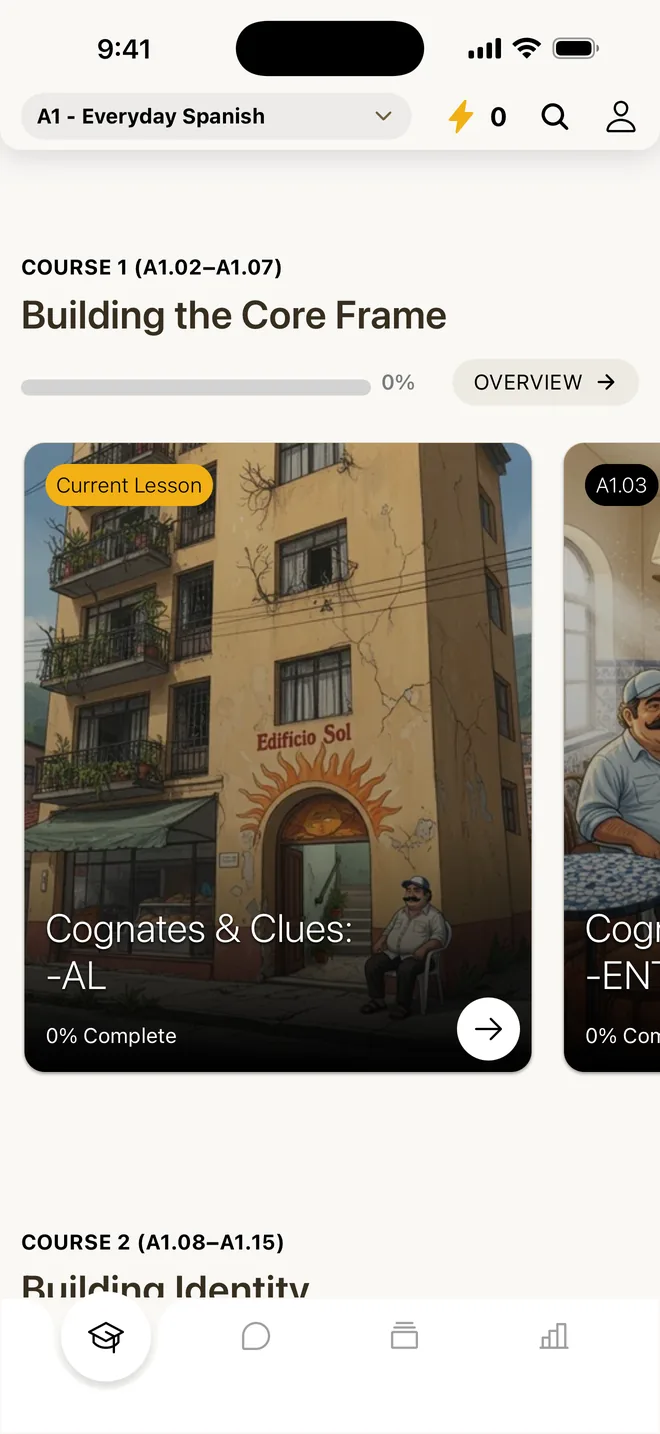
Most apps teach you to recognize a language. Avita gets you saying it.
Avita is a language-learning app for iPhone and Android where every lesson is a spoken conversation inside a story: you answer out loud in full sentences, and every answer is graded and corrected. Here's how that compares with the apps you've probably tried, and when one of them is the better pick.
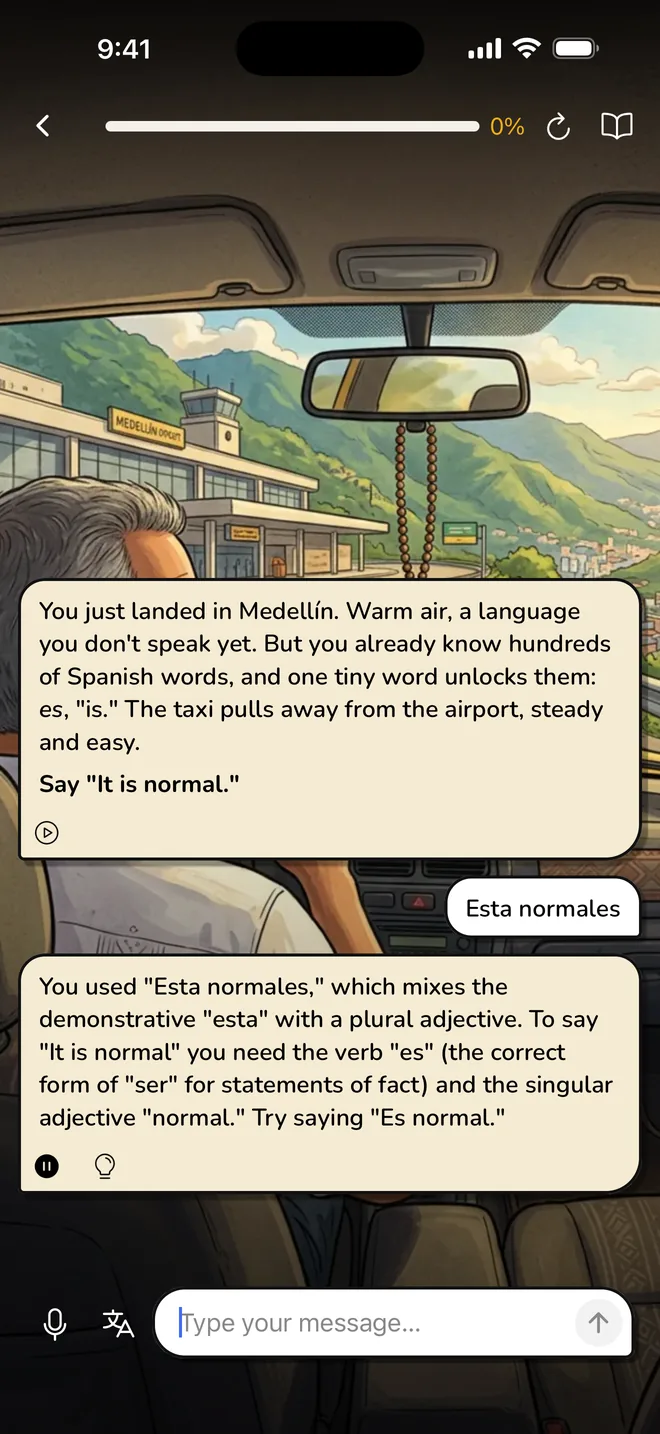

| Aspect | Avita | A typical tap-based app |
|---|---|---|
| How you answer | Out loud, in full sentences | Mostly tapping, matching and choosing |
| Speaking per lesson | About 49 things to say out loud | A handful of speaking exercises, often repeat-after-me |
| Feedback | A score, a corrected version and a reason, every answer | Right or wrong per exercise |
| Structure | A story with recurring characters, A1 to B2 | Units of exercises |
| Grammar | A short reading before every conversation | Often learned by pattern |
Head to head
Avita vs Duolingo: which gets you speaking? (2026)
If your goal is to hold a conversation, Avita is built for it: every lesson has you say about 49 things out loud, each a full sentence that gets a score, a corrected version and a reason.
Avita vs Babbel: which gets you speaking? (2026)
Babbel is a broad, well-built course in 13 languages where speaking is one exercise type among several, mostly repeating a word or phrase you just heard, plus a beta conversation feature called Babbel Speak.
Avita vs Speak: which speaking app fits you? (2026)
Speak and Avita both have you speak out loud from the first lesson, so the right pick depends on your language and what you want corrected.
Avita vs Pimsleur: which gets you speaking? (2026)
Pimsleur and Avita both make you answer out loud, but Pimsleur is a 30-minute audio course you can do hands-free, while Avita has you read a short grammar text and then hold a conversation in which every answer is graded.
Avita vs Rosetta Stone: which gets you speaking? (2026)
Rosetta Stone teaches 25 languages through pictures and audio with no translation, and its speaking practice is mostly saying words and phrases from the screen while TruAccent scores your pronunciation; its newer Chat Missions conversations are typed, in a web browser.
Avita vs Busuu: which is better for speaking? (2026)
Busuu is a complete course in 14 languages with real native speakers correcting your writing and recordings, plus certificates; Avita is built for people who need to speak, with about 49 spoken answers in every lesson, each a full sentence that's graded and corrected right away.
Avita vs a tutor (italki, Preply): which gets you speaking?
A tutor on italki or Preply gives you what no app can: unscripted conversation with a real person who adapts to you, paid per lesson at times you book.
The best apps for speaking
Best apps to practice speaking Spanish (2026): a fair roundup
To practice speaking Spanish, pick an app where you build your own sentences out loud and get feedback on each one.
Duolingo alternatives for speaking: 7 options compared (2026)
If Duolingo hasn't gotten you talking, pick the alternative that matches your situation: Avita if you need to hold conversations in Spanish, French, Italian or German soon (about 49 spoken answers per lesson, each graded and corrected), Speak for Japanese, Korean or Mandarin, Pimsleur or the free Language Transfer for learning by ear, Busuu or Babbel for a full structured course, and italki when you want a real teacher.
Best language apps for speaking practice, by type (2026)
Language apps that make you speak fall into four groups: repeat-after-me (Pimsleur, Speak), guided conversation where you build your own sentences (Avita, plus newer features in Speak, Babbel, Busuu and Duolingo), free conversation with a real person (italki, Preply, Tandem, HelloTalk) and courses that have you speaking from day one (Avita, Language Transfer).
Every comparison says when the other app is the better choice, and every fact about another app carries the date we checked it. Questions about languages, levels and price are on the FAQ; practical help is in the guides.