
On this page
- The short version
- Where Duolingo falls short for speaking
- Avita: a spoken conversation in every lesson
- Speak: phrases first, then conversation
- Pimsleur: audio lessons you answer out loud
- Babbel: a structured course with conversation scenarios
- Busuu: a course with native-speaker corrections
- italki: real teachers, booked by the lesson
- Language Transfer: free audio that makes you think
- How to choose
- Mixing them
Duolingo is a good app for a daily habit and a growing vocabulary. Where people get stuck is the step after: someone asks you a question in Spanish and nothing comes out. Ethan and I hit that wall in Buenos Aires, which is why we ended up building Avita. Below are the apps and services we’d send a friend to if speaking is the goal, what you actually do in each, and who each one suits. We make one of them, so for each app we’ve noted who it suits better than Avita.
The short version
| How you speak | Feedback on what you say | Languages | Free option | Best for | |
|---|---|---|---|---|---|
| Avita | Answer a story’s characters out loud, about 49 times a lesson | Score, corrected version and reason on every answer | 6 courses (Spanish, French, Italian, German, English) | First 5 lessons of every level, 3-day trial | Holding a conversation soon |
| Speak | Repeat phrases, then talk it through in a conversation | Pronunciation and phrasing, in real time | 6 (incl. Japanese, Korean, Mandarin) | 7-day trial | Speaking practice in Asian languages, pronunciation |
| Pimsleur | Answer audio prompts in the pause | Voice Coach for pronunciation | 50+ | 7-day trial, free lesson | Learning by ear on a commute |
| Babbel | Short lessons with speech recognition, plus Babbel Speak scenarios | Pronunciation checks; guided scenarios | 13 | First lesson of every course | A structured grammar course |
| Busuu | Record answers, Conversations | Native-speaker corrections, end-of-chat feedback | 14 | Limited free version | Course plus human corrections and certificates |
| italki | Talk with a teacher on video | A person, live | 150+ | Pay per lesson | The most human feedback per minute |
| Language Transfer | Pause the audio and answer out loud | None | 9 courses, some intro only | Completely free | Understanding how sentences are built |
Where Duolingo falls short for speaking
To be fair to Duolingo: it has speaking exercises from the first lesson. You repeat words, read sentences aloud and pick replies in short dialogues, and its Max plan adds Video Call and Roleplay for open conversation. But in a regular lesson, most of the work is recognizing the right answer: tapping words from a word bank, matching pairs, choosing between options. Duolingo itself notes that answering from a word bank and typing from memory take very different amounts of active recall.
Conversation runs on the opposite skill. Someone asks ¿Y a qué te dedicas? (So what do you do for work?) and you have to build an answer from nothing, in a couple of seconds. You get better at that by doing it, a lot, and by hearing what you got wrong. Every option below gives you more of one or both. (We go deeper in our Avita vs Duolingo comparison.)
Avita: a spoken conversation in every lesson
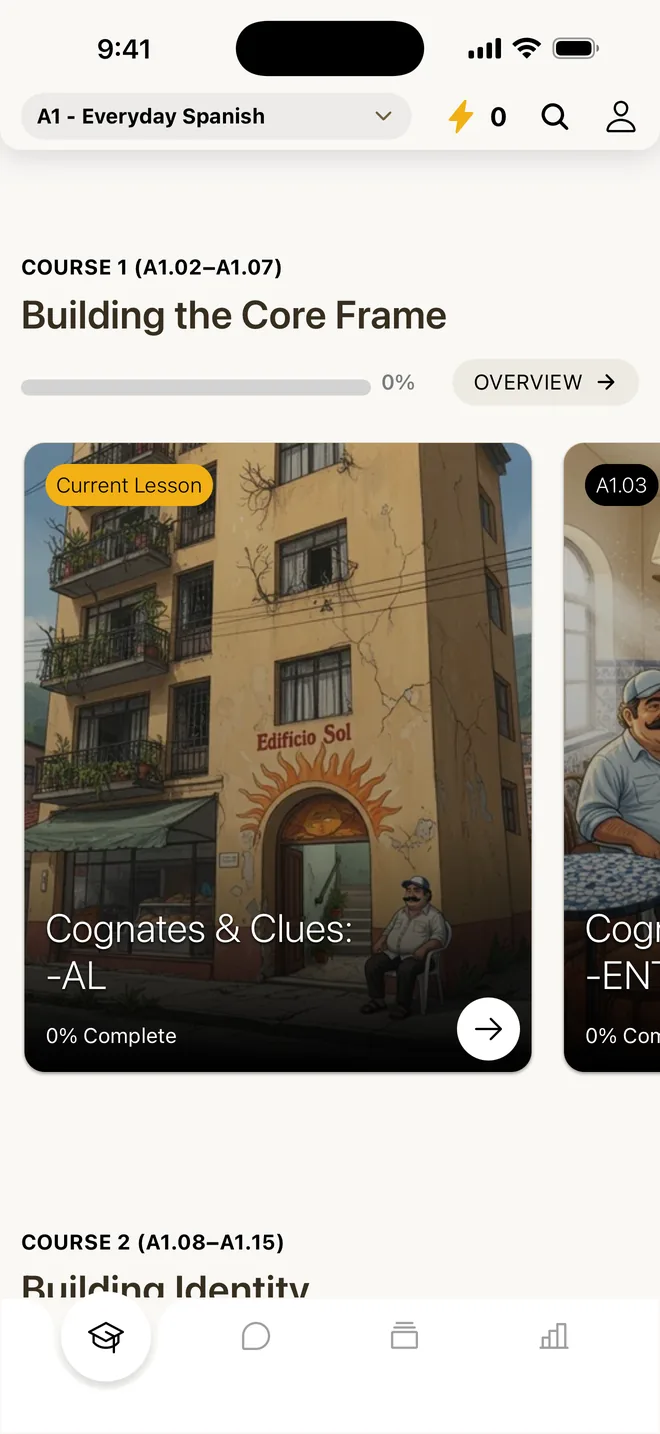
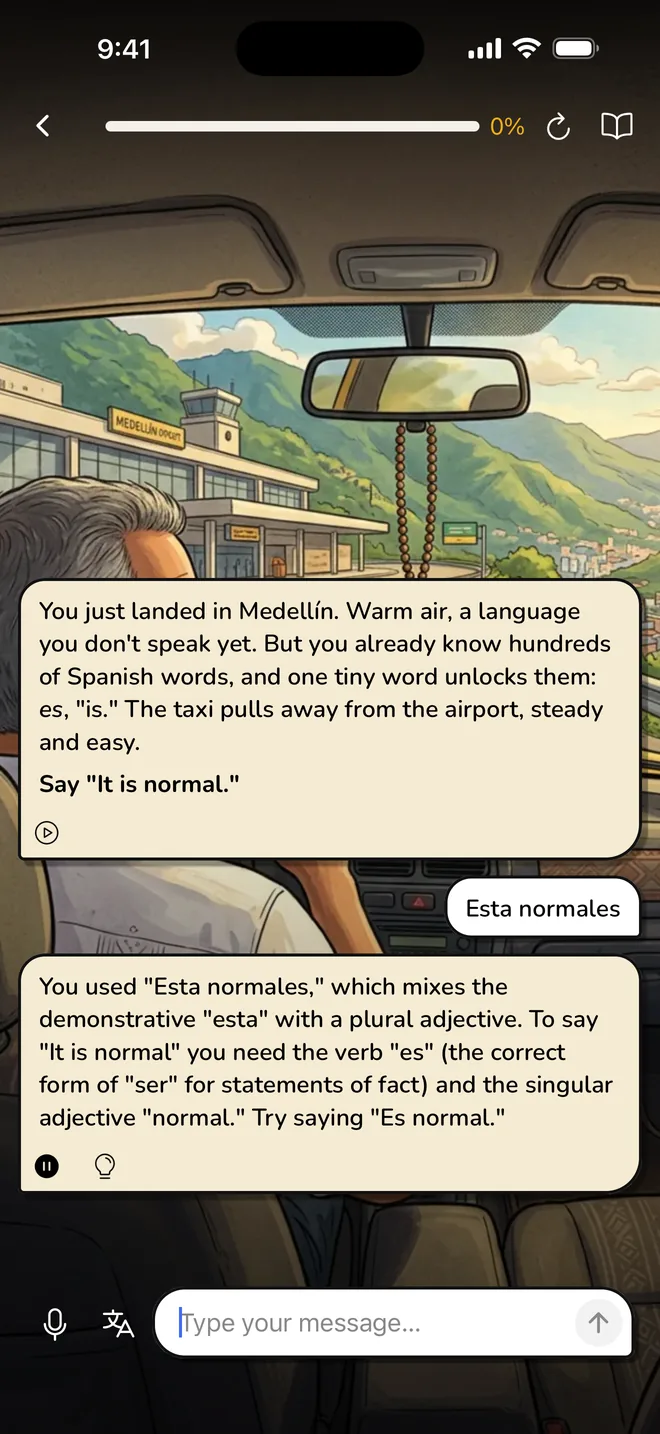
Every Avita lesson is a conversation inside a story. You read a short text that teaches the grammar and words, Listen reads it aloud with each word highlighted, and then a character talks to you and you answer out loud. In Spanish, the story is set in Edificio Sol, an apartment building in Medellín, where you meet Doña Carmen at the bakery and neighbors like Mateo and Inés.
What you say is always your own full sentence. There’s no multiple choice, no word bank and no tiles to tap. Every answer gets a score, a natural corrected version and a short reason. Say Estoy frío when you mean you feel cold, and you’ll see Tengo frío (I’m cold), with a note that Spanish says you have cold, and estoy frío sounds like your body is cold to the touch. If you get stuck, ask for a hint or a translation, or type if you can’t talk right then.
We measured how much speaking that adds up to: about 49 things to say out loud in every lesson (German about 60), roughly 10,000 spoken answers across a course (German about 12,000).
Who it fits: people who need to speak Spanish, French, Italian or German soon (or English, for Spanish and Italian speakers), and people who understand more than they can say.
Downsides: six courses only, iPhone and Android only, no human teachers, and no pronunciation scoring. We grade what you said, not your accent.
Speak: phrases first, then conversation
Speak runs every lesson through three steps it calls Learn, Practice and Apply. You learn phrases and patterns native speakers use, repeat them in new situations until they come out automatically, then use them in a back-and-forth conversation with its built-in partner (Speak runs on AI, and that partner is the core of the app). It gives real-time feedback on your pronunciation and phrasing, and you can retry as often as you like.
For English speakers it teaches Spanish, French, Italian, Japanese, Korean and Mandarin Chinese. There’s no free plan, but there is a 7-day free trial.
Who it fits: anyone who wants speaking practice in Japanese, Korean or Mandarin, which we don’t teach, and anyone who wants feedback on their pronunciation specifically.
Downsides: you’ll need to subscribe after the trial, and the course leans on drilling set phrases before you use them in conversation.
Pimsleur: audio lessons you answer out loud
Pimsleur has been built around speaking from the start. Its core is a 30-minute audio lesson: the course asks you to say something, pauses for you to answer, then gives you the correct version so you can check yourself. New words come back at growing intervals, and each lesson keeps the amount of new material small on purpose. The app adds Voice Coach for pronunciation feedback, Speak Easy for role-play with interactive transcripts, flashcards, offline listening and hands-free use in the car with Apple CarPlay and Android Auto.
It covers more than 50 languages for English speakers, and there’s a 7-day free trial and a free lesson.
Who it fits: commuters and drivers, people who learn by ear, and anyone learning a language most apps skip.
Downsides: in the main audio lessons, nothing listens to your answer. You compare yourself with the recording and decide whether you got it right.
Babbel: a structured course with conversation scenarios
Babbel teaches 13 languages through short lessons with grammar tips and cultural notes, and uses speech recognition to check your pronunciation. Two parts matter for speaking. Babbel Speak, a beta feature in the mobile app’s Speak tab, walks you through real-life conversation scenarios with prompts and hints. Babbel says it’s free for registered users for a limited time, in Spanish, French, German and Italian.
You can try the first lesson of every course free, and Babbel says some languages have up to 80 free lessons.
Who it fits: people who like a clear syllabus, with grammar explained in English.
Downsides: most of a lesson is exercises rather than speaking, and Babbel Speak is a beta that Babbel says may change or become a paid feature. See our Avita vs Babbel comparison for more.
Busuu: a course with native-speaker corrections
Busuu is a complete course in 14 languages, including Japanese, Korean, Arabic and Dutch. Lessons are built around goals like ordering food, with gap fills, multiple choice, dictation and writing tasks. For speaking, you can record answers and send them to the community, where learners who speak the language well correct them, and Conversations let you improvise in a scenario at your level, then get corrections with short explanations at the end. Premium members get corrections faster; free members can send a limited number. The top plan includes official certificates.
Who it fits: learners who want a traditional course, real native speakers reading their work, and a certificate.
Downsides: speaking is one of several skills a lesson trains, not the main activity. Our Avita vs Busuu comparison goes through a lesson side by side.
italki: real teachers, booked by the lesson
italki is a marketplace for one-on-one video lessons, with more than 20,000 teachers across 150+ languages. Professional teachers have teaching qualifications; community tutors are language enthusiasts without formal qualifications. There’s no subscription. You pay per lesson, teachers set their own prices, and lessons run 30 to 90 minutes. You can book a trial lesson to try a teacher first.
Nothing on this list beats a good teacher for feedback. A person hears your accent, notices the mistake you keep making and changes the plan.
Who it fits: anyone who can schedule sessions and budget for them, and anyone who’s ready to talk to a real person.
Downsides: cost adds up at several lessons a week, quality depends on the teacher you pick, and in an hour lesson the teacher does some of the talking. Our Avita vs tutors page covers how to combine the two.
Language Transfer: free audio that makes you think
Language Transfer is a donation-funded project with no price, no ads and no sign-up. Its audio courses explain how a language is put together, then ask you to build sentences: you pause the recording, say your answer out loud and keep going. Complete Spanish, Greek and Swahili are finished, German is in progress, and there are introductory courses in Arabic, Turkish, Italian and French, plus a course in English for Spanish speakers that’s just launching. You can listen in its iPhone and Android app, on YouTube or on SoundCloud.
Who it fits: anyone on a zero budget, and anyone who wants to understand why Spanish sentences work the way they do.
Downsides: there’s no feedback at all, and several courses are introductions only.
How to choose
- If you need to hold conversations in Spanish, French, Italian or German soon: Avita, and add a teacher on italki once a week if you can.
- If your language is Japanese, Korean or Mandarin: Speak, or Pimsleur for audio.
- If you spend an hour a day in the car: Pimsleur, or Language Transfer if money is tight.
- If you want a full course with grammar, writing and a certificate: Busuu or Babbel.
- If you want a person to hear you and you can pay per hour: italki.
- If you have no budget at all: Language Transfer, plus the free lessons in Avita, Babbel and Busuu.
Mixing them
The combinations that work pair high volume with a human now and then. An app gives you dozens of spoken answers a day for the price of a monthly plan; a teacher gives you one hour of careful attention. Doing Avita daily and an italki lesson every week or two is a good balance: you arrive at the lesson with sentences you’ve already said many times, and the teacher can spend the hour on what you still get wrong. Audio courses like Pimsleur and Language Transfer slot into time when you can’t look at a screen.
You don’t have to delete Duolingo either. Keep it for vocabulary on the bus, and put your speaking time somewhere that makes you speak.
Our take: If Duolingo has given you vocabulary but not conversation, move some of your daily time to building sentences out loud and hearing what you got wrong. For Spanish, French, Italian or German, that’s what we built Avita for: about 49 things to say out loud in every lesson, each a full sentence that’s graded and corrected, and the first five lessons of every level are free. If your language isn’t one of ours, or you want a person listening, Speak, Pimsleur and italki are where we’d look.
Questions people ask
What is the best alternative to Duolingo for speaking?
It depends on your language and situation. For Spanish, French, Italian or German conversation soon, Avita has you answer out loud about 49 times a lesson with every answer corrected. For Japanese, Korean or Mandarin, Speak focuses on speaking. For a commute, Pimsleur's audio lessons work hands-free. If you can pay per hour, a teacher on italki gives the most personal feedback.
Is there a free Duolingo alternative for speaking?
Language Transfer is completely free, with no ads or sign-up: you pause its audio lessons and answer out loud, though nothing checks your answers. Avita, Babbel and Busuu also have free starts. Avita's first 5 lessons of every level are free without an account, and a free account gets 3 days of full access. Babbel lets you try the first lesson of every course.
Should I quit Duolingo?
You don't have to. Duolingo is useful for vocabulary and a daily habit, and it's free. The problem is only when it's your sole practice and your goal is conversation. Keep it for spare minutes when you can't talk, and spend your speaking time in an app or lesson where you build your own sentences out loud and get corrected.
Are apps enough to become conversational, or do I need a tutor?
Apps give you volume cheaply, and a teacher gives you careful attention. Both help. A good balance is a daily speaking app, so you've already said hundreds of sentences, plus a lesson with a teacher every week or two to work on what you still get wrong. If a teacher isn't in the budget, a speaking app with corrections on every answer covers a lot of the gap.
Which Duolingo alternative is best for learning by listening?
Pimsleur is built around 30-minute audio lessons that ask you to answer out loud in a pause, and it covers more than 50 languages, with offline listening and CarPlay and Android Auto support. Language Transfer is a free audio option that explains how sentences are built while you answer aloud. Neither checks your answers in the core audio, so you judge them yourself.