
On this page
A lot of the people who write to us have a Duolingo streak, sometimes a very long one, and the same complaint: they can read a menu, but when the waiter asks a question, nothing comes out. Reed and I built Avita for that moment, so we’re biased. This page sticks to what each app asks you to do, minute by minute, and says plainly where Duolingo is the better choice.
What Duolingo is, and what it does well
Duolingo is the app most people start with, and for good reason. It’s free to use, it covers dozens of languages (in 2025 it added 148 new courses in one go), and it’s built to make a daily habit stick. Lessons are short steps on a path, and each one mixes exercise types: translating a sentence by tapping words from a word bank, hearing a sentence and typing it, matching pairs, reading short Stories and listening to DuoRadio episodes.
Duolingo does ask you to speak. Its own February 2026 post on speaking says speaking exercises start in the first lesson: you repeat words, translate sentences aloud and take part in short dialogues. In the dialogue exercises you pick your reply from a few options and say it into the microphone. In many writing exercises you can tap the microphone and answer out loud instead of typing, and the Practice tab has sets made only of speaking exercises.
Conversation practice sits in Duolingo Max, the top paid plan. Video Call puts you on a call with Lily, a character who talks with you about anything; calls run about a minute early in a course and up to three minutes later on. Roleplay drops you into scenarios like ordering coffee in Paris, then gives you feedback on accuracy and complexity at the end. Both are available for English speakers learning Spanish, French, German, Italian and Portuguese, and Video Call also covers some other languages, including Japanese and Korean.
Avita vs Duolingo at a glance
| Avita | Duolingo | |
|---|---|---|
| How you answer | Out loud, in your own full sentences | Mostly tapping, matching and typing, plus speaking exercises |
| Speaking per lesson | About 49 things to say out loud (German about 60) | Speaking is one exercise type among several; no published count |
| Feedback on each answer | A score, a natural corrected version and a short reason | Right or wrong in lessons; end-of-chat feedback in Max Roleplay |
| Open conversation | Every lesson is a conversation; role-play scenarios and open chat in Pro | Video Call and Roleplay in Max |
| Structure | A story with recurring characters, A1 to B2 | A path of short units with Stories and DuoRadio |
| Grammar teaching | A short text at the start of every lesson, read aloud | Mostly learned from patterns in exercises |
| Languages | Spanish, French, Italian, German for English speakers; English for Spanish and Italian speakers | Dozens of languages |
| Free option | First 5 lessons of every level, plus 3 days of full access with a free account | The full course is free; Super and Max are paid |
| Best for | People who need to hold a conversation soon | Building a daily habit, vocabulary and reading on a budget |
How a lesson feels in each
A Duolingo Spanish lesson moves fast. You might tap el, niño, bebe and leche into the right order, match manzana to “apple”, hear Ella come pan and type it, then read a sentence aloud into the microphone. Ten or fifteen exercises later, you get your XP and the streak ticks up. It’s satisfying, and the words stick.
Most of those exercises ask you to recognize the right answer rather than produce it. Duolingo says as much in a post about its word bank: answering from a word bank and typing from memory “require very different levels of active recall.” That’s why it added a toggle to type instead, from level 2 up.
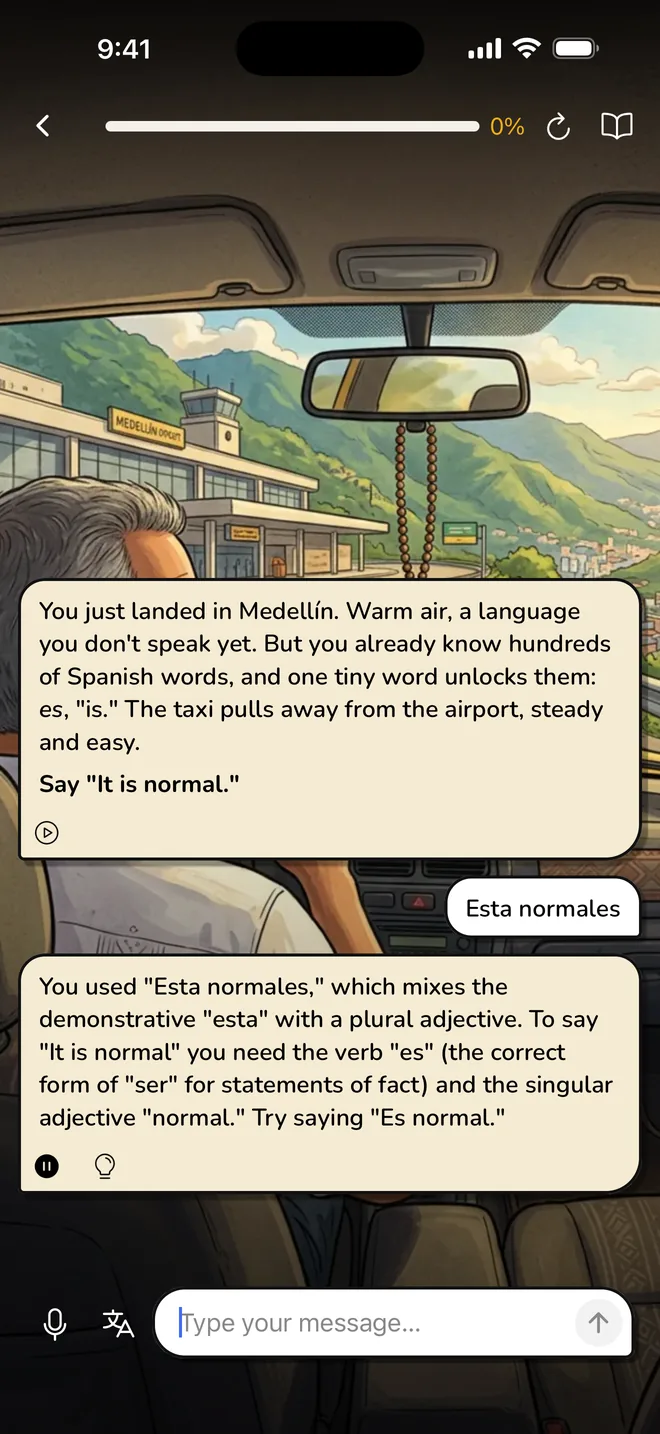
An Avita Spanish lesson starts with reading. A short text teaches the grammar and words for the scene, and Listen reads it aloud with each word highlighted. If you want, you warm up with flashcards of the lesson’s key words. Then the conversation starts.
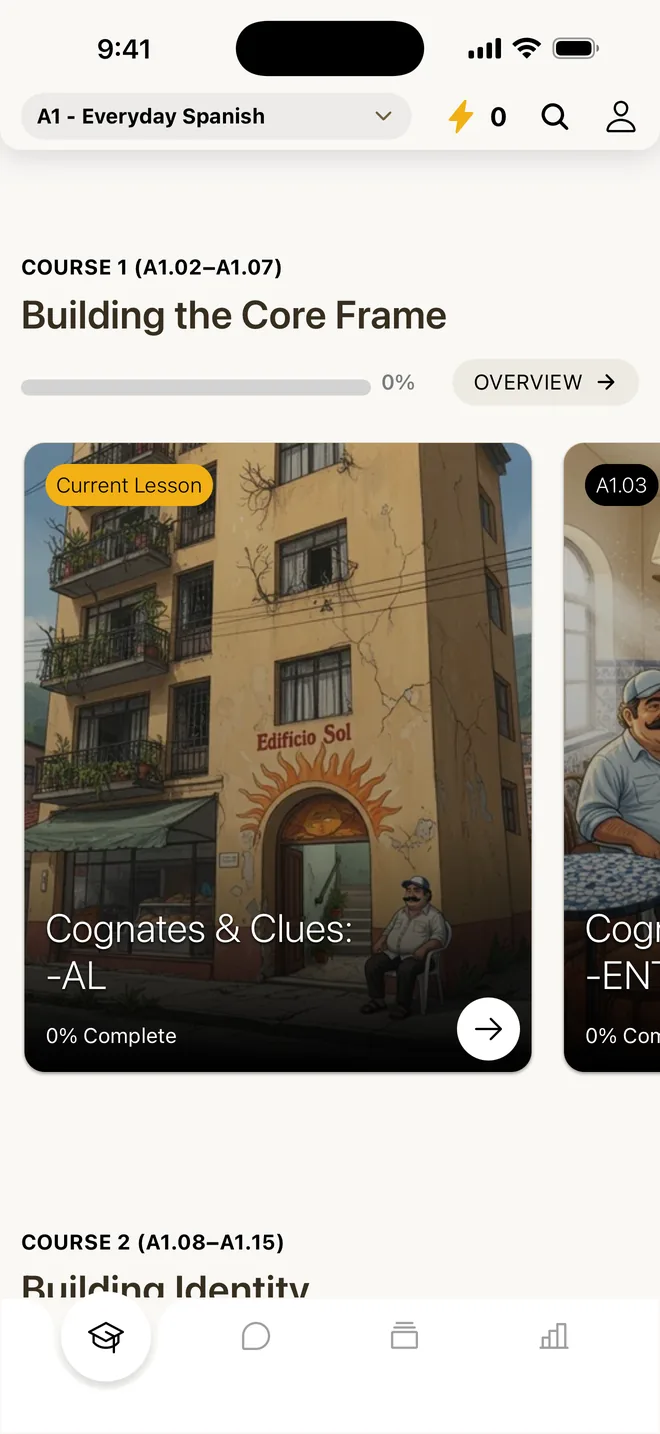
Our Spanish course is set in Edificio Sol, an apartment building in Medellín. In an early lesson on numbers, you’re at Doña Carmen’s bakery, buying cheese bread. You want two:
Then an older neighbor at the end of the counter orders without looking up, you spot 4B on his keychain, and by the end of the lesson you’re asking for dos, por favor (two, please) and una mesa (a table). You answer every prompt out loud, with nothing to tap. If you get stuck you can ask for a hint or a translation, and if you’re on a train and can’t talk, you can type.
How much speaking do you do?
This is the number that matters if your goal is conversation, so we measured ours. An Avita lesson asks you to say about 49 things out loud (German lessons about 60). A full course is roughly 10,000 spoken answers (German about 12,000). Each one is a sentence you build yourself, in reply to someone who asked you something.
Duolingo doesn’t publish a comparable figure, and we won’t invent one. What we can say from its own descriptions: speaking is one exercise type among many in a lesson, a lot of it is repeating or reading a given sentence, and in dialogue exercises you choose a reply from options before saying it. Those exercises train pronunciation and confidence with the sounds. They are a different skill from coming up with a sentence when someone asks you a question you didn’t expect, which is the moment that freezes most learners.
Duolingo’s Video Call is the closest thing to that moment, and it’s good practice. It’s also a Max feature, and early in a course a call lasts about a minute.
Feedback on what you say
In Avita, every spoken answer gets three things: a score, a corrected version that sounds like a native speaker said it, and a short reason. If you ask Carmen for un mesa (a table), you’ll see una mesa and a line explaining that mesa is a la word, so “a” becomes una. The correction comes right after you speak, while you still remember what you were trying to say.
In a regular Duolingo lesson, an exercise is marked right or wrong and you see the correct answer. In Max, Roleplay gives you feedback on accuracy and complexity after the conversation. Lily, on Video Call, deliberately doesn’t correct your grammar; Duolingo describes the call as a low-pressure place where mistakes aren’t penalized. That’s a fair design choice for confidence. It means the corrections you’d get from Avita on every answer aren’t part of the call.
One thing Avita doesn’t do: score your pronunciation. We grade what you said (grammar, word choice, whether it answers the question), not your accent.
Who should pick Duolingo
Duolingo is the better choice if:
- You want to spend nothing. The full Duolingo course is free, and Avita’s free part is the first five lessons of each level plus a three-day trial.
- Your language isn’t one of ours. Avita teaches Spanish, French, Italian and German to English speakers, and English to Spanish and Italian speakers. For Japanese, Portuguese, Korean or most other languages, Duolingo has a course and we don’t.
- You’re learning casually, for fun or for a trip that’s a long way off, and five minutes a day of something light is the goal.
- You want a web version. Avita is only on iPhone and Android.
- You’re starting from zero and want lots of low-pressure exposure to words and spelling before you try to talk.
Who should pick Avita
Avita is built for people who need to speak, usually soon:
- You’re moving abroad, or your partner’s family speaks Spanish, and you need to get through a real conversation.
- You’ve done months or years of an app, you can read a menu, and you still freeze when someone talks to you.
- You understand more than you can say, which is common for heritage speakers.
- You want to learn Latin American Spanish in a story set in Colombia, with grammar explained in plain English before you use it.
Using both together
You don’t have to give up your streak. A split that works: do Duolingo when you have two minutes and can’t talk, on the bus or in a waiting room, for vocabulary and reading. Then do one Avita lesson a day somewhere you can speak out loud. Think of the first as input and the second as output. The words you meet on Duolingo come up again when a neighbor in Edificio Sol asks you a question, and saying them in a sentence of your own is what makes them stick.
If you only have time for one and your goal is conversation, put that time into speaking.
Our take: Duolingo is a great free way to build a habit and a vocabulary, and if your language isn’t one of our six courses, it’s the obvious place to start. If you need to talk to people, Avita gives you about 49 things to say out loud in every lesson, each a full sentence that’s graded and corrected. You can try the first lessons free without an account and decide after you’ve heard yourself answer.
Questions people ask
Is Duolingo good for learning to speak?
Duolingo has speaking exercises from the first lesson: you repeat words, read sentences aloud and pick replies in short dialogues. It's good for getting used to the sounds and building vocabulary. Most of a regular lesson is tapping, matching and typing, though, and open conversation (Video Call and Roleplay) is in the paid Max plan. If speaking is your main goal, pair it with something that makes you build your own sentences out loud.
Can you become conversational with Duolingo alone?
Some people do, but most need extra speaking practice. Conversation means building an answer from nothing when someone asks you a question, and you get better at that by doing it many times and hearing what you got wrong. Most of a regular Duolingo lesson trains recognition. Adding a speaking app like Avita, a conversation partner or a teacher fills that gap, and you can keep Duolingo for vocabulary.
How much do you speak in an Avita lesson?
We measured it from the course content: an Avita lesson asks you to say about 49 things out loud, and German lessons about 60. A full course is roughly 10,000 spoken answers, or about 12,000 in German. Every answer is a full sentence you put together yourself, in reply to a character in the story, and each one is graded and corrected.
Is Avita free like Duolingo?
Not completely. You can start Avita without an account, the first 5 lessons of every level are free, and a free account gets 3 days of full access with no card. After that, Avita Pro includes every lesson in every course plus role-play scenarios and open chat. Duolingo's full course is free, with paid Super and Max plans on top.
Does Duolingo correct your grammar when you speak?
In regular lessons, an exercise is marked right or wrong and you see the correct answer. In Duolingo Max, Roleplay gives feedback on accuracy and complexity after the conversation. Video Call with Lily is designed to be low pressure and doesn't correct your grammar during the call. Avita corrects every spoken answer right away with a natural version and a short reason.