
On this page
Pimsleur was asking people to answer out loud decades before phones had apps, which makes it a closer match for Avita than most of the apps we get compared with. Both make you speak from the first lesson. Pimsleur does it with audio you respond to in the pauses; Avita has you read first, then hold a conversation in which every answer is checked.
What is Pimsleur?
Pimsleur is an audio-first course, now published by Simon & Schuster as an app for iPhone and Android, with courses in more than 50 languages. The method comes from Dr. Paul Pimsleur (1927–1976), a language researcher who taught at UCLA and Ohio State. His 1967 paper “A Memory Schedule” in the Modern Language Journal laid out the idea behind the course: recall a word just before you’d forget it, at intervals that start at a few seconds and grow longer each time.
Pimsleur describes four principles:
- Graduated Interval Recall: new words come back at spaced, growing intervals.
- Anticipation: the course asks you something, pauses so you can answer, then gives you the right answer.
- Core vocabulary: a small set of words learned well before the list grows.
- Organic learning: words arrive inside a conversation, which helps with rhythm and intonation.
Each core lesson is about 30 minutes, and Pimsleur recommends one a day. The Latin American Spanish course has five levels of 30 lessons each, plus about 100 short reading lessons; there’s a separate course for Spanish from Spain. The app adds Voice Coach (pronunciation scores), Speak Easy (role-play with an interactive transcript), flashcards, quick games, offline downloads and hands-free listening with Apple CarPlay and Android Auto. A newer Conversation Coach, which gives guided conversations with feedback on grammar and pronunciation, is in beta for All Access subscribers learning Latin American Spanish, French or Japanese.
Pricing: there’s a 7-day free trial and a free sample lesson. In the US App Store as of October 2026, All Access (every language) is $20.99 a month and a single-language Premium plan is $19.99 a month, with an annual All Access option. Pimsleur also sells lifetime access to a course on its website.
Avita vs Pimsleur at a glance
| Avita | Pimsleur | |
|---|---|---|
| How you answer | Out loud, in full sentences, inside a story; type if you can’t talk | Out loud, in the pause after an audio prompt |
| Speaking per lesson | About 49 things to say out loud (German about 60) | Responses throughout a 30-minute lesson; no published count |
| Feedback on each answer | A score, a natural corrected version and a short reason | The recording gives the right answer; Voice Coach scores pronunciation separately |
| Grammar | A short reading explains it before each conversation | Learned through use; short Enrich Minis audio covers some grammar |
| Reading | Every lesson starts with a text, read aloud with words highlighted | Separate reading lessons focused on sounds and letters |
| Structure | One story per course with recurring characters | Audio lessons in a fixed sequence, in levels of 30 lessons |
| Hands-free and offline | No | Yes, including CarPlay and Android Auto |
| Languages | Spanish, French, Italian, German; English for Spanish and Italian speakers | 50+ |
| Free option | First 5 lessons of every level; 3 days of full access with a free account, no card | 7-day free trial and a free lesson |
| Best for | Building your own sentences and learning why they’re right | Learning by ear, on the move |
What does a lesson feel like in each?
A Pimsleur lesson is a recorded conversation with a narrator guiding you through it. You hear a short exchange between native speakers, then the narrator asks how you’d say a piece of it. There’s a pause. You say it out loud, and then a native speaker says it correctly, so you can compare. Phrases you learned ten minutes ago come back, then ones from yesterday, then ones from last week. Pimsleur asks you not to take notes or look things up during the lesson. You can do it while driving or walking the dog, and that’s the point.
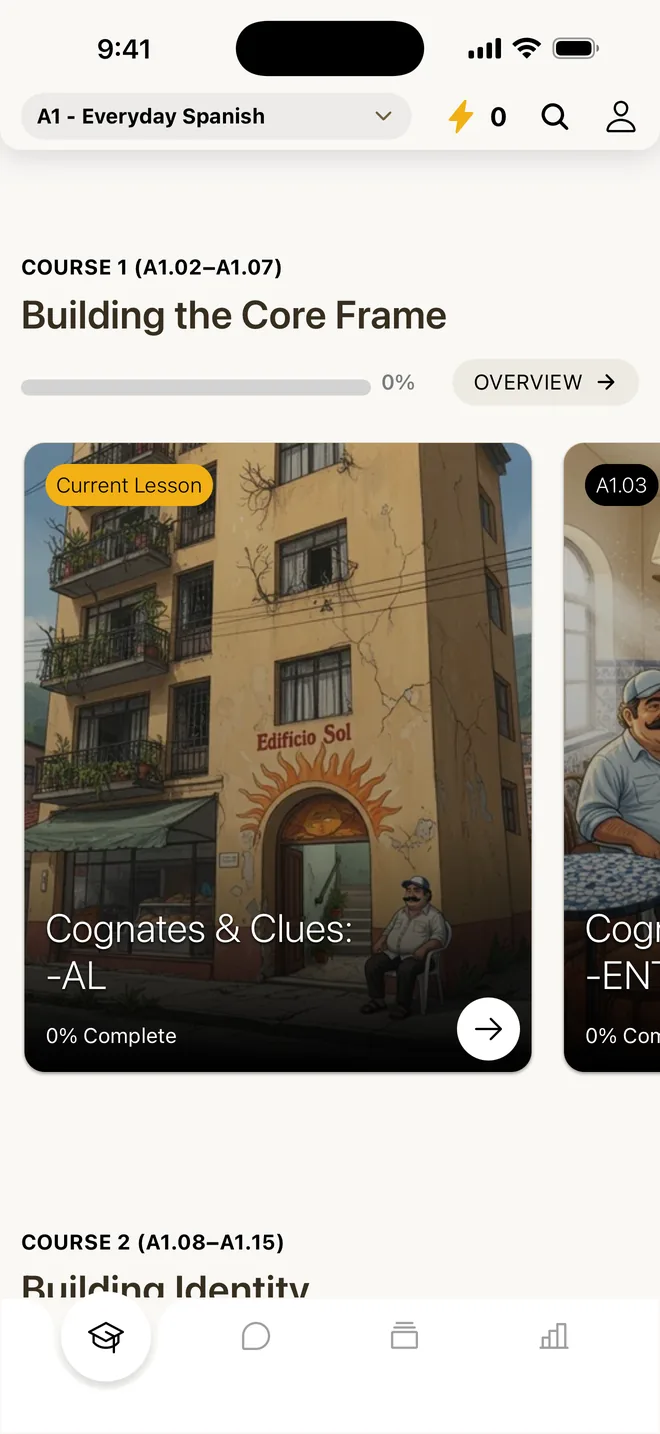
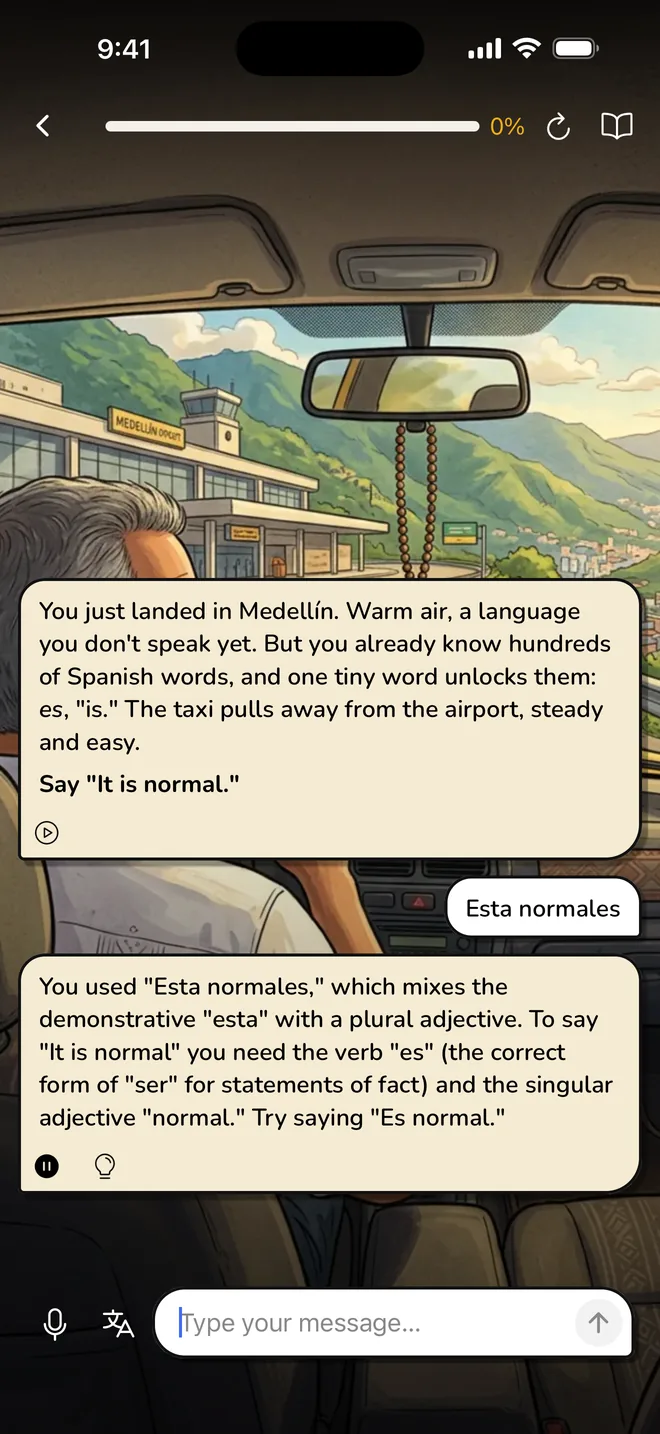
An Avita lesson starts on the page. Our Spanish course is set in Edificio Sol, an apartment building in Medellín, Colombia. Before you talk, you read a short text that teaches the day’s grammar and words, and Listen reads it aloud with each word highlighted. There’s an optional flashcard warm-up. Then the story picks up and a character talks to you.
On your first morning in the building, for example, the lesson is about words that look almost like English. You wake up to a ceiling you don’t recognize and salsa from a neighbor’s radio at seven a.m. The lesson teaches that English words ending in -ant and -ent add an e, so you say Es importante (It’s important), then Es diferente (It’s different) when you see the cracked tiles and the flowerpots. The building never stops making noise: Es constante (It’s constant). The smell of bread comes up from the bakery downstairs: Es urgente (It’s urgent). That lesson has about 55 lines like these, and each one is a sentence you say.
Both are spoken courses. Pimsleur trains your ear and your recall with the screen off. Avita shows you the language first and then asks you to use it in a scene.
How much do you actually speak?
We measured our own courses: an Avita lesson asks you to say about 49 things out loud (German lessons about 60), and a full course comes to roughly 10,000 spoken answers (German about 12,000). Pimsleur doesn’t publish a count of responses per lesson, and we won’t make one up. Its 30 minutes mix listening with answering in the pauses.
What you say differs more than how much. In Pimsleur you’re mostly recalling phrases the recording has already taught you and recombining them as the narrator asks. The repetition is deliberate: it’s the spaced recall the whole method is built on. In Avita, each prompt gives you an English cue or a character’s question, and you build the sentence yourself. Early on that’s slower and harder. It’s also closer to what happens when a neighbor asks you something you didn’t rehearse.
How does the feedback compare?
In a Pimsleur core lesson, the check is the native speaker’s answer after the pause. You compare what you said to what you heard, and you’re the judge. For pronunciation that’s a lot of good models: you hear a native speaker every few seconds. For more, Voice Coach scores your pronunciation, and the Conversation Coach beta adds grammar and pronunciation feedback in a few languages on All Access.
In Avita, every answer gets a score, a natural corrected version and a short reason why. If you say Es importanto, you’d get back Es importante, with a note that the -ant words end in -ante in Spanish. If you’re stuck, you can ask for a hint or a translation, and you can type when you can’t speak out loud. Avita doesn’t score pronunciation, so if your accent is the main thing you want to work on, Pimsleur’s Voice Coach covers something we don’t.
Who should pick Pimsleur?
- You learn best by ear and want to keep your eyes free.
- Your study time is a commute, a walk or a workout, especially with no signal. Pimsleur works offline and in the car; Avita needs a connection and your screen.
- Your language isn’t one of ours. Pimsleur covers more than 50.
- You want Spanish from Spain. Pimsleur has a separate Castilian course; Avita’s Spanish is Latin American.
- You’d rather pay once than subscribe. Pimsleur sells lifetime access to its courses.
- You want pronunciation scores.
Who should pick Avita?
- You want to see the words and understand the grammar before you’re asked to use it.
- You want to know whether each sentence you said was right, and if not, what a native speaker would say and why.
- You want to build your own sentences in conversation, not mainly recall set phrases.
- You’re learning Latin American Spanish and want a place to go with it: neighbors in Medellín, Doña Carmen at the bakery, Mateo and Inés down the hall. Italian starts a new life in Bologna, French a new life in France, German an allotment garden colony in Berlin.
- You want a story to follow across 200+ lessons, from A1 to B2.
- You want to try a lot before paying. The first 5 lessons of every level are free, and a free account gets 3 days of full access with no card.
Can you use both?
Yes, and they fit together better than most pairs of apps. Pimsleur is good when you can’t look at a screen, and Avita needs you to look at one. A schedule we’d recommend: an Avita lesson at home, when you can read the grammar and get every answer corrected, and a Pimsleur lesson in the car or on a walk to keep your ear and recall working. If you only pay for one, choose the one that fits the time you actually have.
Our take: If you study in the car or on foot, or you’re learning a language we don’t teach, Pimsleur is the better choice. If you can sit with a screen and want to read the grammar first, build every sentence yourself and get each one graded and corrected, Avita is built for that. We built it after moving to Buenos Aires and finding that the apps we tried didn’t get us talking, and getting you talking is still the test we hold it to.
Questions people ask
Is Pimsleur good for learning to speak?
Yes. Pimsleur has you answer out loud throughout each 30-minute audio lesson, and its spaced recall brings phrases back right before you'd forget them. Its limit is feedback: in the core lessons you compare your answer with the recording yourself. Avita also keeps you speaking the whole lesson, with about 49 answers each, and grades every full sentence with a corrected version and a short reason.
Can I use Pimsleur or Avita offline or in the car?
Pimsleur lessons can be downloaded for offline use, and the app works hands-free with Apple CarPlay and Android Auto. Avita doesn't have an offline mode and needs your screen, because each lesson starts with a short reading and you see your corrected answers. If most of your study time is behind the wheel, Pimsleur fits it better; Avita fits the time when you can look at your phone.
How much does Pimsleur cost?
Pimsleur has a 7-day free trial and a free sample lesson. In the US App Store as of October 2026, All Access, which covers every language, is $20.99 a month, and a single-language Premium plan is $19.99 a month; there is also an annual All Access plan. Pimsleur sells lifetime access to individual courses on its website. With Avita, the first 5 lessons of every level are free, and a free account gets 3 days of full access.
Does Pimsleur teach grammar?
Mostly through use rather than explanation. The core audio lessons introduce words inside conversations and have you recombine them, and Pimsleur offers short Enrich Minis audio lessons that cover some grammar and culture topics. Avita explains grammar directly: each lesson starts with a short text on the day's grammar and words, read aloud with each word highlighted, and then you use it in a conversation with a character from the story.
Does Avita teach Spanish from Spain like Pimsleur's Castilian course?
No. Avita's Spanish course is Latin American Spanish, set in an apartment building in Medellín, Colombia. Pimsleur has both a Latin American Spanish course and a separate Spain-Castilian course, so if you're moving to Madrid or Barcelona and want that accent and vocabulary from the start, Pimsleur's Castilian course is the closer fit of the two.
Which languages does Avita teach compared with Pimsleur?
Avita teaches Spanish, French, Italian and German to English speakers, and English to Spanish and Italian speakers, each with 200+ lessons from A1 to B2. Pimsleur offers courses in more than 50 languages. If you're learning something outside Avita's six courses, such as Japanese, Portuguese, Korean or Russian, Pimsleur is the option of the two.