
On this page
Speak is the app people bring up most when they hear what we built, and the comparison is fair: it’s the other big app that starts from the idea that you learn to talk by talking. If you’re choosing between the two, you’ve already ruled out tapping tiles. So this page skips the “speaking matters” pitch and gets into what each app has you do, which languages each one teaches, and the cases where Speak is the better choice.
What is Speak?
Speak is a language app from Speakeasy Labs for iPhone and Android, with sign-up on the web at speak.com. It says it has 15 million downloads and a 4.8 rating across the App Store and Google Play. Its conversation partner is AI-driven, and the company is backed by the OpenAI Startup Fund.
Speak’s help center (updated July 2026) lists what English speakers can learn: Spanish, French, Italian, Japanese, Korean and Simplified Chinese. Its largest offering runs the other way: English courses for speakers of 15 native languages, including Korean, Japanese, Portuguese, Spanish, Hindi, Thai and Turkish.
Lessons follow what Speak calls the Speak Method, in three steps:
- Learn: short video lessons with human instructors introduce “the phrases and patterns native speakers use” in real situations. Speak presents this as an alternative to grammar drills.
- Practice: you say those patterns again in new situations until they come out without thinking.
- Apply: you have a back-and-forth conversation with Speak’s conversation partner, get feedback, and can go again as many times as you like.
Lessons adapt to your answers. Outside the course there’s a Free Talk tab with scenario conversations, either in a turn-based Chat mode or a newer voice-first Immersive Roleplay where you can interrupt and your speech is transcribed live. Speak also gives real-time feedback on pronunciation, which is one of its strengths.
Speak has a 7-day free trial, then a subscription. In the US App Store as of October 2026, Premium is $17.99 a month or $83.99 a year, and Premium Plus (which adds custom lessons built around any topic you choose and review lessons generated from your mistakes) is $39.99 a month or $164.99 a year. Speak’s website shows different promotional prices and says pricing varies by region.
Avita vs Speak at a glance
| Avita | Speak | |
|---|---|---|
| How you answer | Out loud, in full sentences you build yourself; type if you can’t talk | Out loud: practice phrases, then converse |
| Speaking per lesson | About 49 things to say out loud (German about 60) | Speaking throughout; no published per-lesson count |
| Feedback on each answer | A score, a natural corrected version and a short reason | Real-time feedback on pronunciation and phrasing; corrections after each turn in Free Talk |
| Pronunciation scoring | No | Yes |
| Grammar | A short reading explains it before each conversation | Phrases and patterns first, no grammar drills |
| Structure | One story per course with recurring characters | Adaptive lessons by level, plus scenario conversations |
| Languages for English speakers | Spanish, French, Italian, German | Spanish, French, Italian, Japanese, Korean, Chinese |
| English courses | For Spanish and Italian speakers | For speakers of 15 languages |
| Free option | First 5 lessons of every level; 3 days of full access with a free account, no card | 7-day free trial |
| Best for | Holding real conversations in Spanish, French, Italian or German | Asian languages, English learners worldwide, pronunciation |
What does a lesson feel like in each?
A Speak lesson feels like a well-produced course. An instructor on video shows you a handful of phrases, you say them and variations of them, and then you use them in a conversation where Speak’s character responds to what you said. The content shifts based on how you do. It’s polished and quick to get into.
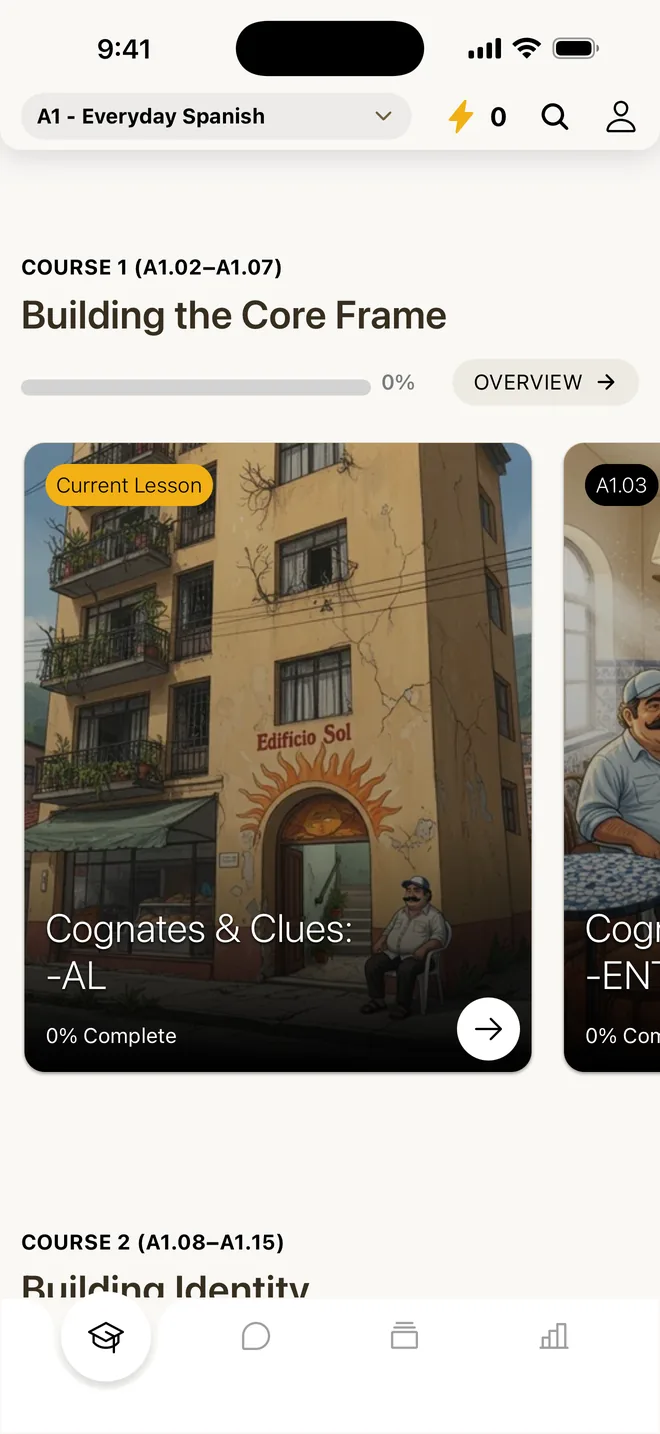
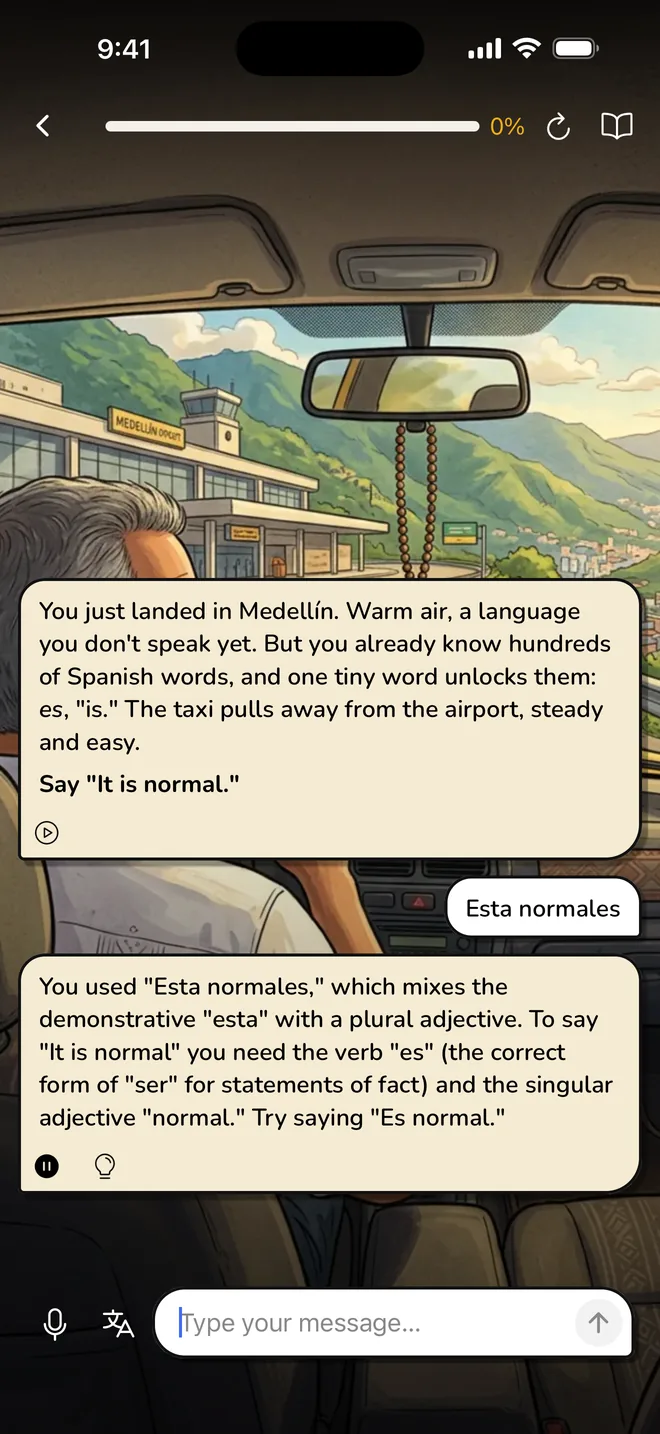
An Avita lesson is a scene in a story that keeps going. Our Spanish course is set in Edificio Sol, an apartment building in Medellín, Colombia, and the neighbors come back lesson after lesson. Before you talk, you read a short text that teaches the grammar and the words for the day, and Listen reads it aloud with each word highlighted. There’s an optional flashcard warm-up. Then the scene starts.
In one early lesson it’s inspection day, and the landlord is going door to door with a clipboard. You tell him what you do: Soy freelancer (I’m a freelancer). He asks you to find out about the neighbors, so you knock on 2A and ask Mateo formally, ¿A qué se dedica? (What do you do?). Mateo mumbles Soy repartidor (I’m a delivery rider), and you relay it: Es repartidor. Across the hall, Inés, a teacher who answers questions like she wrote the exam, wants to know if you teach too: No, no soy profesor (No, I’m not a teacher; profesora if you’re a woman). That lesson runs to about 50 lines like these, and every one is something you say.
Both apps get you speaking from the first lesson. Speak leans on short phrases you can reuse right away. Avita leans on a story and a grammar point you then use for a whole conversation.
How much do you actually speak?
We measured our own courses: an Avita lesson asks you to say about 49 things out loud (German lessons about 60). A full course is roughly 10,000 spoken answers (German about 12,000). Speak doesn’t publish a comparable number, so we won’t guess at one. Both apps have you talking for most of a session.
The bigger difference is what you’re asked to produce. In Speak’s practice step you say patterns you were just shown, then put them to work in conversation. In Avita, every prompt gives you an English cue or a character’s question, and you build the sentence yourself, start to finish. There’s no model sentence to copy first. That’s harder, especially at the start, and it’s on purpose. Merrill Swain’s output hypothesis (1985) argues that having to produce language, and not only understand it, pushes learners to notice the gaps in what they know. Building the whole sentence is where you find those gaps.
How does the feedback compare?
Speak listens to how you sound. It gives real-time feedback on pronunciation and phrasing, and in Free Talk your speech is transcribed as you go, with corrections after each turn and the option to retry that turn. If your accent is what you most want to work on, that’s a good reason to choose Speak. Avita doesn’t score pronunciation.
Avita’s feedback is about the sentence. Every answer gets a score, a natural corrected version and a short reason why. Say Soy un freelancer in that inspection lesson and you’d get back Soy freelancer, with a one-line note that Spanish drops un and una before a job after ser. When you’re stuck you can ask for a hint or a translation, and you can type an answer when you can’t talk out loud.
So the two apps correct different things. Speak’s feedback is strongest on how your Spanish sounds. Avita’s is built around what a native speaker would have said, and why.
Who should pick Speak?
- You want to learn Japanese, Korean or Chinese. Avita doesn’t teach them.
- You’re learning English and your first language is something other than Spanish or Italian, for example Korean, Portuguese, Hindi or Turkish.
- Pronunciation feedback matters most to you.
- You like learning ready-made phrases you can use the same day, with grammar kept in the background.
- You want to make lessons around any topic you pick, which Speak offers on Premium Plus.
Who should pick Avita?
- You’re learning German. Speak’s help center doesn’t list German among the languages English speakers can learn; Avita’s German course is set in an allotment garden colony in Berlin.
- You want Latin American Spanish with a place attached: neighbors in Medellín, Doña Carmen at the bakery, Mateo and Inés down the hall.
- You want the grammar explained in a few paragraphs before you have to use it, instead of picking it up from phrases.
- You like a story you can follow across 200+ lessons, from A1 to B2, with the same characters.
- You want every answer to be a full sentence, graded and corrected, with a reason you can learn from.
- You want to try a lot before paying. The first 5 lessons of every level are free, and a free account gets 3 days of full access with no card.
Can you use both?
You can, though for one language, two subscriptions is usually more than you need. The pairing that makes sense is Avita as your daily course (the reading, the story, the graded conversation) and a week of Speak’s free trial focused on pronunciation if your accent is holding you back. If you’re learning two languages and one of them is Japanese, Korean or Chinese, the split is easy: Speak for that one, Avita for Spanish, French, Italian or German.
If you go with Avita and want open-ended practice too, Avita Pro adds role-play scenarios (ordering at a café, a problem with your hotel room, getting a haircut) and open chat about anything.
Our take: Speak and Avita both start from getting you to talk early; they differ in what they teach and what they correct. Pick Speak for Japanese, Korean or Chinese, for English from a language we don’t teach, or if pronunciation is your main problem. If you need to hold a conversation in Spanish, French, Italian or German, and you want a short reading before you talk, a story to follow and a corrected version of every sentence you say, that’s the app we built. Try Speak’s trial and our free lessons, and see which one you open the next morning.
Questions people ask
Is Speak or Avita better for learning Spanish?
Both get you speaking Spanish out loud from the first lesson. Speak teaches ready-made phrases through short video lessons, has you use them in conversation, and gives pronunciation feedback. Avita teaches Latin American Spanish through a story set in Medellín, explains the grammar in a short reading before each conversation, and grades and corrects every full-sentence answer. Pick Speak if pronunciation is your priority; pick Avita if you want the grammar explained and a corrected version of everything you say.
Does Speak teach German?
Not to English speakers, as of October 2026. Speak's help center lists Spanish, French, Italian, Japanese, Korean and Simplified Chinese as the languages English speakers can learn; German appears only as a native language for its English courses. Avita has a German course for English speakers, set in an allotment garden colony in Berlin, with 200+ lessons from A1 to B2 and about 60 things to say out loud in each lesson.
How much does Speak cost?
Speak offers a 7-day free trial, then a subscription. In the US App Store as of October 2026, Speak Premium is $17.99 a month or $83.99 a year, and Premium Plus is $39.99 a month or $164.99 a year. Speak's website shows different promotional prices and says pricing varies by plan and region, so check the app for what you would pay where you live.
Does Avita give pronunciation feedback like Speak?
No. Avita doesn't score pronunciation, and Speak does, with real-time feedback on how you sound. Avita's feedback is about the sentence: every answer gets a score, a natural corrected version and a short reason why. You can tap any word to hear it, and Listen reads each lesson's text aloud with the words highlighted, but if your accent is the main thing you want to fix, Speak covers that better.
Is there a free version of Speak or Avita?
Speak has a 7-day free trial before a paid subscription. Avita lets you start without an account: the first 5 lessons of every level are free in every course, and a free account gets 3 days of full access with no card. Avita Pro includes every lesson, plus role-play scenarios and open chat, on a monthly, yearly or lifetime plan.
Can complete beginners use Speak and Avita?
Yes, both start from zero. Speak's lessons adapt to your level and begin with short phrases you can use right away. Avita's courses run from A1 to B2, and every lesson opens with a short reading that teaches the grammar and words before you speak, with hints and translations whenever you get stuck. If you want the rule explained before you have to use it, Avita's reading step is built for that.