On this page
Your abuela asks how school is going, you understand every word, and you answer in English. Or you start in Spanish, hit a verb you can’t find, and switch halfway through the sentence. Lots of people who grew up hearing Spanish at home know this exact moment, and most of them are much closer to speaking than it feels. We aren’t heritage speakers ourselves (we learned Spanish as adults, after moving to Buenos Aires), so this guide leans on the research about heritage speakers and on what we’ve learned about getting people to talk.
Why can you understand Spanish but not speak it?
Usually because you got years of listening and much less speaking. A lot of heritage speakers grew up in homes where parents or grandparents spoke Spanish and the kids answered in English. Every one of those conversations trained your ear. Almost none of them trained your mouth.
That pattern gets stronger with each generation. In a Pew Research Center analysis of its 2015 National Survey of Latinos, 97% of immigrant Latino parents said they speak Spanish to their children, compared with 71% of second-generation parents and 49% of parents who are third generation or higher. Less Spanish at home means fewer chances to answer in it.
Linguists who study heritage languages describe the same profile. In their 2007 overview, Maria Polinsky and Olga Kagan note that listening comprehension is usually a heritage speaker’s strongest skill. Polinsky’s later book, Heritage Languages and Their Speakers (2018), describes where speaking tends to break down: long pauses while searching for a word, and trouble with word endings, which in Spanish is where tense and agreement live.
There’s an encouraging finding too. A 2002 UCLA study by Terry Au and colleagues compared adults learning Spanish who had regularly overheard it as children with adults who hadn’t, and found the overhearers spoke with a more native-like accent. Your ear and your accent are a head start most learners would pay for.
Then there’s the emotional layer. Getting teased by cousins, corrected in front of the family, or answered in English the moment you hesitate all teach you that speaking Spanish is risky. So you speak less, which makes the next attempt harder. For a lot of people, that loop does as much to cause the freeze as any gap in grammar.
What “no sabo” tells you about what to practice
No sabo became a joke online, but look at what’s going on in it. Sabo is what you get when you apply the regular -er pattern (como, bebo, aprendo) to saber. Young children growing up with Spanish make the same move. A 2023 study of 20 child heritage speakers in New Mexico by Elisabeth Baker Martínez and Naomi Shin found they often regularized irregular past participles (forms like ponido for puesto), more so with verbs that are less common. It shows you know the rule. The irregular form just never got enough use.
That points straight at the fix: repetition of a short list of very common forms, said out loud. Here are some you might recognize:
| What comes out | Standard form | Meaning |
|---|---|---|
| no sabo | no sé | I don’t know |
| yo cabo | yo quepo | I fit |
| yo poní | yo puse | I put |
| rompido | roto | broken |
| dijieron | dijeron | they said |
| yo hací | yo hice | I did / I made |
Some forms you heard at home, like haiga (for haya) or truje (for traje), aren’t mistakes your family made. They’re real regional and rural Spanish with long histories. Nobody needs to correct abuela. It’s still worth knowing the standard form alongside your family’s, for school, work, or talking with people from other countries.
Which verbs should you practice first?
Verbs are where heritage speakers most often get stuck, so spend most of your practice there, and do it in speech rather than on worksheets. Filling in a chart and producing hice mid-sentence while your uncle waits are different skills.
The yo forms of common irregular verbs
Sé, tengo, hago, pongo, salgo, digo, vengo, conozco, quepo. You probably hear the él/ella forms all the time but rarely say the yo forms yourself.
The irregular past
Hice, dije, puse, tuve, estuve, fui, vine, pude, quise, supe, traje. Practice them by telling what happened yesterday: Ayer fui al súper y no pude encontrar las tortillas. (Yesterday I went to the store and couldn’t find the tortillas.)
Past tenses for telling stories
The imperfect sets the scene, and the preterite moves the story forward: Cuando era chiquita, íbamos a casa de mi abuela todos los domingos. Un domingo, mi tío llegó con un perro. (When I was little, we went to my grandma’s house every Sunday. One Sunday, my uncle showed up with a dog.) Family conversations run on stories like this, so practice telling them.
The subjunctive in everyday frames
Plenty of heritage speakers understand it and still avoid it when talking. Start with frames you’ve heard a thousand times: Quiero que vengas. (I want you to come.) Ojalá que no llueva. (Hopefully it doesn’t rain.) Cuando llegues, me avisas. (Let me know when you get there.)
Usted, if your family uses it with elders
¿Cómo está usted? ¿Le sirvo más café? (How are you? Can I get you more coffee?) Switching between tú and usted takes practice for everyone.
For a quick check on a form, our free Spanish conjugator has the full charts. Then close the chart and say five sentences with the verb.
A 20-minute daily routine for the freeze
You don’t need hours. You need daily speaking that’s low-stakes enough that you actually do it.
- Five minutes of narrating. Describe what you’re doing out loud while you make breakfast or drive: Estoy haciendo café. Después tengo que llamar a mi mamá. (I’m making coffee. Then I have to call my mom.) It feels silly. Do it anyway.
- Five minutes on one verb pattern. Pick one row from the lists above and say ten sentences of your own with it.
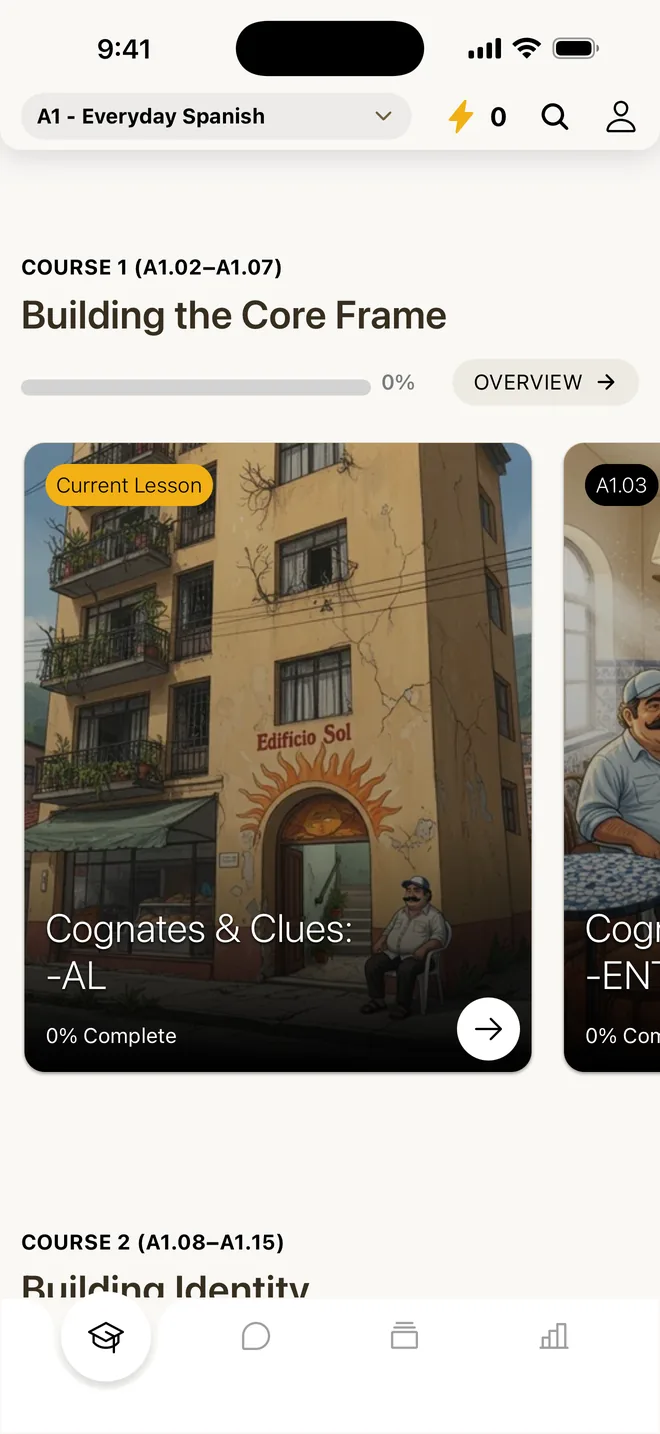
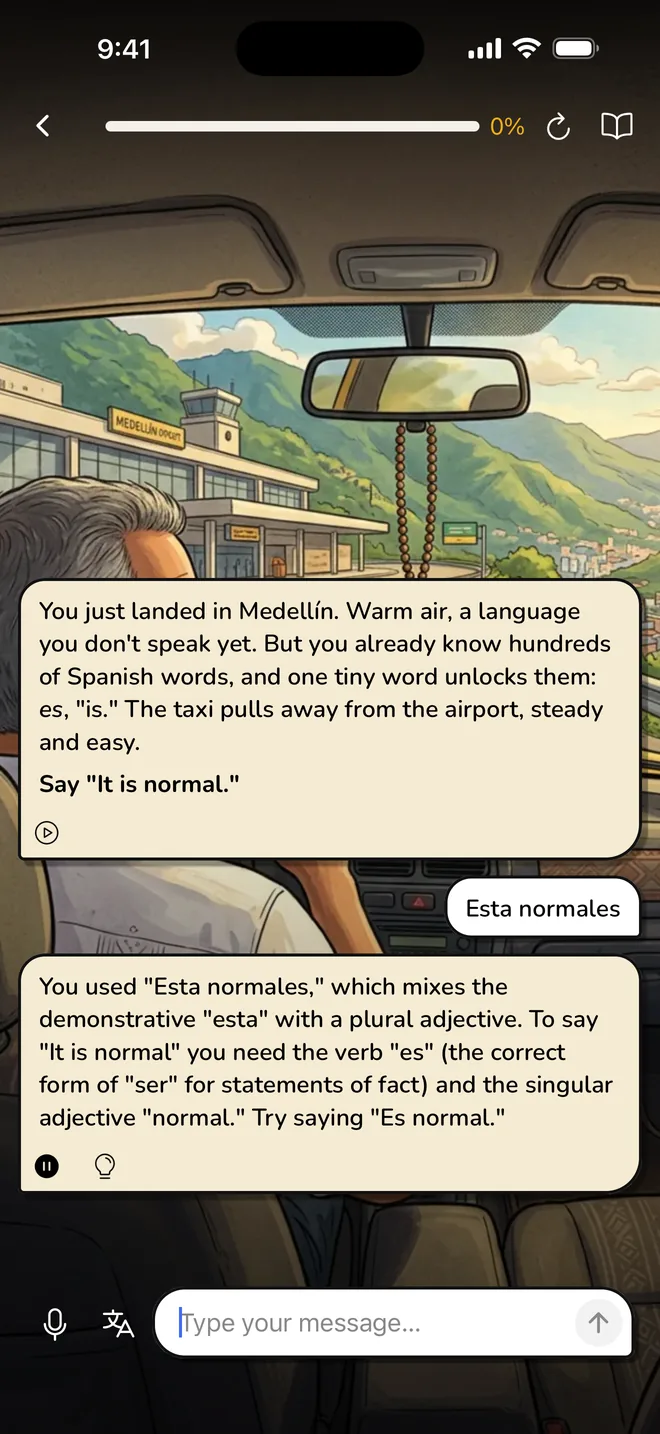
- Ten minutes of conversation practice. This is the part most heritage speakers skip, because there’s no one to practice with who won’t judge. A tutor or conversation partner works well here, and so does an app that makes you answer out loud. In Avita, every lesson is a spoken conversation in a story, set in an apartment building in Medellín. You answer about 49 times per lesson in full sentences, and each answer comes back scored, with a natural corrected version and a one-line reason. Nobody’s watching, and nobody switches to English on you.
Since you already understand a lot, don’t assume you should start at the very beginning. The first five lessons of every level in Avita are free, so you can try a few levels and stay where you’re stretched but not lost. If your family’s Spanish is from somewhere other than Colombia, the grammar is the same; you’ll just notice a few different words.
If you’re in college, check whether your school offers a Spanish for heritage speakers course. Many U.S. schools do, and those classes are built around your profile instead of treating you like a beginner.
How do you practice with family without the pressure?
Family is the best practice partner you have and also the scariest. A few ways to tilt it in your favor:
Pick one person. The whole dinner table is the hardest setting there is: fast, overlapping, full of inside jokes. Choose the most patient relative, often a grandparent or a favorite aunt, and practice one-on-one.
Ask for stories. When they’re telling a story, they do most of the talking, and you get to practice the easier skill: asking questions. Try ¿Cómo era el pueblo donde creciste? (What was the town you grew up in like?), ¿Cómo conociste a mi abuelo? (How did you meet my grandpa?) or ¿Me enseñas a hacer los tamales? (Will you teach me to make tamales?) Cooking together is great for this, because your hands are busy and the conversation has a topic.
Say what you want out loud. Families often switch to English to be kind. Tell them what you’d prefer instead: Quiero practicar mi español. Aunque me equivoque, sígueme hablando en español. (I want to practice my Spanish. Even if I make mistakes, keep talking to me in Spanish.) Decide how you want corrections too: Corrígeme solo si no me entiendes. (Only correct me if you don’t understand me.)
Use voice notes. A WhatsApp voice note to your mom or abuela lets you rehearse, delete and re-record before you send it. It’s speaking with a safety net.
Have a line ready for the teasing: Estoy aprendiendo, tenme paciencia. (I’m learning, be patient with me.) Said with a smile, it usually ends the joke and gets you help instead.
About the jokes
The “no sabo kid” jokes can sting because they land on something you didn’t choose. Plenty of families chose English at home for reasons that made sense at the time, and plenty of kids just answered in the language they used at school. None of that makes the Spanish you have any less yours.
The way out is the same for everyone who learns to speak a language: you speak it badly for a while, out loud, and it gets better. You start with an accent many learners never get and an ear that already understands the jokes. What’s left is practice.
Our take: A beginner’s vocabulary course will mostly hand you things you already have. What you’re missing is the habit of answering in Spanish, and that’s built in a setting where mistakes are cheap, then carried to one patient relative at a time. The first full phone call with your grandmother in Spanish is a good goal to set.
Questions people ask
What is a heritage speaker of Spanish?
A heritage speaker is someone who grew up hearing Spanish at home, usually from parents or grandparents, while growing up mainly in another language such as English. Heritage speakers range from people who are fully fluent to people who understand a lot but barely speak. Listening is usually their strongest skill, and many have an accent that sounds native even when their grammar feels shaky.
Why can I understand Spanish but not speak it?
Because understanding and speaking are trained separately. If your family spoke Spanish and you answered in English, you got years of listening practice and very little speaking practice. Your ear developed, while the parts of speaking that need repetition, like irregular verb forms and finding words quickly, never got the reps. Daily speaking practice closes that gap faster than going back to beginner vocabulary.
What does "no sabo kid" mean?
It's an online joke about U.S. Latinos who understand Spanish but don't speak it well, named after saying "no sabo" instead of "no sé" (I don't know). The mistake comes from applying the regular verb pattern to an irregular verb, which children learning Spanish do too. It's a sign you know the pattern; the irregular form just didn't get as much use. Practicing common irregular forms out loud fixes it.
Is it too late for a heritage speaker to become fluent in Spanish?
No. Adults who heard Spanish as children start with real advantages: strong listening comprehension and often a more native-like accent than other adult learners. What's usually missing is speaking practice, especially with verbs, and confidence. Daily speaking practice and regular low-pressure conversations with family are what move you forward. Fluency still takes time, but you're starting well ahead of most adult learners.
Should a heritage speaker take a regular Spanish class?
A beginner class is often a poor fit, because it spends months on listening and vocabulary you already have. If your college offers a Spanish for heritage speakers course, that's usually a better choice. Otherwise, focus on speaking practice: a tutor, a conversation partner, or an app where you answer out loud and get corrections, and start at a level that stretches you.
How do I practice Spanish with my parents without feeling embarrassed?
Start one-on-one with the most patient person in the family, and ask them for stories so they do most of the talking. Tell them directly that you want them to keep speaking Spanish even when you make mistakes, and decide how you want to be corrected. WhatsApp voice notes help too, because you can re-record before sending.