
On this page
Every beginner Spanish course has to make the same bet: out of a whole language, which few hundred words and patterns go first? We made ours a while ago and had never checked what it adds up to. So we counted.
The A1 level of our Spanish course for English speakers has 57 lessons. Every prompt in them expects a spoken answer, and we pulled the expected answer for each one: 2,820 answers and about 10,600 Spanish words in all. That works out to just under 50 per lesson, which matches the “about 50” we always quote. Here is what’s in them.
Nine verbs carry most of it
About two thirds of all A1 answers (67%) use at least one of nine verbs. Here they are, with the share of answers that use each one:
| Verb | What it does | Share of A1 answers |
|---|---|---|
| ser (to be: identity, traits, time) | Es normal. Carmen es generosa. | 24% |
| estar (to be: location, state) | Estoy en Medellín. Está cansada. | 12% |
| ir (to go, and the future) | Voy al parque. Voy a comer. | 10% |
| tener (to have) | Tengo un problema. | 7% |
| querer (to want) | Quiero un café. | 7% |
| hay (there is, there are) | Hay un parque. | 4% |
| gustar (to like) | Me gusta el pan. | 3% |
| poder (can) | ¿Puedes repetir, por favor? | 2% |
| hacer (to do, to make) | ¿Qué hace? | 1% |
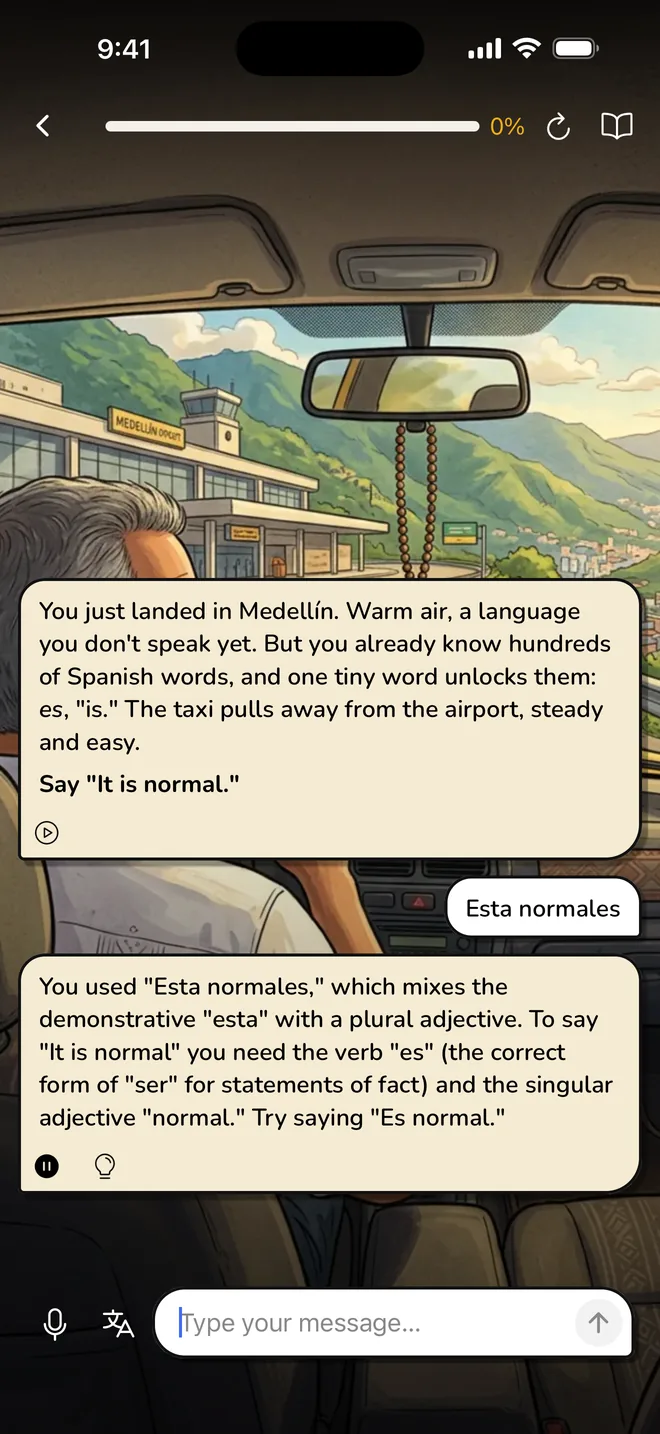
The single form you’ll say most is es (is), 558 times. Part of that comes from the very first lessons, which use es to turn words you already know into sentences: Es normal, Es legal, Es digital. After that come está (212), voy (165), quiero (130), tengo (129) and hay (121).
None of this was planned as a frequency list. Each lesson was written around one structure and one scene, and these verbs kept coming back because almost any scene needs them. You can’t order breakfast, give directions or explain why you moved without ser, estar, tener and querer.
The two “to be” verbs get the most room
Together, ser and estar show up in about a third of everything you say at A1. That’s on purpose: English has one verb where Spanish has two, and the only way to get a feel for the choice is to make it over and over.
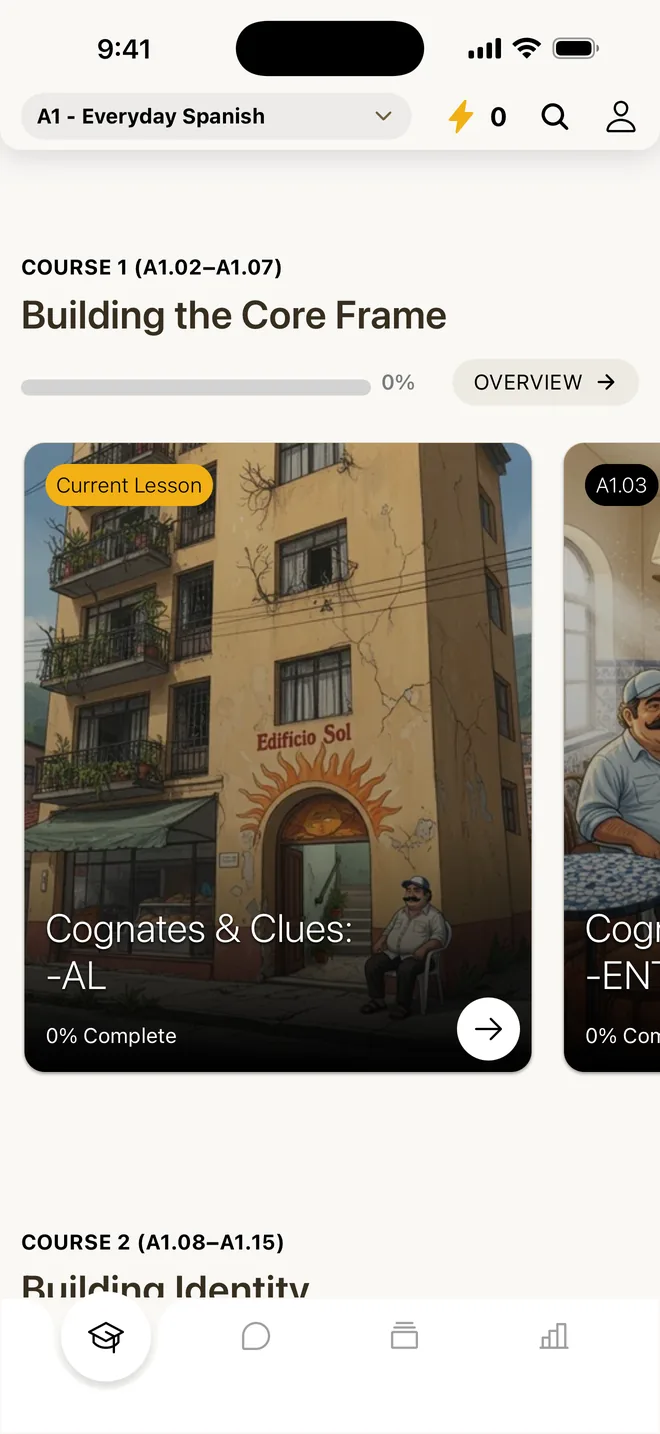
One lesson puts them side by side, and the story does the explaining. Over coffee at her kitchen table in Edificio Sol, your neighbor Inés goes through the people in the building, starting with what they’re like and how they are today:
The second one comes with a warning in the lesson: está buena about a person means something else entirely, and Carmen would hear about it.
A later lesson does the same with hay and estar: first you ask whether a place exists, then where it is. Your shower handle has just come off in your hand, and you go down to the lobby to ask Don Miguel. A few prompts later your neighbor Lina texts, asking for a pharmacy:
One answer in five is a question
At A1, 18% of answers are questions. That share drops to 8% at A2 and about 4% at B1 and B2.
We think that’s the right shape. A beginner in a real conversation spends a lot of time asking: where something is, what someone said, whether they have a minute. Two early lessons are almost all questions. The first teaches you to ask with just your voice, so Es caro (It’s expensive) becomes ¿No es caro? (Isn’t it expensive?) by raising your pitch. The next adds qué, dónde, cómo, quién and por qué. Later lessons on polite requests and making plans are question-heavy too.
Asking is also one of a beginner’s best tools for keeping a conversation going while you understand only part of it. ¿Puedes repetir, por favor? (Can you repeat, please?) is worth more in your first month than any noun.
The future comes before the past
We searched the A1 answers for the common past-tense forms (fui, fue, tuve, hice, comí, hablé and others) and found none. Those same forms show up in 192 A2 answers.
What A1 has instead is the near future: voy a plus a verb, in 119 answers.
This order can look backwards, since stories are usually told in the past. The reason is practical. Voy a is just ir in the present plus a verb you already know, so it costs you almost nothing new, and it covers a lot of what beginners need to say: plans, intentions, what you’re about to do. The past needs whole new sets of endings, and it gets its own lessons at A2.
Short sentences, on purpose
The average A1 answer is 3.8 words long. Very few are single words (about 5%), and very few run past ten words (under 1%). Most look like Tengo una pregunta (I have a question) or Voy a la oficina (I’m going to the office): a full sentence, with a subject and a verb, short enough to say in one breath.
Answers get longer as the course goes on: 4.5 words on average at A2, 4.9 at B1, 5.7 at B2. At B2, about one answer in twelve is ten words or more, with connectors that A1 never asks for:
One number barely moves through all four levels: 12% to 14% of answers use no. Saying what you don’t want, don’t have and aren’t going to do comes up at every level.
A small vocabulary, used a lot
The 2,820 A1 answers use about 970 different words. The 50 most common account for 55% of everything you say.
That’s by design. A1 gives you a few hundred words and makes you use them again and again, in a different sentence each time, so they’re there when you need them. The last A1 lesson asks you to tell your own story with them. You’re on the roof of the building with your neighbors:
That’s estar, querer, ser and no in three sentences, all of it from A1.
How we counted
We took the 57 published A1 lessons in our Spanish course for English speakers, including the opening lesson on the five vowels, and used the expected answer for every prompt. For the shares, a verb counts once per answer however many times it appears; the counts of single forms like es are every use. The counts come from the expected answers in the course, not from what learners actually said, so they show what the course asks you to say, not how anyone did. You can read the lesson texts in our free lesson library.
If you’re starting Spanish on your own, the list above is a fair place to begin: get ser, estar, ir, tener and querer into short sentences you can say out loud, learn to ask questions, and leave the past for later. Our day-one plan has a week of exercises built on the same idea.
Our take: The count came down to nine verbs, a lot of questions and a lot of no. That’s the vocabulary of someone who is new somewhere and needs to get through the day, which is exactly who A1 is for.
Questions people ask
What Spanish verbs should a beginner learn first?
In Avita's A1 Spanish course, about two thirds of the 2,820 spoken answers use one of nine verbs: ser, estar, ir, tener, querer, hay, gustar, poder and hacer. Ser and estar alone appear in about a third of all answers. If you're starting on your own, those nine are a practical first set, because almost any everyday conversation needs them.
Do you learn the past tense in A1 Spanish?
Not in Avita's course. We searched the A1 answers for common past-tense forms like fui, fue, tuve and hice and found none; they appear in 192 A2 answers. A1 covers the near future instead, voy a plus a verb, which uses the present tense of ir and lets beginners talk about plans without learning a new set of endings.
How long are the sentences you say in A1 Spanish?
In Avita's A1 Spanish lessons the average spoken answer is 3.8 words, like Tengo una pregunta (I have a question). Only about 5% are single words and under 1% run past ten words. Answers get longer through the course, averaging 5.7 words at B2, where about one answer in twelve is ten words or more.
How many words do you use at A1 in Avita's Spanish course?
The 2,820 spoken answers in Avita's 57 A1 Spanish lessons use about 970 different words, roughly 10,600 words in total. The 50 most common words make up 55% of everything you say. The level is built to make you use a few hundred words many times, in a different sentence each time, rather than to cover every situation.
Why are so many beginner answers questions?
About 18% of A1 answers in Avita's Spanish course are questions, against 8% at A2 and about 4% at B1 and B2. Beginners spend much of a real conversation asking where something is, what someone said or whether they have a minute, and asking for a repeat is how you keep going when you only understand part of what you hear.