
On this page
A pharmacy is often the first place where a new arrival has to explain something personal in Spanish. Ordering a coffee takes one sentence and some pointing. At a pharmacy counter you have to say what hurts, how long it has hurt, and then understand the answer, which is usually a question you didn’t expect. If you’re sick, you’re tired too, and the words you studied go missing.
A pharmacy conversation is also short and predictable. A handful of sentence frames covers most visits, and you can rehearse all of them out loud before you need them. Here’s what we’d learn, in the order you’ll use it, in Latin American Spanish.
(One note before we start: this post is about the words. It isn’t medical advice, and for anything serious you want a doctor, not a phrase list.)
What is the pharmacy called?
Farmacia works everywhere. In a lot of Latin America you’ll also see droguería on the sign: the Diccionario de americanismos lists it for Colombia, Venezuela, Argentina, Uruguay, Bolivia, Cuba and several other countries, as a shop that sells medicine. In Spain the same word mostly means a shop for cleaning products and paint, so don’t go looking for cough syrup in a Madrid droguería.
If you need to find one, you already have the sentence:
- ¿Hay una farmacia por aquí? (Is there a pharmacy around here?)
- ¿Dónde queda la droguería más cercana? (Where’s the nearest pharmacy?)
How do you ask for something?
The most useful opening at the counter is ¿Tiene algo para…? (Do you have something for…?). Finish it with the problem and the pharmacist takes it from there.
- ¿Tiene algo para el dolor de cabeza? (Do you have something for a headache?)
- ¿Tiene algo para la tos? (…for a cough?)
- ¿Tiene algo para las picaduras de mosquito? (…for mosquito bites?)
You’ll also hear remedio. The Real Academia’s dictionary gives a sense of it as anything that helps with an illness, with an example sentence you could say word for word at a counter: ¿Tiene algún remedio para el dolor de oídos? (Do you have anything for an earache?) Use usted with the pharmacist. It’s the safe default with someone you don’t know who’s helping you.
If you know exactly what you want, name it: Necesito ibuprofeno (I need ibuprofen), Busco un jarabe para la tos (I’m looking for a cough syrup). Brand names change from country to country, so the name of the active ingredient travels better than the brand on the box at home.
How do you say what’s wrong?
Three frames handle almost every symptom.
The first is me duele plus a body part. It works like me gusta: the thing that hurts is the subject. One thing, me duele. Two or more, me duelen.
- Me duele la garganta. (My throat hurts.)
- Me duele el estómago. (My stomach hurts.)
- Me duelen los oídos. (My ears hurt.)
Notice it’s la garganta, not mi garganta. Spanish uses the article with body parts, since me already tells everyone whose throat it is.
The second is tengo plus a noun, for things you “have”:
- Tengo tos. (I have a cough.)
- Tengo fiebre. (I have a fever.)
- Tengo diarrea. (I have diarrhea.)
- Tengo gripa. (I have the flu.) Gripa is what you’ll hear in Colombia, Mexico, Panama and Ecuador; gripe is understood everywhere.
The third is estoy plus an adjective, for how you are right now:
- Estoy resfriado. / Estoy resfriada. (I have a cold.)
- Estoy mareado. / Estoy mareada. (I’m dizzy.)
Then add when it started, because the first question back is almost always about time:
- Desde ayer. (Since yesterday.)
- Desde anoche. (Since last night.)
- Hace dos días. (For two days. Literally: it’s been two days.)
Put it together and you have a full opening that takes about four seconds to say: Buenas. Me duele mucho la garganta desde ayer. ¿Tiene algo para eso? (Hi. My throat has really hurt since yesterday. Do you have something for it?)
What will the pharmacist ask you?
Conversations tend to stall right after your opening line, when a question comes back that you didn’t rehearse. These are the ones to expect, with short answers you can give:
If you have an allergy or take something daily, learn that sentence first. It’s the one that matters most, and it’s the one you least want to put together on the spot.
What should you ask before you leave?
Most of the important information comes after the pharmacist hands you the box. Four questions cover it:
- ¿Cada cuántas horas lo tomo? (How often do I take it? Literally: every how many hours?)
- ¿Antes o después de comer? (Before or after eating?)
- ¿Cuántas pastillas por día? (How many pills a day?)
- ¿Se necesita receta? (Do you need a prescription?)
The answers come back with numbers, so listen for the pattern: una cada ocho horas (one every eight hours), dos al día (two a day), por cinco días (for five days). Numbers spoken fast are the hardest part of any transaction, so they’re worth drilling on their own.
Useful words for what’s in the bag: pastillas (pills), jarabe (syrup), gotas (drops), crema (cream), curitas in much of Latin America (bandages).
What if you don’t understand the answer?
You won’t catch everything, and that’s normal. Have these ready and use them without apologizing:
- ¿Me lo puede repetir más despacio, por favor? (Can you repeat that more slowly, please?)
- ¿Me lo puede escribir? (Can you write it down for me?)
- Perdón, no entendí la última parte. (Sorry, I didn’t get the last part.)
¿Me lo puede escribir? is the best one on the list. Pharmacists write dosages on boxes all the time, and it means you can read it again at home when your head is clearer.
How to practice this out loud before you need it
Reading this list won’t get the sentences out of your mouth at a counter. Saying them will. Here’s a routine that takes about ten minutes a day for a week.
- Write your own three sentences. Your usual problems, your allergies, the medicine you take. Say each one out loud five times, at full volume, as if someone is listening.
- Swap the pieces. Run me duele through every body part you can name: la cabeza, la espalda, el oído, las piernas. The frame becomes automatic once you’ve said it with ten different endings.
- Rehearse the questions coming back. Have someone read the pharmacist’s questions above in random order, or record them yourself and play them back, and answer each one without looking. The goal is answering a question you didn’t see coming.
- Drill the dosage numbers. Say una cada seis horas, una cada ocho horas, dos al día, tres veces al día until they come out without counting.
- Record one full visit. Opening, symptoms, two answers, two questions, thank you. Listen back once. It’ll sound slower than you’d like. That’s fine.
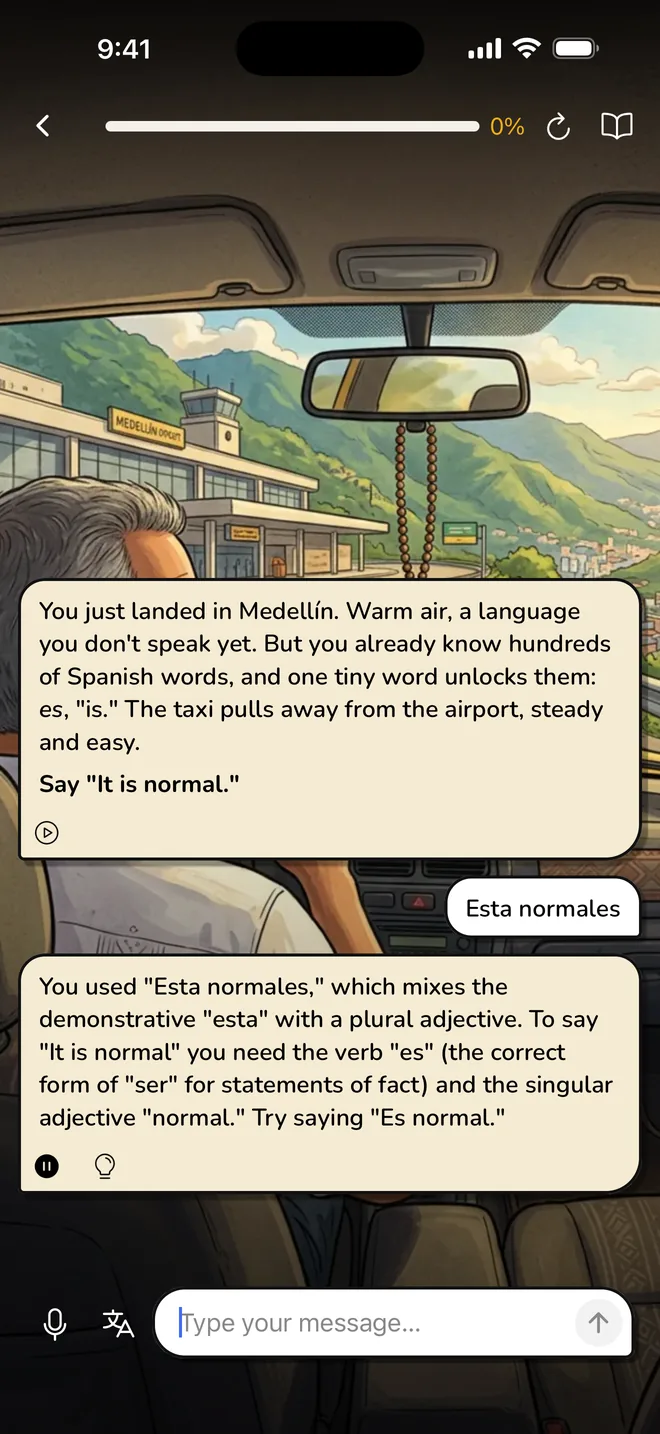
Answering questions you can’t predict is exactly what’s hard to practice on your own, and it’s the reason we built Avita the way we did. Every lesson is a spoken conversation with a character from the story: you answer out loud in full sentences, about 50 times a lesson, and each answer comes back graded with a natural corrected version. If you’d rather start without an app, our guide to practicing speaking alone has more routines like the one above.
And if the problem is less the words and more the freeze when someone’s waiting on you, our guide to speaking anxiety is about exactly that.
Our take: Learn one sentence for what’s wrong, one for how long, and ¿Me lo puede escribir? Say them out loud this week while you’re healthy. The day you need them, you won’t have to build them from scratch.
Questions people ask
How do you say "I need something for a headache" in Spanish?
The most useful frame is ¿Tiene algo para el dolor de cabeza? (Do you have something for a headache?). Swap the ending for any problem: para la tos (for a cough), para la garganta (for my throat). If you know what you want, say Necesito ibuprofeno (I need ibuprofen). Use usted with the pharmacist, since it's the safe default with someone you don't know.
How do you say what hurts in Spanish?
Use me duele plus the body part with an article: Me duele la cabeza (My head hurts), Me duele el estómago (My stomach hurts). If more than one thing hurts, switch to me duelen: Me duelen los oídos (My ears hurt). Spanish uses la or el here rather than mi, because me already says whose head it is.
What is a droguería in Spanish?
In much of Latin America, including Colombia, Venezuela, Argentina and Uruguay, a droguería is a shop that sells medicine, so the word on the sign may be droguería rather than farmacia. In Spain the same word usually means a shop for cleaning products and paint. Farmacia is understood everywhere.
How do you ask how often to take a medicine in Spanish?
Ask ¿Cada cuántas horas lo tomo? (How often do I take it?, literally every how many hours?). Follow up with ¿Antes o después de comer? (Before or after eating?). The answer will usually come back as a number pattern like una cada ocho horas (one every eight hours) or dos al día (two a day), so practice hearing those.
How can I practice pharmacy Spanish before I travel?
Write three sentences about your own situation (what usually goes wrong, any allergy, any daily medicine) and say each one out loud several times. Then have someone read you the pharmacist's likely questions in random order, or record them yourself, and answer without looking. Ten minutes a day for a week is enough to make the frames automatic.