On this page
- Which conversations matter most?
- Should you use usted or tú with your partner’s parents?
- What should you say when you meet the parents?
- How do you survive the family dinner?
- How do you handle phone calls with abuela?
- How long does it take to talk with your partner’s family?
- How should you practice before the visit?
- What if you freeze or get it wrong?
Your partner’s family doesn’t need you to be fluent. They need to see you trying, and they need a few conversations to go well: the first meeting, a long dinner, a phone call with a grandmother who doesn’t speak a word of English. Those moments are predictable, which means you can prepare for them specifically instead of working through a generic course and hoping it covers dinner with your suegros (in-laws).
Which conversations matter most?
It’s almost always the same short list:
- Meeting the parents: greetings, introductions and the questions they’re definitely going to ask you.
- The family meal: complimenting the food, accepting (or declining) seconds, offering to help, following a table full of people talking at once.
- Phone and video calls with grandparents: no gestures, a bad connection and often a stronger regional accent.
- One-on-one moments: ten minutes alone with your partner’s dad in the car, or helping his mom in the kitchen.
- Celebrations: a birthday, a holiday, a toast.
Prepare for these and you’re ready for most of what a visit throws at you. The phrases below cover all five, and the one-on-one moments get easier with every rehearsal you do beforehand.
Should you use usted or tú with your partner’s parents?
Start with usted for parents, grandparents and older aunts and uncles, and switch only when they invite you to. That’s the safe default almost everywhere. Using tú too early can come across as overly familiar; using usted too long just means someone eventually laughs and tells you ¡Tutéame! (Call me tú!).
If you’d rather not guess, ask: ¿Prefiere que le hable de tú o de usted? (Would you prefer I call you tú or usted?) It’s polite, and it shows you know the difference.
Where the family is from changes the picture:
- Colombia and Costa Rica: usted isn’t only formal. In much of Colombia and in Costa Rica, people use it with friends and even with their own children. If your partner’s mom calls everyone usted, that’s warmth, not distance.
- Argentina and Uruguay: family and friends use vos (¿Vos querés más?, Do you want more?). Expect to hear it; usted is still a safe choice with older relatives at first.
- Spain: tú comes much faster, especially among younger people. Your partner’s parents may use it with you from the first hello.
Ask your partner what their family does before you go. They’ll know, and it takes thirty seconds.
One practical note: usted uses the same verb forms as él and ella, so it’s ¿Cómo está? rather than ¿Cómo estás?, and ¿Le ayudo? rather than ¿Te ayudo? (Can I help you?). Practice these out loud until they come out without thinking, because under pressure you’ll default to whatever you’ve practiced most.
What should you say when you meet the parents?
Greetings first. A kiss on the cheek is a normal hello in much of Latin America, and Spain usually does two. Your partner can tell you what their family does so you’re not left hanging.
- Mucho gusto, señora. Soy Alex. (Nice to meet you, ma’am. I’m Alex.)
- Encantado de conocerlos. (Delighted to meet you all.) Use encantada if you’re a woman.
- Gracias por recibirme en su casa. (Thank you for having me in your home.)
- Le traje esto. (I brought you this.) Showing up with something small is a good idea almost anywhere.
- Sofía me ha hablado mucho de ustedes. (Sofía has told me a lot about you.)
Then come the questions. You can predict nearly all of them, so prepare your answers in advance and say them out loud until they’re smooth:
- ¿A qué te dedicas? (What do you do for work?)
- ¿De dónde eres? ¿Y tu familia? (Where are you from? And your family?)
- ¿Tienes hermanos? (Do you have brothers and sisters?)
- ¿Cómo se conocieron? (How did you two meet?)
- ¿Te gusta la comida de aquí? (Do you like the food here?)
- ¿Y hablas español? (And do you speak Spanish?)
For that last one, have a warm answer ready: Estoy aprendiendo. Todavía me cuesta, pero estoy practicando todos los días. (I’m learning. It’s still hard for me, but I’m practicing every day.)
The “how did you meet” story deserves extra prep. It will come up with every relative, so write a version of three or four sentences, in the past tense, and rehearse it until you could tell it half asleep: Nos conocimos en una fiesta de un amigo. Hablamos toda la noche y después salimos a cenar. (We met at a friend’s party. We talked all night and then went out to dinner.)
How do you survive the family dinner?
The food part is easy and gets you a lot of goodwill:
- ¡Está riquísimo! (This is delicious!)
- ¿Quién lo cocinó? ¿Me enseña a hacerlo? (Who made it? Will you teach me how to make it?)
- ¿Me pasa la sal, por favor? (Could you pass the salt, please?)
- No, gracias, ya estoy lleno. (No thanks, I’m full.) Use llena if you’re a woman. Expect them to insist, and know that Bueno, un poquito más (OK, just a little more) is often the right answer.
- ¿Le ayudo con los platos? (Can I help you with the dishes?)
- ¡Salud! (Cheers!)
- Muchas gracias por todo. Estuvo delicioso. (Thank you so much for everything. It was delicious.)
The conversation part is harder. A table of relatives talking over each other, quickly, with inside jokes, is one of the hardest listening situations in any language. A few things help:
- Follow the topic, not every word. If you know they’re talking about a cousin’s wedding, you can follow far more than you think.
- Talk to the person next to you. One-on-one inside a group is much easier than addressing the whole table.
- Pull the conversation toward something you can follow. A question like ¿Cómo celebraban la Navidad cuando eran niños? (How did you celebrate Christmas when you were kids?) gets people telling stories, and stories are easier to follow than banter.
- It’s fine to just listen for a while. Nobody expects you to keep up with everything on the first visit.
How do you handle phone calls with abuela?
Phone calls are harder than talking in person because you lose facial expressions and gestures, and grandparents may speak faster or with a stronger accent than you’re used to. Video is easier than audio, so ask for video when you can.
- ¡Hola, abuela! ¿Cómo está? (Hi, Grandma! How are you?)
- ¿Me escucha? Se escucha un poco mal. (Can you hear me? The connection’s a little bad.)
- Perdón, no le entendí. ¿Me lo repite? (Sorry, I didn’t catch that. Could you repeat it?)
- Se cortó. (It cut out.)
- ¿Cómo ha estado de salud? (How has your health been?)
- Le mando un beso muy grande. (Sending you a big kiss.)
Before the call, pick three things to tell her: something you did this week, something about her grandchild, a question about her. Let your partner start the call and hand you the phone once it’s going.
How long does it take to talk with your partner’s family?
Longer than a few weeks, much less than “fluent.” For context, the U.S. Foreign Service Institute puts Spanish in its fastest group for English speakers, at about 30 weeks (roughly 690 class hours) of full-time, intensive classes to reach professional working proficiency. You don’t need professional proficiency to enjoy dinner with your in-laws.
Here’s our rough guide, assuming around 20 to 30 minutes of speaking practice a day. These are estimates, not research findings, and they shift a lot with how much you speak:
| After about | You can usually |
|---|---|
| 1 month | Greet everyone, introduce yourself, say thank you, handle the dinner phrases above |
| 3 months | Have a slow one-on-one conversation about family, work and plans with a patient relative |
| 6 months | Hold your own one-on-one, follow the gist at the table, manage a short phone call |
| 12+ months | Follow most of a lively family dinner and jump in |
If you have a visit booked in three months, aim for the 3-month row and prepare the specific conversations in this guide on top of it. Our page on how long it takes to become conversational goes deeper.
How should you practice before the visit?
Out loud. Reading phrases on the plane won’t help when you’re standing in the doorway shaking hands. You need to have said them, many times, at normal speed.
Rehearse your scripts: your introduction, your “how we met” story and your answers to the questions above. Record them on your phone and listen back.
Practice with your partner, with ground rules. Partners are great practice, and they’re also the person you most want to impress, which can make it tense. Pick a set time, say 15 minutes after dinner, when you only speak Spanish. Ask your partner to play their mom or dad and fire the real questions at you. Agree that they’re a conversation partner during that time, not your teacher, and save corrections for the end.
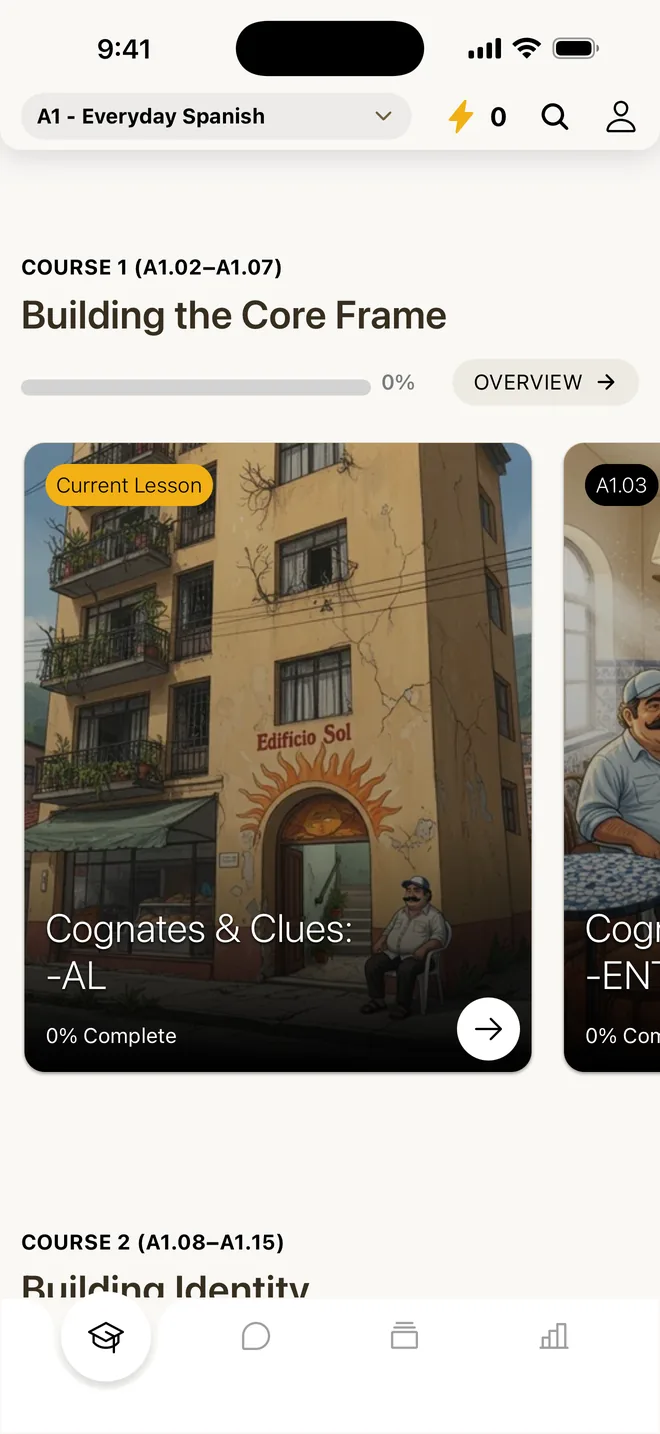
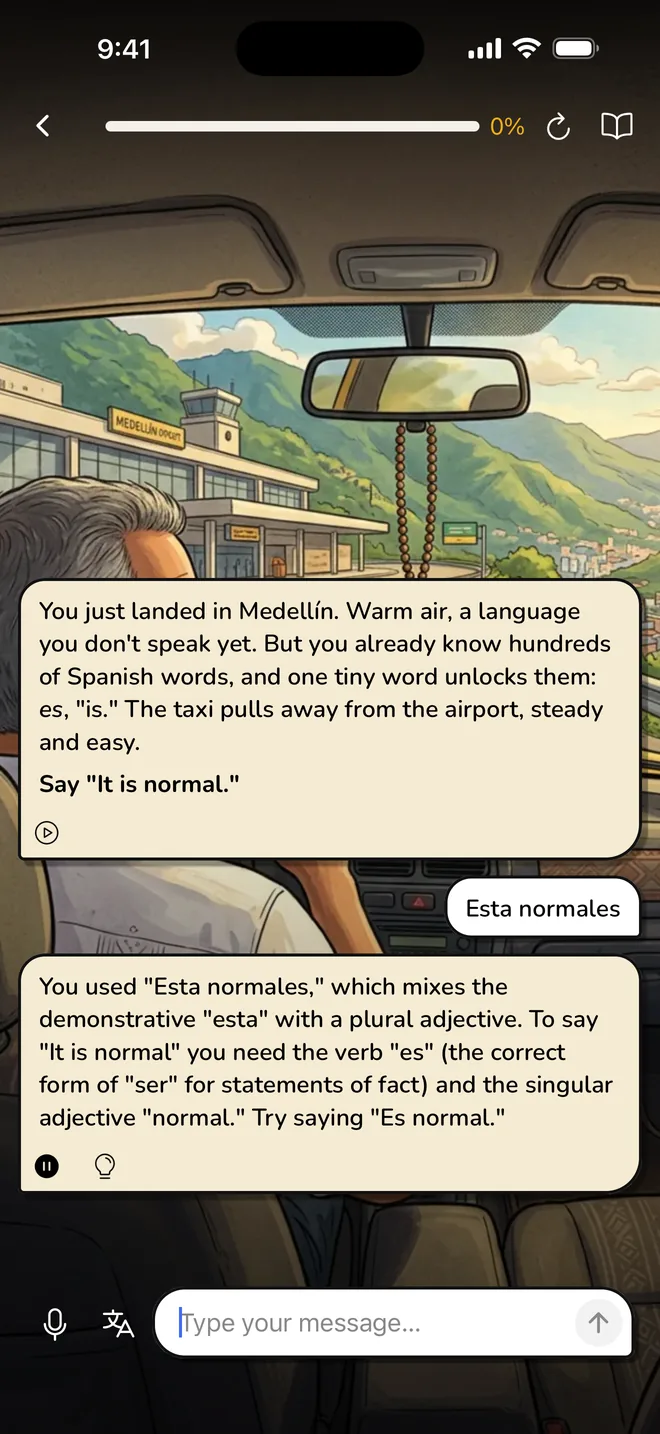
Get daily reps somewhere low-pressure. This is where an app that makes you speak helps. In Avita, each lesson is a conversation with characters from a story, and you answer out loud about 49 times, in full sentences, with every answer scored and corrected. The Spanish course is Latin American, set among neighbors in an apartment building in Medellín, so the everyday small talk is close to what you’ll hear at a family table. With Avita Pro you also get open chat about anything, which is a good place to practice telling your “how we met” story until it flows.
Finally, learn the family’s words. Ask your partner what nicknames everyone uses, how the family says “grandma” (abuela, abuelita, or nona in many Argentine and Uruguayan families), and any words that are particular to their region. Using one of them at the right moment gets a bigger reaction than a perfect subjunctive.
What if you freeze or get it wrong?
You will, and it’ll be fine. Someone will switch to English to help you, or laugh, or finish your sentence. Have one line ready: Perdón, todavía estoy aprendiendo. ¿Cómo se dice…? (Sorry, I’m still learning. How do you say…?) Asking them to teach you a word turns a stumble into a chance for them to help.
Our take: Don’t wait until you’re “good enough” to speak with your partner’s family. A rehearsed introduction and a well-practiced “how we met” story will carry you further on the first visit than a semester of grammar. The grammar mistakes get forgotten. The fact that you tried in their language usually doesn’t.
Questions people ask
Should I use usted or tú with my partner's parents?
Use usted with your partner's parents and grandparents until they tell you to use tú. It's the safe default almost everywhere, and switching when invited is easy. Regional habits vary: in much of Colombia and in Costa Rica people use usted even with family, in Argentina and Uruguay families use vos, and in Spain tú comes much sooner. Ask your partner what their family does.
How long does it take to learn enough Spanish to talk to my in-laws?
With about 20 to 30 minutes of speaking practice a day, expect to handle greetings and dinner phrases within a month, a slow one-on-one conversation with a patient relative around three months, and to follow a lively family dinner after a year or more. These are rough estimates. The more of your practice you spend speaking out loud, the faster it goes.
What should I say when I meet my partner's Spanish-speaking parents?
Start with Mucho gusto (nice to meet you) and Gracias por recibirme en su casa (thank you for having me in your home). Then prepare for the questions you'll almost certainly get: what you do for work, where you and your family are from, how you two met, and whether you speak Spanish. Rehearse short answers out loud so they come out smoothly.
Should my partner teach me Spanish?
Your partner is a great practice partner but often a frustrating teacher, because constant correction from someone you love can wear on both of you. Set a fixed time to speak only Spanish, ask them to play their parents and ask real questions, and save corrections for the end. Get grammar explanations and daily speaking reps elsewhere, from a course, an app or a tutor.
What if my partner's family speaks a different kind of Spanish than I'm learning?
That's normal and fine. Grammar is the same across Spanish-speaking countries; the differences are mostly vocabulary, accent and how people say "you." Learn a standard variety, then ask your partner for the family's own words and listen to podcasts or TV from their region. Picking up a few of the family's expressions goes a long way.